

Ryanair boosts balance sheet with €400m share placement

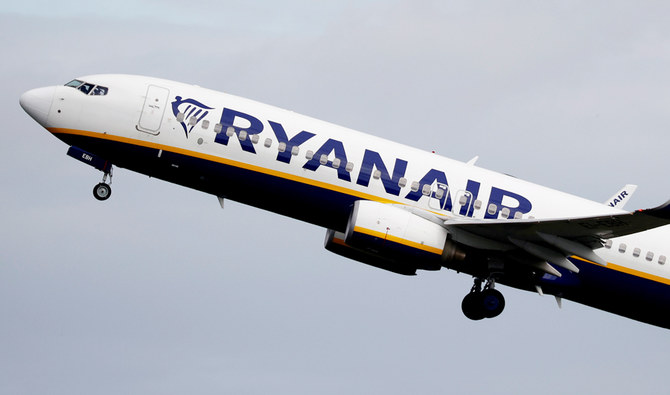
A Ryanair plane takes off from Manchester Airport, Britain, June 21, 2020. (REUTERS)
Short Url
Updated 05 September 2020
Follow

Ryanair boosts balance sheet with €400m share placement

  • Ryanair issued 35,242,291 shares, about 3.2 percent of its total share capital, at a price of 11.35 per share, a discount of roughly 2.6 percent to its closing price on Thursday

DUBLIN: Ryanair has raised €400 million ($473.6 million) from shareholders to strengthen its balance sheet as it eyes potential market opportunities in the wake of the COVID-19 pandemic, Europe’s largest low-cost carrier said on Friday.
The move adds to a large cash pile at an airline that has been less badly affected by the pandemic than many of its rivals owing to its relatively low level of debt and lack of exposure to the badly hit long-haul and business-class markets.
Ryanair issued 35,242,291 shares, about 3.2 percent of its total share capital, at a price of 11.35 per share, a discount of roughly 2.6 percent to its closing price on Thursday.
The airline said it was raising the funds to capitalize on opportunities created by COVID-19 disruption and to de-risk its debt repayments over the next 12 months.
“As we look beyond the next year, we expect that there will be significant growth opportunities for Ryanair’s low-cost model as competitors shrink, fail or are acquired by government bailed out carriers,” the airline said.

FASTFACT

Ryanair has €1.9 billion of debt maturing next year, including an €850 million Eurobond and £600 million raised under Britain’s Covid Corporate Financing Facility.

“The placing will provide Ryanair with greater financial flexibility to capture these opportunities.”
Ryanair flew a little less than half as many passengers in August than in the same month last year, but it has one of the strongest balance sheets in the industry with more than €3.9 billion in cash at June 30 and unencumbered Boeing 737 jets worth about €7 billion.
However, it also has €1.9 billion of debt maturing next year, including an €850 million Eurobond and £600 million raised under Britain’s Covid Corporate Financing Facility.
Bernstein analyst Daniel Roeska described the placement as a “small raise for a big company.”
“They do not need the cash and the amounts involved are small,” Roeska said. “Insulating against winter chill, defending the BBB rating and getting shareholders to show their support for the group do make sense as reasons, however, given upcoming refinancing needs.”


Industry leaders highlight Riyadh’s Metro, infrastructure as investment catalysts

Updated 29 December 2025
Follow

Industry leaders highlight Riyadh’s Metro, infrastructure as investment catalysts

RIYADH: Saudi Arabia’s capital, Riyadh, is experiencing a transformative phase in its real estate sector, with the construction market projected to reach approximately $100 billion in 2025, accompanied by an anticipated annual growth rate of 5.4 percent through 2029.

The Kingdom is simultaneously advancing its data center capacity at an accelerated pace, with an impressive 2.7 GW currently in the pipeline. This expansion underscores the critical role of strategic land and power planning in establishing national infrastructure as a cornerstone of economic growth.

These insights were shared by leading industry experts during JLL’s recent client event in Riyadh, which focused on the city’s macroeconomic landscape and emerging trends across office, residential, retail, hospitality, and pioneering sectors, including AI infrastructure and Transit-Oriented Development.

Saud Al-Sulaimani, Country Lead and Head of Capital Markets at JLL Saudi Arabia, commented: “Riyadh is positioned at the forefront of Saudi Arabia’s Vision 2030, offering unparalleled opportunities for both investors and developers. National priorities are continuously recalibrated to ensure strategic alignment of projects and foster deeper collaboration with the private sector.”

He added: “Recent regulatory developments, including the introduction of the White Land Tax and the rent freeze, are designed to stabilize the market and are expected to drive renewed focus on delivering premium-quality assets. This dynamic environment, coupled with evolving construction cost considerations in select segments, is fundamentally reshaping the market landscape while accelerating progress toward our national objectives.”

The event further underscored the transformative impact of infrastructure initiatives. Mireille Azzam Vidjen, Head of Consulting for the Middle East and Africa at JLL, highlighted Riyadh’s transit revolution. She detailed the Riyadh Metro, a $22.5 billion investment encompassing 176 kilometers, six lines, and 84 stations, providing extensive geographic coverage, with a depth of 9.8 km per 100 sq. km. This strategic development generates significant TOD opportunities, with properties in proximity potentially commanding a 20-30 percent premium. JLL emphasized the importance of implementing climate-responsive last-mile solutions to enhance mobility and accessibility, particularly given Riyadh’s extreme temperatures.

Gaurav Mathur, Head of Data Centers at JLL, emphasized the rapid expansion of the Kingdom’s AI infrastructure, signaling a critical area for technological investment and innovation.

Focusing on the construction sector, Maroun Deeb, Head of Projects and Development Services, KSA at JLL, explained that the industry is actively navigating complexities such as skilled labor availability, material costs, and supply chain dynamics.

He highlighted the adoption of Building Information Modeling as a key driver for enhancing operational efficiency and project delivery.