

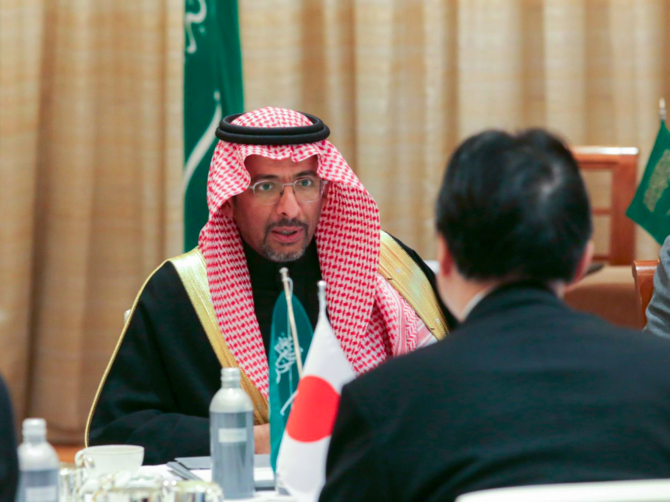

RIYADH: Saudi Arabia’s minister of industry and mineral resources has concluded his three-day official visit to Tokyo, highlighting the Kingdom’s commitment to fostering economic ties with Japan.
During the visit, Bandar Alkhorayef emphasized attracting investments to contribute to the Saudi industrial and mineral sectors.
As the Japanese investors’ roundtable discussions commenced, the minister expressed optimism about the Kingdom’s potential as a hub for green metal investments.
Alkhorayef stated: “We believe Saudi Arabia offers a great combination of natural resources and competitiveness in energy and the location to access different markets.”
He added: “We intend to make Saudi Arabia a green metal hub and are working closely with our Ministry of Energy to ensure we have the right capabilities to attract green metal investments.”
The minister emphasized the Kingdom’s industrial prowess, noting that the region has focused on this sector for many years, with a historical emphasis on the oil and gas field, particularly petrochemicals.
Alkhorayef revealed a strategic shift, saying: “Our strategy does not only address our local needs, but it is also to participate in the challenge of global supply chains that have been disrupted in the last few years.”
The minister underscored the importance of the strong ties between Saudi Arabia and Japan, stating that the interest in bringing companies from the Asian country to the Kingdom stems from their excellent relations in the past, characterized by shared values.
As part of the visit, Alkhorayef engaged in discussions with key entities, including the Japan Bank for International Cooperation, the country’s External Trade Organization, and the Nippon Export and Investment Insurance.
These discussions aimed to enhance the Saudi-Japanese partnership and increase the Kingdom’s exports to the Asian nation.
In a statement, Alkhorayef reaffirmed the Kingdom’s commitment to welcoming Japanese business interest, saying: “The Kingdom opens its doors to Japanese investors and invites them to capitalize on the investment opportunities that we have developed in accordance with our industrial and mining strategy.”
He also highlighted the importance of investing in the Saudi workforce, stating: “Investing in the sons and daughters of our nation is a key pillar of Vision 2030.”
The minister added: “I am confident that the youth of the Kingdom possess the ambition, passion, and seriousness to make this investment successful and achieve the goals of the Human Capability Development Program, enabling them to compete globally.”
Alkhorayef also addressed the media at the Foreign Correspondents’ Club of Japan, where he outlined Saudi Arabia’s plans to diversify its economic base in line with the goals of Vision 2030.
He provided insights into the Kingdom’s industrial and mineral wealth system, highlighting its efforts to become a center for various manufacturing and mining activities.
The minister announced that the Kingdom’s geological survey program has yielded promising results, allowing for a reevaluation of mineral deposits.
He hinted at a significant announcement at the Future Minerals Forum next month, where a new estimation of mineral deposits, previously valued at $1.3 trillion, will be disclosed.


