

Mass wedding in northwestern Pakistan attracts hundreds despite coronavirus fears

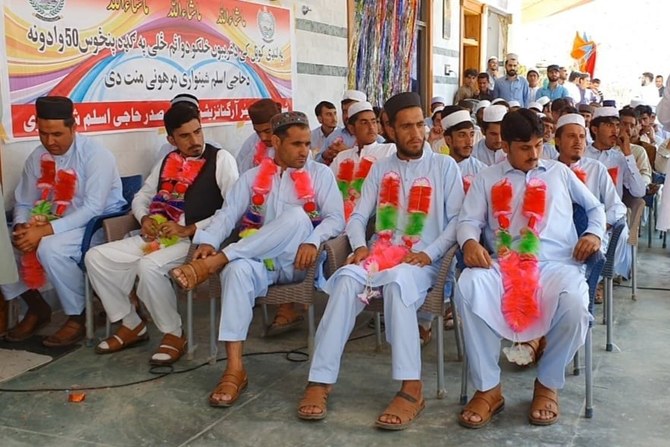
Garlanded grooms attend a mass wedding ceremony in Landikotal, Khyber Pakhtunkhwa on Aug. 5, 2020. (Photo courtesy: Shinwari Welfare Organization)
Short Url
Updated 06 August 2020
Follow

Mass wedding in northwestern Pakistan attracts hundreds despite coronavirus fears

  • Family members and guests gather in Landikotal sans face masks and with little or no social distancing measures in place
  • Mass ceremonies sponsored by charities help poor people bear the cost of weddings that often involve expensive gifts and dowries 

PESHAWAR: At least 50 couples tied the knot during a mass wedding ceremony in Pakistan’s northwestern Khyber Pakhtunkhwa province on Wednesday, even as a countrywide ban on big gatherings including weddings remains in place to stem the spread of coronavirus infections.
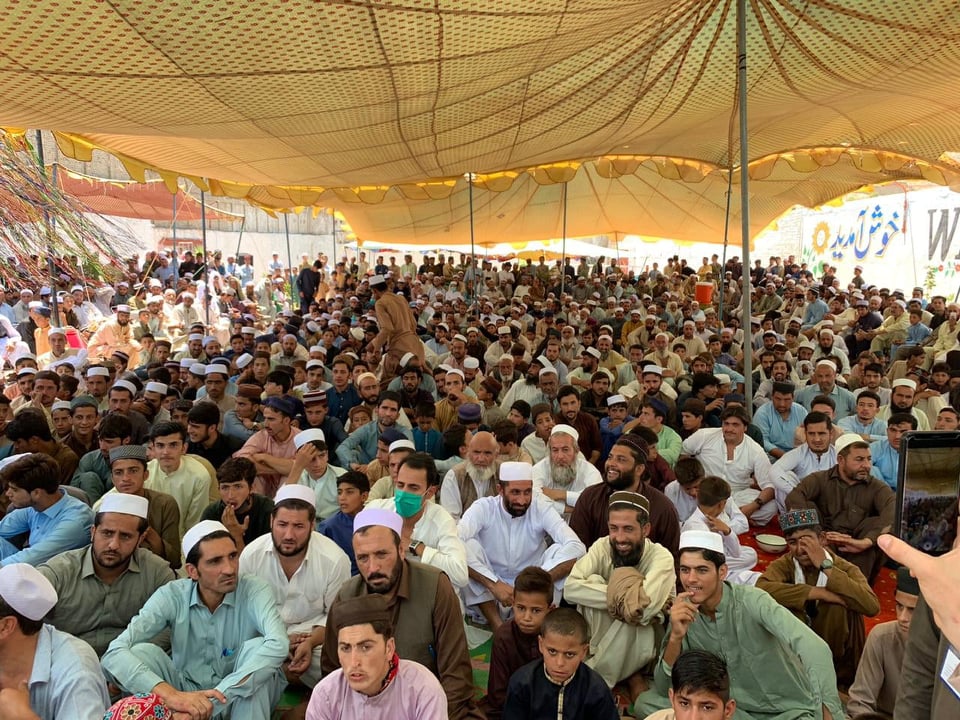


Relatives and guests attend the wedding ceremony of 50 couples who tied the knot in a mass ceremony in Landikotal, Khyber Pakhtunkhwa on Aug. 5, 2020. (Photo courtesy: Shinwari Welfare Organization)

Family members and guests gathered in the hundreds at the wedding venue in Landikotal in Khyber district, sans face masks and with little or no social distancing measures in place. 

“We held the program without any fear of the disease,” said Hajji Aslam Shinwari, the chief executive of the Shinwari Welfare Organization (SWO) which organized the ceremony, adding that the virus had not affected Pakistan’s remote tribal districts.
Pakistan’s Khyber Pakhtunkhwa province, of which the tribal districts are a part, has reported 34,359 infections and 1,215 deaths to date. 
Weddings are often a huge financial outlay for Pakistani families, with age-old customs such as the payment of hefty dowries in the form of jewelry, clothes, and money still widely practiced across the country. 
Shinwari said he had established SWO with the help of some friends three years ago to support poor couples bear wedding costs in the tribal areas and parts of Khyber Pakhtunkhwa.
“Before I formed this organization, poor people used to come and ask for Rs4,000 or more to help them arrange marriages,” he said. “I then decided to completely finance their weddings.”
School teacher Musa Khan, who tied the knot during Wednesday’s mass ceremony, said he had been jobless since March when schools across the country were shut down due to the coronavirus outbreak.
“I and my parents pray for a long and happy life for Shinwari and his organization because I would have been unable to get married for another 10 years without his assistance,” he told Arab News.
Religious scholar Maulana Amanuddin lauded the mass wedding as a “healthy trend” in accordance with Islamic laws.
“The most blessed marriage is the one with the least expenses,” he said, quoting a widely known saying attributed to the Prophet Muhammad (pbuh).


Pakistan’s Lahore marks Basant festival after government lifts decades-old ban on kite flying

Updated 5 sec ago
Follow

Pakistan’s Lahore marks Basant festival after government lifts decades-old ban on kite flying

  • Pakistan’s Punjab province outlawed Basant in 2000s after authorities linked metal-coated kite strings and celebratory gunfire to multiple deaths and injuries
  • The three-day festivities began after midnight on Thursday as residents gathered on brightly lit rooftops to fly colorful kites to welcome the cultural festival

ISLAMABAD: The eastern Pakistani city of Lahore on Friday welcomed the return of Basant spring festival after the government this year lifted a more than two-decade-old ban on kite flying for a period three days, with Punjab Chief Minister Maryam Nawaz urging masses to follow precautions.

Provincial officials, including Punjab Information Minister Azma Bokhari, were seen flying kites in videos widely shared online. Meanwhile, the prices of air tickets from various Pakistani cities to Lahore have skyrocketed during the three days of the festival as more and more people try to join the celebrations after over a 20-year-hiatus.

Basant, once a vibrant tradition signaling the arrival of spring with colorful kites and rooftop festivities, was outlawed in Pakistan’s Punjab province in the 2000s after authorities linked metal-coated kite strings and celebratory gunfire to multiple deaths and injuries.

The government of CM Nawaz this year allowed Basant festivities in the provincial capital of Lahore, Pakistan’s cultural heart, on Feb. 6-8, but issued an extensive safety plan regarding kite materials and motorcyclists and pedestrians to avoid any untoward incident.

Commuters ride past a large model of a kite celebrating the Basant festival in Lahore on February 3, 2026. (AFP)

The three-day festivities began after midnight on Thursday as residents of Lahore gathered on their brightly lit rooftops along with family, friends and guests visiting from other cities and abroad to fly colorful kites to welcome the return of Basant.

“Kites return to the skies of Lahore as Basant comes alive again after 25 years,” CM Nawaz said on X. “A celebration of culture, color, and community! Let’s enjoy the festivities together responsibly, follow all safety SOPs (standard operating procedures), and make this Basant safe for everyone.”

The Pakistan Meteorological Department (PMD) this week forecast favorable weather conditions for kite flying in Lahore on Feb. 6-8, marked by light westerly winds blowing at speeds of 10–15 kilometers an hour.

Authorities have distributed 1 million safety rods among motorcyclists through designated safety points across Lahore, with spending on the initiative crossing Rs110 million ($392,000), according to local media reports. To enforce regulations and manage traffic flow, around 100 road safety camps have been set up in the city, staffed by teams from the district administration, traffic police and rescue services.

In addition, the Punjab government has launched a free shuttle service to reduce traffic congestion and promote safer travel via 695 buses deployed across Lahore.