

Over 100 university students accuse Egyptian man of rape

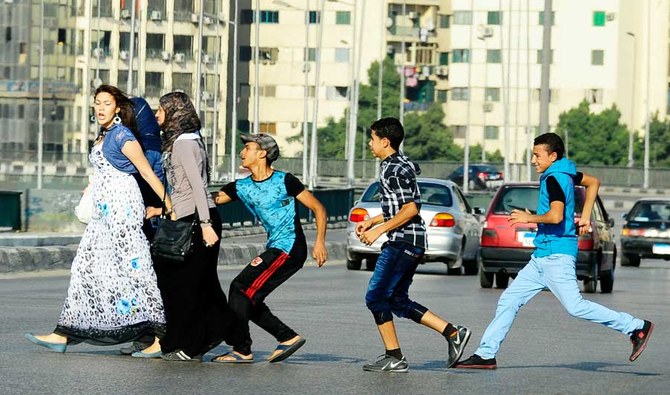
In this Aug. 20, 2012 file photo, an Egyptian youth, trailed by his friends, gropes a woman crossing the street with her friends in Cairo, Egypt. (AP)
Short Url
Updated 03 July 2020
Follow

Over 100 university students accuse Egyptian man of rape

  • MP asks attorney general to monitor case amid online uproar

CAIRO: A 22-year-old Egyptian man has been accused via social media of sexually assaulting and harassing more than 100 females over the course of several years. Egyptian authorities are being asked to open an investigation into the allegations.

The accusations originated from a group of around 100 female students at the American University in Cairo (AUC), who used their Twitter accounts to accuse the man — who was previously a student at the university — of sexual harassment and abuse as well as blackmail.

AUC said the man, whom Arab News has chosen not to name, left the university in 2018 and stressed that it is committed to maintaining a safe environment for all members of the university’s community and does not tolerate sexual harassment.

One woman claimed that the man had molested her and her sister when they were between the ages of 13 and 14, and threatened to publish fabricated images of them if they did not do as he asked.

Another student said the man had harassed, chased and threatened her and that he said he would tell her family that she had slept with him — she denies having done so. She wrote that he wanted to blackmail her into submitting to his demands.

One woman claimed the man has a history of predatory sexual behavior dating back to when he was a child, and said he had repeatedly moved schools because of complaints about his harassment of female students. The same person claimed the man’s father used his social influence to ensure his son was able to transfer between schools both in Egypt and overseas so he could complete his education.

She said that when the man arrived at AUC he continued to harass and assault women. After befriending them, she claimed, he would assault them at his family’s villa. He allegedly photographed some of these assaults and would use the pictures to blackmail the women into submitting to further abuse.

Earlier this week a group of women created an Instagram account called assaultpolice, through which they have so far collected 150 accusations against the man and testimonies from victims of his alleged assaults. They have also collected texts and voice messages that the man allegedly sent to some of his victims.

As social media users called for the man to be arrested, it emerged that rumors of a rapist at AUC had surfaced among the university’s internal social media groups. At the time, some claimed that the man concerned was undergoing treatment for mental illness and that such claims could push him to commit suicide.

After those claims surfaced, the man apparently transferred to university in Barcelona. Some have said that the man’s father threatened the women making the accusations, but that they contacted his new university and sent screenshots of the threats they had received, leading to his suspension from that university.

On Friday, accusations that the same student had also raped a young man emerged.

According to some Egyptian media outlets, the security services have opened an investigation into the case.

MP Mohamed Fouad has submitted a request to the attorney general asking him to follow up on the case, and has also asked the public prosecution to look into the accusations.

Fouad also asked the National Council for Women (NCW) to look into the story and to provide psychological and legal support to the victims of the man’s alleged harassment, extortion and rape.

The NCW, headed by Maya Morsy, issued a statement saying that it would follow up on the issue and calling on the concerned authorities to investigate the matter and take the necessary measures.

The council also called on all women who fell victim to the harasser to file an official charge against the man “so that he receives the punishment that he deserves according to the law.”

“It will serve as an example,” the NCW said.


Two dead in UAE, 8 injured in Qatar from waves of Iranian strikes on Gulf neighbors

Updated 8 sec ago
Follow

Two dead in UAE, 8 injured in Qatar from waves of Iranian strikes on Gulf neighbors

  • UAE defense ministry said Iran fired 137 missiles and 209 drones at the territory
  • Qatar intercepted most of the 65 missiles and 12 drones launched by Iran, said officials

ABU DHABI: Explosions rocked cities across the Gulf on Saturday, killing two people in Abu Dhabi, while smoke and flames rose from Dubai landmark The Palm as Iran launched waves of attacks in retaliation for US and Israeli strikes.

The attacks hit airports in Abu Dhabi, Dubai and Kuwait, as well as Gulf military bases and residential areas, raising fears of a wider conflict and rattling a region long seen as a haven of peace and security.

Across the UAE, Iran fired 137 missiles and 209 drones at the territory, the country’s defense ministry said, as projectiles streaked across the skies of every Gulf state but Oman, a mediator in the recent US-Iran talks.

The UAE defense ministry said most of the missiles and drones were intercepted but at Abu Dhabi’s Zayed International Airport officials said at least one person was killed and seven wounded in an “incident.”

Earlier, falling debris killed a Pakistani civilian in Abu Dhabi, the United Arab Emirates’ capital, officials said.

At Dubai International Airport four people were injured according to airport authorities and four others were also hurt at the luxury Palm development.

In Qatar, officials said Iran launched 65 missiles and 12 drones toward the Gulf state, most of which were intercepted, but eight people were injured in the salvos, with one of them in critical condition.

“We are scared of what the future is for us now, and we can’t say how the next few days are going to be,” Maha Manbaz, a nursing student in Doha told AFP.

‘Terrified’

Smoke poured from US bases in Abu Dhabi and Bahrain’s capital Manama, home of the American navy’s Fifth Fleet, witnesses saw.

A drone struck Kuwait’s international airport and a base housing US personnel was targeted. Three Kuwaiti soldiers and 12 other people were wounded, authorities said.

After Iran’s Revolutionary Guards reported missile strikes, US Central Command (CENTCOM) said on X that no American naval vessels were hit, damage to US facilities was minimal, and no US casualties had been reported.

Residential buildings were also targeted in Manama, with officials saying firefighters and civil defense teams had been dispatched to the scene.

“The sound of the first explosion terrified me,” said a 50-year-old retiree living near the US base in Manama’s Juffair area, where residents were quickly evacuated.

The UAE, Saudi Arabia and Qatar warned they reserved the right to respond to the attacks.

The oil-and-gas-rich Arab monarchies, lying just across the Gulf from Iran, are long-term American allies and host a clutch of US military bases.

“The Gulf states are sandwiched between Iran and Israel, and have to bear the worst inclinations of both,” said Bader Al-Saif, an assistant professor at Kuwait University.

“Iran’s attacks on the Gulf are misplaced. They’ll only alienate its neighbors and invite further distancing from Iran,” he added.

Conflict is unusual in the Gulf, which has traded on its reputation for stability to become the Middle East’s commercial and diplomatic hub.

‘Significant damage’

The unprecedented barrage targeted Qatar’s Al Udeid base, the region’s biggest US military base, as well as Riyadh and eastern Saudi Arabia.

The UAE, Qatar and Kuwait all announced that their airspace was closed.

An AFP journalist in Qatar saw one missile destroyed in a puff of white smoke, while another in Dubai saw a volley of Patriot interceptors taking off.

Iran fired missiles at Al Udeid last June after US strikes targeted Iranian nuclear facilities during a brief war with Israel.

The escalation also saw Saudi Crown Prince Mohammed bin Salman and UAE President Mohamed bin Zayed speak for the first time since a public row in late December.

The Saudi de facto ruler called the Emirati president and the pair discussed Iran’s retaliatory strikes on the Gulf and expressed solidarity and sympathy.

In Kuwait, an Iranian missile attack caused “significant damage” to the runway at an air base hosting Italian air force personnel, Italian Foreign Minister Antonio Tajani was quoted by the ANSA news agency as saying.

Late on Saturday, Kuwaiti officials said a drone targeted a naval base there with air defense forces intercepting the projectile, according to a post by the defense ministry on X.

For many residents in the Gulf, which has drawn a cosmopolitan, largely expat population, the reaction was one of shock.

“I heard the explosions, I don’t know what I felt,” a Lebanese woman living in Riyadh told AFP.

“We came to the Gulf because it’s known to be safer than Lebanon. Now I don’t know what to do or how to think really.”