HANOI: Southeast Asian leaders are holding an annual summit Friday by video to show unity and discuss a regional emergency fund to tame the immense crisis wrought by the coronavirus pandemic. The long-divisive South China Sea conflicts are also in the spotlight.
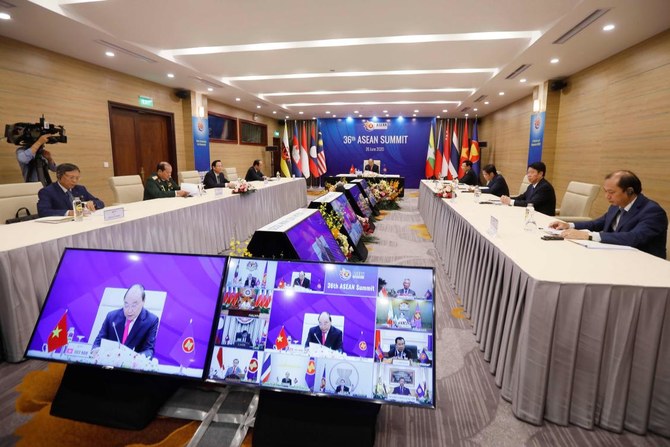
The leaders of the Association of Southeast Asian Nations linked up online due to regional travel restrictions and health risks, which have delayed dozens of meetings and shut out the ceremonial spectacles, group handshakes and photo-ops that have been the trademark of the 10-nation bloc’s annual summits.
Vietnam, the current ASEAN chair, had planned face-to-face meetings, but most member states assessed it was still too risky for leaders to travel. Still, it organized a colorful opening ceremony with traditional songs and dance in Hanoi for about 200 Vietnamese officials and foreign diplomats. They showed up without masks and sat close to each other while the heads of state watched remotely on their screens.
“The COVID-19 pandemic is a test for ASEAN,” Vietnamese Prime Minister Nguyen Xuan Phuc said. He added that the contagion “is fanning the flame of dormant challenges within the scope of political, economic and social environment,” and helping escalate frictions among major powers.
Southeast Asian nations have been impacted by the pandemic differently, with hard-hit Indonesia grappling with more than 50,000 infections and more than 2,600 deaths, and the tiny socialist state of Laos reporting just 19 cases. The diverse region of 650 million people, however, has been an Asian COVID-19 hot spot, with a combined total of more than 138,000 confirmed cases that have well surpassed that of China, where the outbreak started.
The economic toll has been severe, with ASEAN’s leading economies, including Singapore, Indonesia, Thailand and Malaysia, facing one of their most severe recessions in decades.
“We recognized the significant cost and unprecedented challenges to the region and the world caused by the coronavirus disease pandemic,” Vietnam says on behalf of ASEAN states in a draft communique to be issued after Friday’s summit.
“We noted with grave concern the human and socioeconomic costs caused by COVID-19 and remained committed to implementing targeted policies to instill confidence that ASEAN is at the forefront of this critical battle.”
A high-priority project would be the establishment of an ASEAN COVID-19 response fund, which could be used to help member states purchase medical supplies and protective suits. Thailand has pledged to contribute $100,000 and ASEAN partners, including China, Japan and South Korea, were expected to announce contributions after the terms of the fund were recently finalized, a senior Southeast Asian diplomat told The Associated Press.
A regional stockpile of medical supplies has also been proposed and the group will undertake a study to be financed by Japan on the possibility of establishing an ASEAN center on public health emergencies, said the diplomat, who spoke on condition of anonymity because of a lack of authority to speak publicly.
While the conservative bloc has tried to project unity, it has been riven by longstanding rivalries and disputes, particularly in the South China Sea that mainly involve four of its members — Vietnam, the Philippines, Malaysia and Brunei — pitted against China’s overlapping claims to one of the world’s busiest waterway. It’s also a crucial battleground for influence by Beijing and Washington.
The lingering disputes, along with the plight of Rohingya Muslims from Myanmar who are languishing in crowded refugee camps in neighboring Bangladesh, are among the thorniest issues on the ASEAN agenda.
“We underscored the importance of non-militarization and self-restraint in the conduct of all activities by claimants and all other states, which could further complicate the situation and escalate tensions in the South China Sea,” the draft ASEAN communique said.
China has come under fire for what rival claimants say are aggressive actions in the disputed waters while countries scrambled to deal with the viral outbreaks. Vietnam protested in April after a Chinese coast guard ship rammed and sank a boat with eight fishermen off the Paracel Islands. The Philippines backed Vietnam and protested new territorial districts announced by China in large swatches of the sea.
Washington also lashed out at China, which denied accusations that it was exploiting the intense preoccupation with the pandemic to advance its territorial claims as “sheer nonsense.”


ASEAN coronavirus fund, sea feud in spotlight in virtual summit
https://arab.news/vj66k
ASEAN coronavirus fund, sea feud in spotlight in virtual summit

- ASEAN link up online due to regional travel restrictions and health risks
- A high-priority project would be the establishment of an ASEAN COVID-19 response fund


Nigeria signals more strikes likely in ‘joint’ US operations
- Nigeria on Friday signalled more strikes against jihadist groups were expected after a Christmas Day bombardment by US forces against militants in the north of the country
LAGOS: Nigeria on Friday signalled more strikes against jihadist groups were expected after a Christmas Day bombardment by US forces against militants in the north of the country.
The west African country faces multiple interlinked security crises in its north, where jihadists have been waging an insurgency in the northeast since 2009 and armed “bandit” gangs raid villages and stage kidnappings in the northwest.
The US strikes come after Abuja and Washington were locked in a diplomatic dispute over what Trump characterised as the mass killing of Christians amid Nigeria’s myriad armed conflicts.
Washington’s framing of the violence as amounting to Christian “persecution” is rejected by the Nigerian government and independent analysts, but has nonetheless resulted in increased security coordination.
“It’s Nigeria that provided the intelligence,” the country’s foreign minister, Yusuf Tuggar, told broadcaster Channels TV, saying he was on the phone with US State Secretary Marco Rubio ahead of the bombardment.
Asked if there would be more strikes, Tuggar said: “It is an ongoing thing, and we are working with the US. We are working with other countries as well.”
Targets unclear
The Department of Defense’s US Africa Command, using an acronym for the Daesh group, said “multiple Daesh terrorists” were killed in an attack in the northwestern state of Sokoto.
US defense officials later posted video of what appeared to be the nighttime launch of a missile from the deck of a battleship flying the US flag.
Which of Nigeria’s myriad armed groups were targeted remains unclear.
Nigeria’s jihadist groups are mostly concentrated in the northeast of the country, but have made inroads into the northwest.
Researchers have recently linked some members from an armed group known as Lakurawa — the main jihadist group located in Sokoto State — to Islamic State Sahel Province (ISSP), which is mostly active in neighboring Niger and Mali.
Other analysts have disputed those links, though research on Lakurawa is complicated as the term has been used to describe various armed fighters in the northwest.
Those described as Lakurawa also reportedly have links to Al-Qaeda affiliated group for the Support of Islam and Muslims (JNIM), a rival group to ISSP.
While Abuja has welcomed the strikes, “I think Trump would not have accepted a ‘No’ from Nigeria,” said Malik Samuel, an Abuja-based researcher for Good Governance Africa, an NGO.
Amid the diplomatic pressure, Nigerian authorities are keen to be seen as cooperating with the US, Samuel told AFP, even though “both the perpetrators and the victims in the northwest are overwhelmingly Muslim.”
Tuggar said that Nigerian President Bola Tinubu “gave the go-ahead” for the strikes.
The foreign minister added: “It must be made clear that it is a joint operation, and it is not targeting any religion nor simply in the name of one religion or the other.”


