ISLAMABAD: A Pakistan International Airlines plane crash in Karachi last month, which killed 97 people aboard, was caused by the pilots’ overconfidence and lack of focus, revealed an initial inquiry report into the incident that was unveiled in the National Assembly of Pakistan on Wednesday.
“Several warnings and alerts related to speed, landing gear and ground proximity were disregarded [by the air crew],” said the 21-page report that was shared by the country’s aviation minister, Ghulam Sarwar Khan, with his colleagues in parliament.
Shortly after the crash, critics and opposition members lambasted Prime Minister Imran Khan and his administration for its failure to improve the national flag carrier’s performance and skills of its technical staff, including pilots. The country has a spotty record of aviation safety, and it has witnessed frequent plane and helicopter crashes over the years.
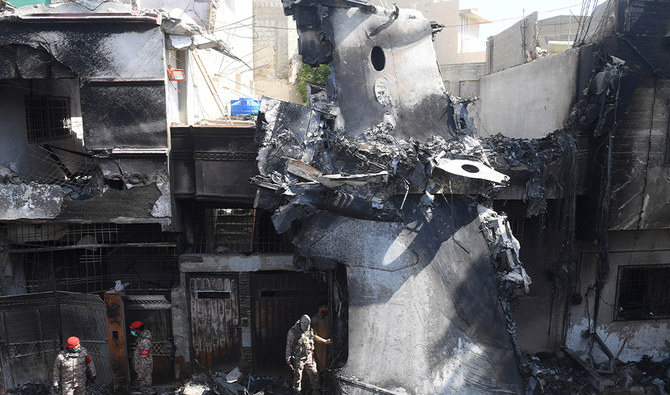
The PIA Airbus A320 crashed last month in a densely populated residential neighborhood in Karachi that is situated near the Jinnah International Airport, killing all but two of the 97 people on board. The ill-fated flight PK8303 from Lahore came down about a kilometer short of the runway on its second attempt to land.
“The landing was undertaken with landing gears retracted … Both engines scrubbed the runway at various locations causing damage to both of them,” the inquiry report said.
The minister also revealed on the basis of Flight Data Recorder (FDR) and Cockpit Voice Recorder (CVR) that the pilots were not focused.
“The pilots were discussing the coronavirus throughout the flight. They were not focused … There was overconfidence,” Khan said.
The minister also blamed the control tower for not pointing out damage to the plane after a botched attempt at landing. “The pilots and the controller failed to follow the standard rules,” he noted.
There was no technical fault in the plane and both the pilots were medically fit to fly, the minister continued, adding that the pilot retracted the landing gears at a distance of five nautical miles from the runway even though they were extended before.
Khan said the plane was on auto-landing, but the pilot disengaged it.
Pakistan has witnessed 12 plane crash incidents since its inception in 1947, and the minister attributed the staggering statistics to the lack of merit within the organization.
“Unfortunately, the degrees of four of our pilots were found bogus while forty percent pilots have fake licenses,” he said while vowing to restructure the national airlines and take action against all those responsible for making “political appointments.”
Pakistan has 860 active pilots while 262 of them did not appear in the exam themselves, revealed the minister, adding that the accountability will be ensured.
“An inquiry has been initiated into the fake licenses of pilots,” Khan added.


![]()

PIA crash that killed 97 caused by pilots’ 'overconfidence' — preliminary report
Short Url
https://arab.news/bqg5e
PIA crash that killed 97 caused by pilots’ 'overconfidence' — preliminary report
- Aviation minister says there was no technical fault in the plane and the pilots were medically fit to fly
- Shocks his listeners by telling them that 40 percent of the pilots in the country have fake licenses
Latest updates





Recommended


© 2026 SAUDI RESEARCH & PUBLISHING COMPANY, All Rights Reserved And subject to Terms of Use Agreement.