

Pakistan says net-metering promotes ‘unhealthy investments’ in solar power

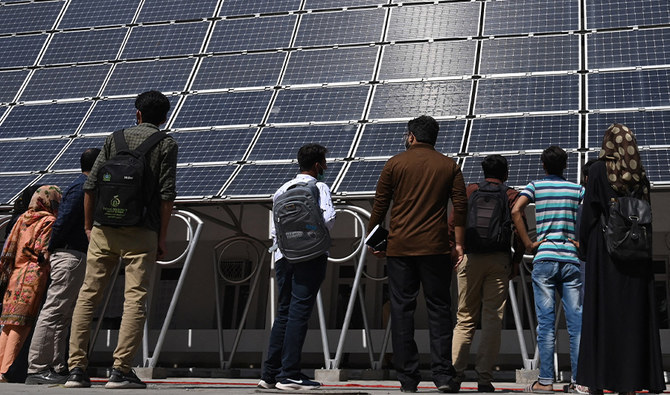
Students look at the facade of a building made with solar panels producing some 148 Kilowatts during its inauguration at the University of Engineering and Technology in Lahore on October 12, 2020. (AFP/FILE)
Short Url
Updated 27 April 2024
Follow

Pakistan says net-metering promotes ‘unhealthy investments’ in solar power

  • Government says massive solar installation is affecting 30 million consumers, imposing Rs1.90 per unit burden on them
  • Experts say the government’s ‘regressive policies’ will make it difficult to cut fossil fuel and promote renewable energy

ISLAMABAD: The Pakistan government said on Saturday net-metering was promoting unhealthy investments in installation of solar power by affluent domestic and industrial consumers, hinting at cutting the buyback rates to discourage uptick in the sector.

The government approved the net-metering policy in 2017, allowing solar panel purchasers to sell power they produced to the national grid to spur the solar energy use and cut power shortages. Under the policy, the government is paying Rs21 per unit for the net-metered electricity which the government says is resulting in the subsidy of Rs1.90 per unit, burdening the government.

This development comes at a time when the price of solar panels has plummeted by more than 60 percent in Pakistan in recent weeks due to the bulk imports from China because of lower rates, making the country witness a surge in the solar power installation by domestic and industrial consumers to reduce their electricity bills.

“The present system of net-metering is promoting unhealthy investments in solar power,” the energy ministry said in a statement on Saturday. “Affluent consumers have been massively installing solar power due to which domestic, industrial consumers and the government have to bear the burden of Rs 1.90 per unit under the head of subsidy.”

The ministry warned the subsidy was affecting some 25 to 30 million “poor consumers,” and if the trend of the solar power continued, the bills of ordinary consumers would surge by at least Rs 3.35 per unit. However, it clarified no fixed tax was being imposed on the solar power.

The 2017 net-metering policy was aimed at promoting renewable energy in the system, which helped enhance the solarization in the country that now “needs to be balanced,” the ministry said.

Pakistan has ideal climatic conditions for solar power generation, with over nine hours of sunlight in most parts of the country. Utilizing just 0.071 percent of the country’s area for solar photovoltaic (solar PV) power generation would meet Pakistan’s electricity demand, according to the World Bank.

Currently, only 5.4 percent of Pakistan’s installed power generation capacity of 39,772 megawatts comes from renewables like wind, solar and biomass, while fossil fuels still make up 63 percent of the fuel mix, followed by hydropower at 25 percent, according to the National Electric Power Regulatory Authority (NEPRA).

The South Asian nation of 241 million aims to shift to 60 percent renewable energy by 2030 with 50 percent reduction in projected emissions, but it stands far behind in meeting the goal despite a recent surge in the solar power.

Energy experts said the government’s “inconsistent” solar power policies would result in discouraging the sector and its failure in meeting the national and international commitments of cutting the greenhouse gas emissions.

“Public sector the world over is promoting renewable energy to cut fossil fuel while we are discouraging consumers with regressive policies,” Aamir Hussain, chairman of Pakistan Alternative Energy Association, told Arab News.

He said the association had suggested the government to issue licenses to consumers for their actual household or industry load instead of allowing them to install massive solar power with a promise to buyback the surplus.

“The government should come up with an inclusive policy to promote renewable energy instead of discouraging consumers by slapping taxes or cutting the rates,” he added.


Islamabad steps up vehicle checks to boost security as 166,000 cars get electronic tags

Updated 18 January 2026
Follow

Islamabad steps up vehicle checks to boost security as 166,000 cars get electronic tags

  • Authorities say over 3,000 vehicles registered in past 24 hours as enforcement intensifies
  • Extended service hours introduced to push full compliance with digital monitoring system

ISLAMABAD: Authorities in the Pakistani capital have intensified enforcement against vehicles without mandatory electronic tags with more than 166,000 cars now registered, according to data released on Sunday evening, as Islamabad moves to strengthen security and digital monitoring at key entry and exit points.

The Islamabad Capital Territory (ICT) administration introduced the electronic tagging system late last year as part of a broader effort to regulate traffic, improve record-keeping and enhance surveillance in a city that hosts the country’s main government institutions, foreign missions and diplomatic enclaves.

Under the system, vehicles are fitted with electronic tags that can be read automatically by scanners installed at checkpoints across the capital, allowing authorities to identify unregistered vehicles without manual inspections. Vehicles already equipped with a motorway tag, or m-tag, are exempt from the requirement.

“A total of 166,888 vehicles have successfully been issued M-Tags so far, including 3,130 vehicles in the last 24 hours,” the ICT administration said, according to the Excise Department.

Officials said readers installed at checkpoints across Islamabad are fully operational and are being used to stop vehicles still without tags, as enforcement teams carry out checks across the city.

To facilitate compliance, authorities have expanded installation facilities and extended operating hours. The Excise Department said m-tag installation is currently available at 17 booth locations, while select centers have begun operating beyond normal working hours.

According to Director General Excise Irfan Memon, m-tag centers at 26 Number Chungi and 18 Meel are providing services round the clock, while counters at Kachnar Park and F-9 Park remain open until midnight to accommodate motorists unable to visit during daytime hours.

Officials said the combination of enforcement and facilitation was aimed at achieving full compliance with minimal disruption, adding that operations would continue until all vehicles operating in the capital are brought into the system.

The enforcement drive builds on a wider push by the federal government to integrate traffic management, emergency response and security monitoring through technology-driven “safe city” initiatives. Last month, Interior Minister Mohsin Naqvi reviewed Islamabad’s surveillance infrastructure and said reforms in monitoring systems and the effective use of technology were the “need of the hour.”

Authorities have urged motorists to obtain electronic tags promptly to avoid delays and penalties at checkpoints as enforcement continues across the capital.