

PIF set to have $2 trillion in assets under management by 2030: report

In just eight years since its restructuring, the Saudi fund has become a dominant force both domestically and internationally, with the aim of advancing Vision 2030 and achieving the status of the world’s largest sovereign wealth fund by the end of the decade. (SPA)
Short Url
Updated 28 April 2024
Follow

PIF set to have $2 trillion in assets under management by 2030: report

  • In March 2024, PIF’s assets under management surpassed $925 billion, up from $700 billion at the end of 2022

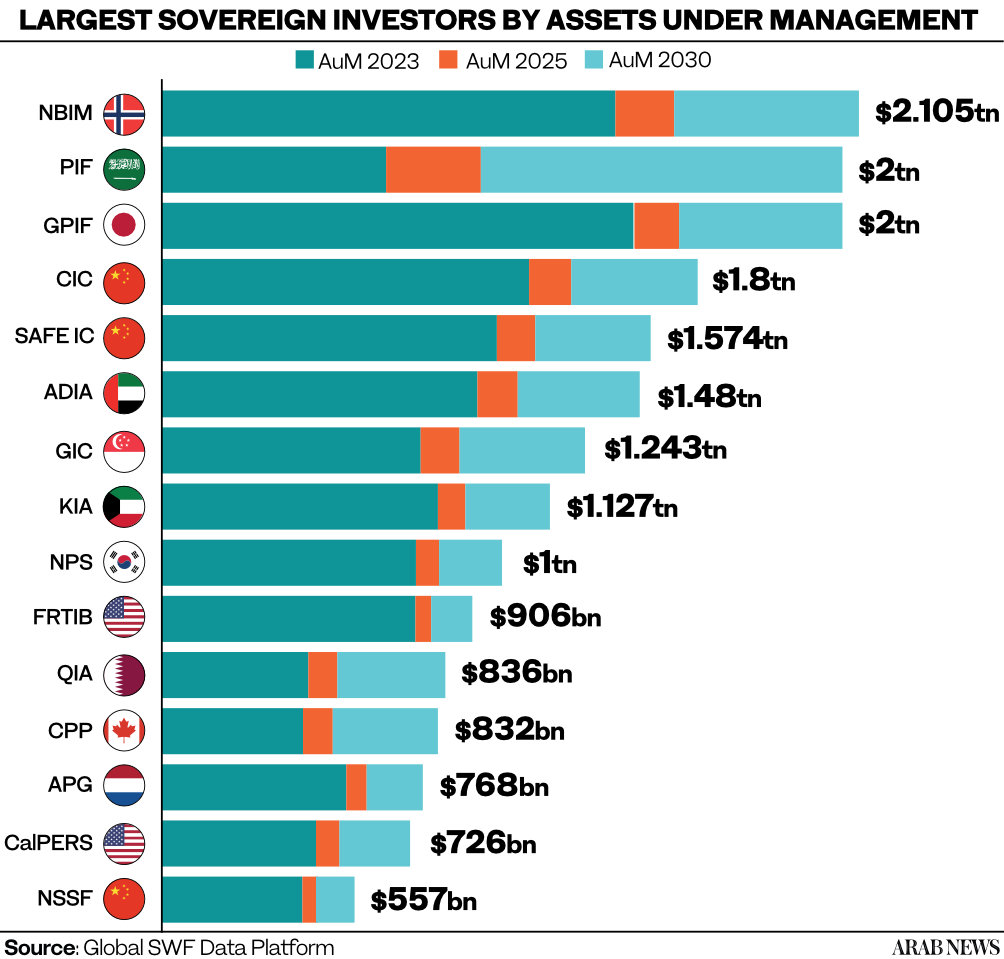
RIYADH: Saudi Arabia’s Public Investment Fund is poised to reach $2 trillion in assets under management by 2030, propelling it from 5th to 2nd place globally among sovereign wealth bodies, according to Global SWF.

The organization that monitors activity in this area stated that PIF’s rapid ascent can be attributed to the fund’s focus on  direct investments, emphasis on  key sectors of the Saudi economy, dedication to sustainability  through leading investments in  renewables and green assets, and active participation in the digital economy.

The institute’s 2024 annual report disclosed that in 2023, PIF took the lead as the top investor among all sovereign wealth funds, allocating $31.6 billion across 49 deals – a 33 percent increase from the prior year. 

This progress elevated the fund by 10 positions between global sovereign investors in new capital deployed within a mere three years.

In just eight years since its restructuring, the Saudi fund has become a dominant force both domestically and internationally, with the aim of advancing Vision 2030 and achieving the status of the world’s largest sovereign wealth fund by the end of the decade.

In March 2024, PIF’s assets under management surpassed $925 billion, up from $700 billion at the end of 2022, securing its position as the fifth largest global sovereign wealth fund, after the government transferred an additional 8 percent stake in Aramco to its portfolio.

The fund strategically delved into co-investments and forged joint ventures to bolster Saudi Arabia’s drive for economic diversification. 

Noteworthy examples include partnerships with mining giant Ma’aden, tire makers Pirelli, and car manufacturer Hyundai.

This was alongside an agreement with Baosteel and Aramco for the construction of a steel mill. 
The report highlighted that unlike numerous sovereign wealth funds that frequently choose co-investing as their primary strategy, both globally and in the Gulf region, PIF stands out with a strong preference for direct investments in private equity.

Specifically, it targets critical sectors of the Saudi economy, including sports and leisure, tourism, and gaming, as well as construction, and heavy industry.

Despite the clear advantages that co-investing offers – such as enhanced due diligence, favorable fee terms, and portfolio diversification – some sovereign investors may shy away due to concerns about deal visibility and relinquishing transaction control to other government funds.

According to the report, PIF stood out from other funds due to its substantial domestic investments, which significantly impacted its international investment capacity relative to other funds.

In 2023, Saudi Arabia’s sovereign wealth fund saw an 18 percent growth in its US equities portfolio, driven by rising stock values. 

PIF maintained a passive approach, keeping major positions unchanged. 

According to the report, its largest holding remained a 63 percent stake in Lucid Motors. 

PIF initiated its investment of $1 billion in the electric vehicle rival to Tesla back in 2018, and following Lucid’s initial public offering three years later has continued to infuse capital into the company.

This included an injection of $2 billion in June 2023, and Lucid is on course to commence EV production in Saudi Arabia by 2025.

PIF’s US-listed portfolio includes $8.1 billion in gaming companies such as Activision Blizzard, Electronic Arts, and Take-Two, reflecting the Kingdom’s plan to invest $38 billion to become a hub for this sector as part of Vision 2030.

In its report, Global SWF discussed the challenges encountered by sovereign investors in recent years and the corresponding solutions they implemented in 2023 to enhance the resilience of their portfolios.

One significant challenge involved addressing the decarbonization of the global economy. This was tackled through the introduction of a new sustainable investment strategy, shedding light on “climate alpha.” This typically refers to investments or strategies that aim to address global warming and its associated risks and opportunities.

This could include investments in companies or projects that are focused on renewable energy and efficiency, sustainable agriculture, clean transportation, and other environmentally friendly initiatives.

Sovereign investors showcased their dedication to sustainability during COP28, highlighted by the UAE’s launch of a $30 billion climate-focused fund, supported by BlackRock and fellow state-backed wealth funds. The goal is to access these areas while also greening existing black assets through de-carbonization.

Meanwhile, Saudi Arabia has taken a leading role in direct investments within the EV and automotive sectors. As well as its stake in Lucid, the Kingdom launched its own EV carmaker, Ceer, in a joint venture with Taiwan’s Foxconn. 

Further partnerships include collaborations with Tasaru for component localization, Hyundai for a car plant, and Pirelli for tire manufacturing.

According to Global SWF, sovereign investors directed a record $26.1 billion towards green assets in 2023, prioritizing investments in the energy transition, including renewables, battery storage, and EVs.

Gulf sovereign wealth funds contributed nearly half of this sum, leading the charge in driving the energy transition agenda.

The report also underscored another challenge encountered by sovereign funds, which is market volatility and the risks stemming from geo-economic fragmentation.

To tackle this issue, fund investors have embraced a more comprehensive total portfolio strategy. This strategy integrates alpha and beta return drivers, merging top-down and bottom-up analyses, with a significant emphasis on diversification.

By adopting this holistic approach, investors gain a thorough understanding of their investments, facilitating more informed decision-making, enhanced risk management, and the opportunity to optimize portfolio performance by focusing on the unique attributes and dynamics of each component within the portfolio.

The rise of disruptive artificial intelligence was also addressed in the report, which noted it represents a significant risk for sovereign investors as it can lead to rapid changes in industries, markets, and investment landscapes.

AI-powered technologies can impact traditional business models, alter consumer behavior, and introduce new competitive dynamics. To address this challenge, one proposed solution by sovereign investors is to integrate AI-powered portfolios into their investment strategies.

By incorporating AI technologies into portfolio management, sovereign funds can leverage advanced algorithms and data analytics to gain valuable insights. 

AI-powered portfolios can analyze vast amounts of data in real-time, identifying trends, patterns, and market signals that may not be immediately apparent to human analysts. This can lead to more accurate risk assessments, better market timing, and enhanced investment decision-making.

Additionally, AI can enable sovereign investors to automate certain aspects of portfolio management, such as rebalancing, trade execution, and risk monitoring. This not only increases operational efficiency but also allows for more agile responses to changing market conditions.

According to the report, 2023 saw sovereign wealth funds adjusting their real estate investments amidst concerns of global interest rate hikes and a potential property bubble.

Despite an overall softening in the market, some segments, such as data centers and affordable housing, saw growth as fund investors aligned with emerging megatrends. Data center investments surged by 150 percent to $7.6 billion in 2023, indicating a strong focus on future-oriented assets.

This shift reflects a move from traditional investments to a more sophisticated strategy, exemplified by PIF’s forming partnerships to develop data centers.

The report flagged up that in 2023, the GCC region – led by the Abu Dhabi Investment Authority, Abu Dhabi’s Mubadala, ADQ, PIF, and the Qatar Investment Authority – saw a record surge in sovereign capital to $4.1 trillion in assets under management, with transactions totaling $82.3 billion.

Projections indicate these sovereign wealth funds could reach $7.6 trillion in assets by 2030. This growth, according to the report, is fueled by high oil prices and a maturing investment landscape, driving economic diversification with growth forecasts of 3.6 percent and 3.7 percent for GCC nations in 2024 and 2025.

In this region, two distinctive sovereign wealth fund management approaches were highlighted by Global SWF. 

Abu Dhabi’s strategy involves the establishment of multiple SWFs, each with specific missions overseen by different royals. Saudi Arabia, on the other hand, centralizes its investment and strategic efforts under PIF, aligned with the government’s overarching vision.

Further, its leaders have no problems in announcing grand plans for the fund, using it in its name to buy football clubs or golf leagues, and in sharing its finances publicly given its fundraising efforts, in a rather refreshing fashion, the report said.

The institute presented updated projections in the State-Owned Investors 2030 section, factoring in the industry’s recovery in assets under management in 2023. 

It anticipates that public pension funds and central banks will reach $54.9 trillion by 2025 and $71 trillion by 2030. By then, Norway’s Norges Bank Investment Management, Saudi’s PIF, and Japan’s Government Pension Investment Fund could lead the table with over $2 trillion in assets under management each.


Saudi Arabia faces demographic shift as birth rates decline; sectors rethink strategies

Updated 5 sec ago
Follow

Saudi Arabia faces demographic shift as birth rates decline; sectors rethink strategies

RIYADH: Saudi Arabia is approaching a demographic crossroads, with birth rates dropping from 44 births per 1,000 people in 1980 to 16 in 2023, according to World Bank data.

Experts warn that the implications extend beyond human capital, healthcare, education, and real estate, affecting large cars, family homes, and insurance systems, as the population ages and the proportion of young people declines.

Experts speaking to Al-Eqtisadiah noted that by 2050, Saudi Arabia will face a significant aging challenge, as the population pyramid will expand in the middle and upper age groups relative to its base, signaling a shift from a youthful growth phase.

They added that these changes could reduce the number of new entrants to the labor market while increasing retirees, putting financial pressure on pension systems unless early reforms are implemented, such as raising the retirement age and promoting long-term savings.

The Kingdom’s population currently stands at approximately 34.6 million, with projections reaching 47.7 million by 2050, according to population pyramid data.

Saudi Arabia is not alone: Japan, South Korea, and China have experienced sharp declines in birth rates, resulting in demographic crises and extensive government interventions.

Arab experiences, including Tunisia, Morocco, and Lebanon, also show the long-term economic effects of falling fertility.

Demographic change brings economic challenges

Ihsan Buhulaiga, economic expert and founder of Joatha Consulting, told Al-Eqtisadiah that declining birth rates in Saudi Arabia are not primarily an economic challenge, but a societal issue related to preserving national identity and Saudi culture. He emphasized the need for forward-looking policies and effective initiatives to address these changes.

Buhulaiga added that declining fertility has concerned many countries. Some, like Japan, struggled due to reliance on traditional policies, while others, such as Sweden, succeeded through bold, progressive approaches.

He noted that declining population growth leads to an aging society, a reduced labor force, and increased pressure on healthcare and social systems, requiring policies tailored to each country’s context.

UN projections indicate that population growth will slow to 0.72 percent by 2050, with fertility rates dropping from 2.12 to around 1.8 children per woman. Saudi Arabia’s total fertility rate fell from 2.8 in 2011 to 2 in 2024, while fertility among Saudi women specifically declined from 3.8 to 2.7 in 2024, according to the General Authority for Statistics.

Buhulaiga highlighted the challenge of an expanding population pyramid in its middle and upper segments compared to its base — more seniors relative to births and young people — which shifts society toward stability and potentially aging, compared with the previous phase of youthful growth.

Rising burdens on pensions and long-term healthcare

Ayman Zuhri, population and migration studies expert, told Al-Eqtisadiah that continued declines in birth rates are gradually changing the age structure, reducing new entrants to the labor market while increasing the proportion of seniors.

Life expectancy gains expand the senior population, transforming the population pyramid from a traditional pyramid shape to a more columnar form over the coming decades.

Zuhri highlighted two sides of declining fertility: the “demographic opportunity” occurs when fertility drops from high to medium levels, reducing the child dependency burden and expanding the working-age population, which can drive economic growth if accompanied by quality education and productivity improvements.

The second stage is aging, where low fertility and longer life expectancy increase pension and healthcare burdens and shrink the national labor force, prompting reliance on technology, migration, or both.

Saudi births declined from 465,000 in 2017 to 417,000 in 2022 — a drop exceeding 10 percent in six years. The sharpest decline occurred among the 20-to 24-year-old group, down more than 40 percent, while women aged 35 to 44 saw a slight increase, reflecting delayed childbearing.

Zuhri stressed that continued fertility decline alongside rising life expectancy sets Saudi society on an aging trajectory, challenging pensions, healthcare, and workforce sustainability, emphasizing investment in education, workforce skills, and national labor productivity.

Lower purchasing power and shrinking demand for large cars, detached homes

Mohammed Al-Abbas, economic expert and writer, noted that Saudi household sizes are shrinking, though the precise cause remains unclear.

He warned that continued low fertility over the next decade would significantly affect human capital, productivity, and purchasing power, with implications for imported goods.
Al-Abbas believes that the real estate sector will be among the hardest hit, as smaller households reduce demand for independent homes, large urban developments, furniture, family cars, and construction materials. 

By 2050, the share of those aged 65 and above is expected to rise from 10 percent today to nearly 16 percent, changing the ratio from one senior per 10 people to one per six.

Women’s careers a factor in lower fertility

A study by Princess Nourah bint Abdulrahman University surveyed 2,172 Saudi women aged 18 to 50 from various regions. Participants from the central and eastern regions reported the highest rates of viewing childbirth as a barrier. 

Reasons included pursuing higher education, focusing on careers, and striving for financial stability.

Zuhri noted that declining fertility is not only linked to economic factors but also reflects substantial social changes regarding women’s roles, education, and work. Countries investing in women’s empowerment are better positioned to leverage demographic shifts positively.

Recruitment and labor market implications

Buhulaiga said that Vision 2030’s focus on reducing oil dependence and expanding non-oil sectors, including services requiring growing workforces, means expatriate inflows are likely to continue, maintaining the working-age population until aging gradually appears after 2040.

The Kingdom relies heavily on foreign labor, which accounted for about 41.6 percent of the population in 2022. As Vision 2030 targets are met — diversifying the economy, increasing foreign investment, and attracting skilled talent — migration is expected to rise. This will affect age distribution, particularly the 20-to 60-year-old working-age group.

Al-Abbas noted that a significant decline in fertility would have a major impact on human capital, putting pressure on labor markets and public services such as education and healthcare, and potentially increasing reliance on foreign labor despite efforts to build a national workforce.

Education investment at risk

Al-Abbas said the education sector will be highly affected, as declining student numbers in early and general education stages will reduce investment demand.

Zuhri added that fewer students could improve quality if resources are efficiently used, but would require restructuring educational infrastructure.

Changes in healthcare, insurance, and pensions

As the population ages, demand for chronic and long-term care rises, altering health spending and increasing demand for geriatric medical staff and long-term nursing.

Al-Abbas explained that declining birth rates mean a larger segment of seniors will require care different from that needed by younger populations, representing a major shift in healthcare priorities. 

Health insurance, he added, is also expected to face profit declines, as most insured individuals enter old age when health issues are more prevalent.

Regarding pensions, he noted that continued declines will place substantial pressure on retirement systems, highlighting the need for proactive reforms. 

Zuhri added that fewer new entrants relative to retirees will create financial strain on pension systems unless early restructuring occurs, including raising retirement age, adjusting contributions, and promoting long-term savings.

International experiences

Japan, South Korea, and China have faced demographic crises due to sharp fertility declines, requiring extensive government interventions.

Arab experiences in Tunisia, Morocco, and Lebanon also show that the impact of falling fertility depends on accompanying economic policies.

In Tunisia and Morocco, lower fertility eased numerical pressure but did not produce significant gains due to unemployment and weak investment.

In Lebanon, declining fertility coincided with heavy youth emigration, creating gaps in sectors like healthcare.

Countries facing low population growth adopt diverse policies based on cultural, economic, and social contexts. Policies to encourage childbirth often include financial incentives, flexible parental leave, and support for work-family balance. 

Awareness campaigns have also been used in Japan and South Korea to change social attitudes toward early parenthood.

Training older workers and investing in technology

To address labor shortages, some countries have adopted flexible immigration policies to attract skilled young workers, as seen in Canada and Australia, while others focus on integrating and upskilling migrants, similar to Germany’s approach with Syrian refugees.

Increasing workforce productivity and investing in technology involves ongoing training for older workers in Singapore and Japan, as well as automation and AI to offset labor gaps, particularly in healthcare and industry.

Extending working life and reforming pension systems have been applied in Italy and the Netherlands by raising retirement ages. Sweden encourages part-time work for seniors to ease system pressure. 

Improving healthcare and extending active life expectancy, as in the EU, involves preventive health measures and programs for active aging.

Finally, restructuring the economy to adapt to aging involves strengthening sectors like elderly care in China and reducing reliance on young labor by developing technological industries, as in Russia.

Solutions for Saudi Arabia

Zuhri recommends leveraging the demographic opportunity through education, digital skills, and higher female labor participation, while transitioning to a skilled, tech-driven economy. 
He also advocates pension reforms, family support, and managed migration to attract talent.

He emphasized that these policies mitigate the impact of declining fertility on the labor market and support sustainable economic stability while maintaining fertility levels close to replacement.

Buhulaiga highlighted successful solutions from countries such as Sweden, which relied on family support, immigration, and improved work-life balance, while enhancing seniors’ economic contribution.

Japan, despite failing to reverse its fertility decline, focused on offsetting population shortfalls through technology and extended working life.

Canada relies on organized immigration to fill labor gaps and ensure sustainable population growth.

Sweden: a balanced model

Buhulaiga views Sweden’s experience as a balanced approach to declining fertility. The country offers paid parental leave of 480 days, approximately 16 months, at 80 percent of salary, with 90 days allocated to each parent to promote shared childcare and gender equality.

The government provides monthly child allowances and low-cost childcare services, facilitating mothers’ return to work and maintaining a stable fertility rate of around 1.7–1.8 children per woman.

Sweden encourages work-life balance through flexible schedules and the right to return to jobs after parental leave. Seniors are supported through gradual retirement age increases, incentives to work beyond retirement, preventive healthcare, active aging programs, and part-time work opportunities.

Buhulaiga emphasized that without policies to boost citizens’ productivity, reliance on foreign labor — occupying higher-paid and safer jobs — would increase. He stressed engaging citizens in emerging economic sectors through empowerment, vocational training, and leadership preparation.

He called for leveraging international models like Sweden’s to encourage young people to have children and highlighted the importance of digital transformation and AI adoption.

This reduces dependence on low-and medium-skilled labor, raises productivity without inflating foreign labor numbers, and allows citizens to enter the workforce while balancing childbearing with economic participation.