


Babar Azam and Shaheen Afridi help Pakistan down New Zealand to draw T20I series

Pakistan’s Shaheen Shah Afridi celebrates after taking the wicket of New Zealand’s Ish Sodhi during the fifth T20 international cricket match between Pakistan and New Zealand, in Lahore, Pakistan, Saturday, April 27, 2024. (AP)
Short Url
Updated 27 April 2024
Follow

Babar Azam and Shaheen Afridi help Pakistan down New Zealand to draw T20I series

  • Azam’s 44-ball 69 took Pakistan to 178-5, while Afridi’s 4-30 restricted New Zealand to 169 in 19.2 overs
  • The series gave both the teams a kickstart to their preparations for the T20 World Cup in June this year

LAHORE: Skipper Babar Azam hit a solid half century while spearhead Shaheen Shah Afridi grabbed four wickets as Pakistan overcame New Zealand by nine runs in the fifth and final Twenty20 international in Lahore on Saturday.
Azam’s 44-ball 69 and Fakhar Zaman’s 33-ball 43 took Pakistan to 178-5 in their 20 overs before Shaheen claimed 4-30 to restrict New Zealand to 169 in 19.2 overs, squaring the series at 2-2.
But Pakistan’s win only came in the final over with 12 needed as Josh Clarkson 38 not out threatened to pull off a heist, but two run outs in Mohammad Amir’s over sealed the home win much to the delight of a full house at Qaddafi Stadium.
The first match of the series was abandoned while Pakistan clinched the second and New Zealand the third by identical seven-wicket margins – all in Rawalpindi.
New Zealand took the fourth match, also in Lahore, by four runs.
The series gave both the teams a kickstart to their preparations for the Twenty20 World Cup to be held in the United States and the West Indies in June.
While Pakistan would be disappointed not to have won a series against a depleted New Zealand side missing a host of players due to Indian Premier League, unavailability and injuries, the visitors got a boost from their bench strength.
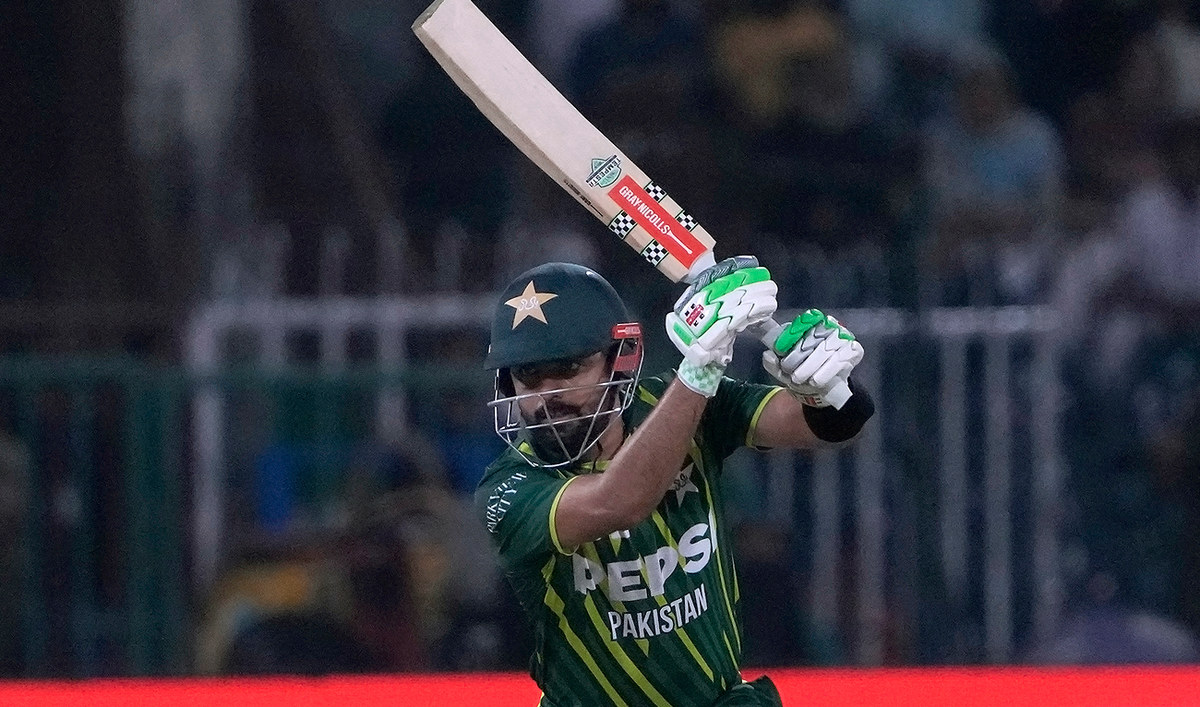


Pakistan's Babar Azam plays a shot during the fifth T20 international cricket match between Pakistan and New Zealand, in Lahore, Pakistan, Saturday, April 27, 2024. (AP)

Shaheen gave Pakistan an ideal start by dismissing Tom Blundell for four in his first over – his 15th wicket in his opening over of a Twenty20 international – and 50th in all T20 matches.
Tim Seifert put New Zealand back on track with an aggressive 33-ball 52 – his ninth T20I half century containing seven boundaries and two sixes.
He added 76 for the second wicket with skipper Micheal Bracewell (23) but from 81-1 New Zealand lost four wickets in the space of 25 balls for the addition of just 22 runs.
Leg-spinner Usama Mir (2-21) had Seifert and Mark Chapman (12) while fellow spinner Shadab Khan accounted for Bracewell as New Zealand’s chase was derailed.
Shaheen returned for a second spell to dismiss James Neesham (16), Zak Foulkes (naught) and Ish Sodhi (three) in successive overs.
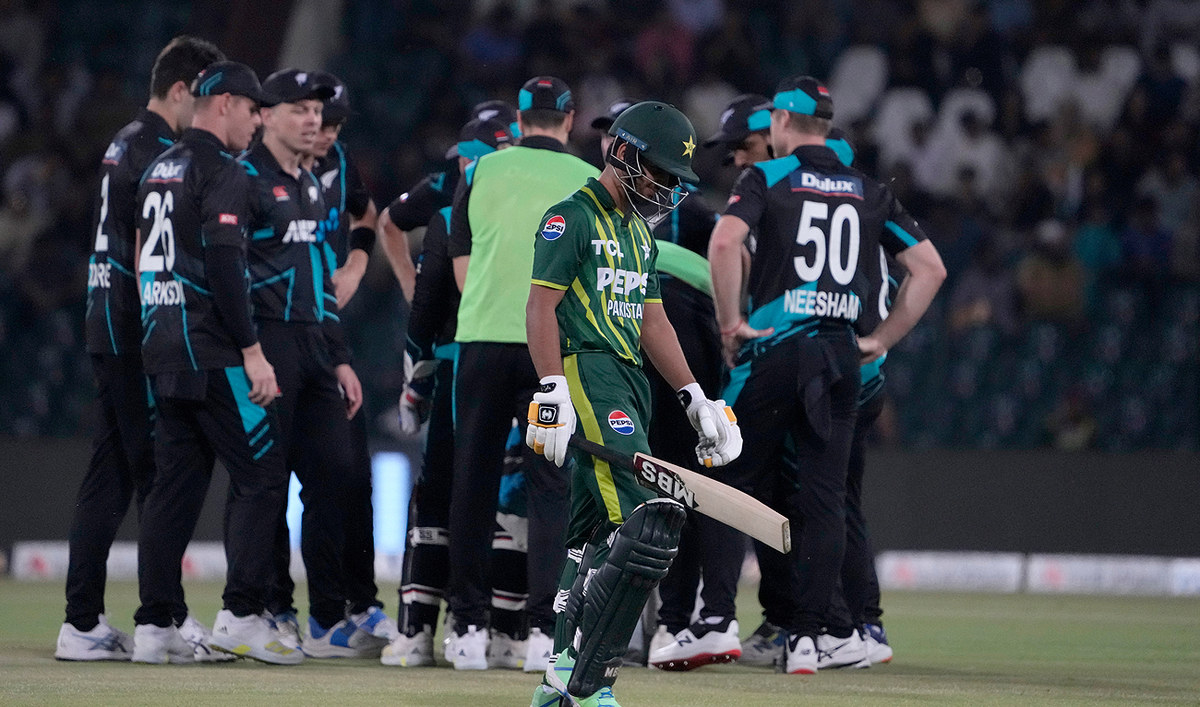


Pakistan's Saim Ayub, center front, walks off the field after losing his wicket during the fifth T20 international cricket match between Pakistan and New Zealand, in Lahore, Pakistan, Saturday, April 27, 2024. (AP)

Earlier, Azam saw his opening partner Saim Ayub fall in the second over for just one but that did not deter him as he added 73 for the second wicket with Usman Khan who made a brisk 24-ball 31.
Azam hit six boundaries and two sixes in his 34th T20I half-century before he was bowled by pacer Ben Sears in the 15th over.
Zaman hit four boundaries and a six before he was smartly caught by Chapman on the boundary off Foulkes as Pakistan managed 55 in the last five overs.
Shadab Khan hit a six and a four in his five-ball 15 not out.
New Zealand made three changes as they brought back Seifert, Cole McConchie and Foulkes while pace spearhead Shaheen returned for the home team.


Pakistan engages Saudi Arabia, China in bid to ease surging Middle East tensions 

Updated 10 March 2026
Follow

Pakistan engages Saudi Arabia, China in bid to ease surging Middle East tensions 

  • Pakistan’s foreign minister stresses need for de-escalation in conversations with Chinese, Saudi counterparts
  • Tensions in the Middle East continue to remain high as conflict between US, Israel and Iran intensifies

ISLAMABAD: Pakistan’s Deputy Prime Minister Ishaq Dar spoke to the foreign ministers of Saudi Arabia and China on Tuesday, stressing the importance of diplomatic engagement to de-escalate tensions in the Middle East as the Iran war intensifies. 

Pakistan has constantly engaged regional countries in efforts to broker a ceasefire in the Middle East, after the US and Isreal launched coordinated strikes against Iran on Feb. 28. 

Iran launched fresh attacks on Gulf countries on Tuesday morning, where it has targeted US military bases in recent weeks. In addition to firing missiles and drones at Israel and American bases in the region, Iran has also been targeting energy infrastructure which, combined with its stranglehold on the Strait of Hormuz, has sent oil prices soaring worldwide. 

Dar spoke to Saudi Foreign Minister Prince Faisal bin Farhan to discuss developments in the Middle East and ongoing deliberations at the UN Security Council, Pakistan’s foreign office said in a statement. 

“DPM/FM shared Pakistan’s perspective, underscoring the importance of continued coordination and diplomatic engagement to support de-escalation and promote peace and stability across the region and beyond,” the statement said. 

Dar, who also serves as Pakistan’s foreign minister, spoke to Chinese foreign minister Wang Yi over the telephone separately. The two discussed the evolving regional situation and broader global developments.

Dar underscored the need to ease tensions in the Middle East and the wider region during the conversation, the foreign office said. 

Yi appreciated Pakistan’s constructive efforts aimed at promoting de-escalation and stability in the region, it added. 

“The two leaders stressed the importance of de-escalation and emphasized the need to pursue dialogue and diplomacy in accordance with the principles of the UN Charter,” the foreign office’s statement said. 

The conflict in the Middle East has hit Pakistan hard as well, forcing Islamabad to hike petrol and diesel prices by Rs55 per liter last Friday. 

Pakistan’s government has also announced a set of austerity measures, which include closing schools and cutting down on government expenditures, as it evaluates petrol stocks and looks for alternative supply routes.