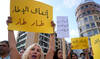
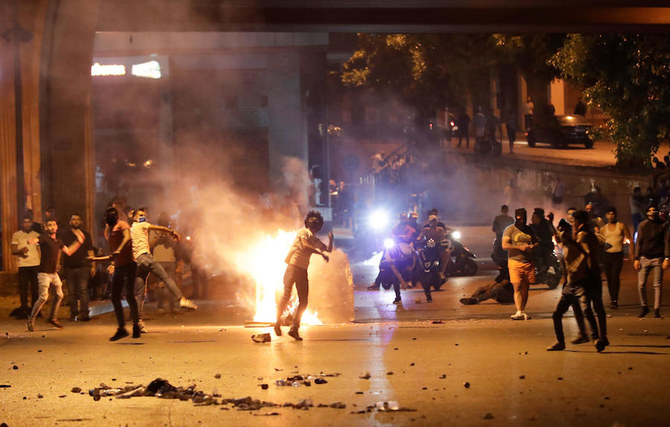
BEIRUT: Lebanese protesters took to the streets in Beirut and other cities Saturday in mostly peaceful protests against the government, calling for its resignation as the small country sinks deeper into economic distress.
The protests come after two days of rallies spurred by a dramatic collapse of the local currency against the dollar. Those rallies degenerated into violence, including attacks on private banks and shops.
The local currency, pegged to the dollar for nearly 30 years, has been on a downward trajectory for weeks, losing over 60% of its value. But the dramatic collapse this week deepened public despair over the already troubled economy. Lebanon is heavily dependent on imports and the dollar and local currency have been used interchangeably for years.
The unrivaled economic and financial crises are proving a major challenge to the government of Prime Minister Hassan Diab, who took office earlier this year after his predecessor resigned amid nationwide protests. Diab was faced with handling the coronavirus pandemic soon after taking office. Lebanon’s financial problems predate the coronavirus pandemic, which put the country in lockdown for months, further compounding the crisis.
Diab’s government is supported by the powerful militant group Hezbollah and its allies, but has already been weakened by the economic crisis. He was due to address the nation later Saturday.
For the protesters Saturday, many of them members of organized political parties, Diab’s government has failed to handle the crisis.
Neemat Badreddin, a political activist, described the government as captive to the interests of political groups and not the public.
“This current government proved to be a failure,” said Badreddin, wearing a face mask featuring the Lebanese flag with its green cedar tree in the center. “We want a new government ... we want stability and we want to be able to live without begging or without people having to migrate.”
Protesters in Beirut carried a banner that read “There is an alternative.”
In the southern city of Sidon, some directed their wrath at the central bank governor. One protester raised a banner called him the “protector of all thieves in Lebanon.”
In the northern city of Tripoli, army troops forcefully dispersed dozens of protesters who had blocked the road preventing trucks from moving forward, according to videos posted online. The protesters allege the trucks were smuggling goods to Syria — a common complaint in Lebanon as the neighboring country grapples with its own economic hardships.
After an emergency Cabinet meeting Friday to address the crisis, the government announced that the central bank would inject fresh dollars into the market to prop up the Lebanese pound — a measure that many everyday Lebanese and government critics say is likely to offer only temporary relief.
The dollar shortage, coupled with already negative economic growth, has crunched Lebanon’s middle class and increased poverty in the small Mediterranean nation of over five million that’s home to over 1 million Syrian refugees.
The heavily indebted government has been in talks for weeks with the International Monetary Fund after it asked for a financial rescue plan but there are no signs of an imminent deal.

Lebanon protesters call on government to resign amid crisis
Short Url
https://arab.news/9fyg9
Lebanon protesters call on government to resign amid crisis
- The protests come after two days of rallies spurred by a dramatic collapse of the local currency against the dollar
- The local currency, pegged to the dollar for nearly 30 years, has been on a downward trajectory for weeks, losing over 60% of its value
Halt to MSF work will be ‘catastrophic’ for people of Gaza: MSF chief
GENEVA: Israel’s ban on Doctors Without Borders’ humanitarian operation in Gaza spells deeper catastrophe for the Palestinian territory’s people, the head of the medical charity told AFP on Monday.
Israel announced on Sunday that it was terminating all the activities in Gaza and the West Bank by the organization, known by its French acronym MSF, after it failed to provide a list of its Palestinian staff.
MSF slammed the move, which takes effect on March 1, as a “pretext” to obstruct aid.
“This is a decision that was made by the Israeli government to restrict humanitarian assistance into Gaza and the West Bank at the most critical time for Palestinians,” MSF secretary-general Christopher Lockyear warned in an interview with AFP at the charity’s Geneva headquarters.
“We are at a moment where Palestinian people need more humanitarian assistance, not less,” he said. “Ceasing MSF activities is going to be catastrophic for the people of the Gaza Strip and the West Bank.”
MSF has been a key provider of medical and humanitarian aid in Gaza, particularly since war broke out after Hamas’s October 7, 2023 attack on Israel.
The charity says it currently provides at least 20 percent of hospital beds in the territory and operates around 20 health centers.
In 2025 alone, it carried out more than 800,000 medical consultations, treated more than 100,000 trauma cases and assisted more than 10,000 infant deliveries.
It also provided more than 700 million liters of water, Lockyear pointed out.
’Impossible choice’
Israel announced in December that it planned to prevent 37 aid organizations, including MSF, from working in Gaza for failing to submit detailed information about their Palestinian employees. The move drew widespread condemnation from NGOs and the United Nations.
It had alleged that two MSF employees had links with Palestinian militant groups Hamas and Islamic Jihad, which the medical charity vehemently denies.
“If Israel has any evidence of such things, then they should share that evidence,” Lockyear said, insisting that “there’s been no proof given to us.”
He decried “an orchestrated campaign to delegitimize us,” calling on other countries to defend efforts to bring desperately-needed humanitarian aid into Gaza.
“They should be speaking to Israel, pressuring Israel to ensure that there is a reverse of any banning of humanitarian organizations.”
Lockyear said MSF, which counts around 1,100 staff inside Gaza, had been trying to engage with Israeli authorities for nearly a year over the requested lists.
But it had been left with “an impossible choice,” he said.
“We’ve been forced to choose between the safety and security of our staff and being able to reach patients.”
’Can only get worse’
The organization said it decided not to hand over staff names “because Israeli authorities failed to provide the concrete assurances required to guarantee our staff’s safety, protect their personal data, and uphold the independence of our medical operation.”
Lockyear insisted that was a “very rational” decision, pointing out that 15 MSF staff had been killed in Gaza during the war, out of more than 500 humanitarian workers and more than 1,700 medical workers killed in the Strip.
Lockyear highlighted that without independent humanitarian organizations in Gaza, an already “catastrophic” situation “can only get worse.”
“We need to increase massively the humanitarian assistance that’s going into Gaza,” he said, “not restrict it, not block it.”
Israel announced on Sunday that it was terminating all the activities in Gaza and the West Bank by the organization, known by its French acronym MSF, after it failed to provide a list of its Palestinian staff.
MSF slammed the move, which takes effect on March 1, as a “pretext” to obstruct aid.
“This is a decision that was made by the Israeli government to restrict humanitarian assistance into Gaza and the West Bank at the most critical time for Palestinians,” MSF secretary-general Christopher Lockyear warned in an interview with AFP at the charity’s Geneva headquarters.
“We are at a moment where Palestinian people need more humanitarian assistance, not less,” he said. “Ceasing MSF activities is going to be catastrophic for the people of the Gaza Strip and the West Bank.”
MSF has been a key provider of medical and humanitarian aid in Gaza, particularly since war broke out after Hamas’s October 7, 2023 attack on Israel.
The charity says it currently provides at least 20 percent of hospital beds in the territory and operates around 20 health centers.
In 2025 alone, it carried out more than 800,000 medical consultations, treated more than 100,000 trauma cases and assisted more than 10,000 infant deliveries.
It also provided more than 700 million liters of water, Lockyear pointed out.
’Impossible choice’
Israel announced in December that it planned to prevent 37 aid organizations, including MSF, from working in Gaza for failing to submit detailed information about their Palestinian employees. The move drew widespread condemnation from NGOs and the United Nations.
It had alleged that two MSF employees had links with Palestinian militant groups Hamas and Islamic Jihad, which the medical charity vehemently denies.
“If Israel has any evidence of such things, then they should share that evidence,” Lockyear said, insisting that “there’s been no proof given to us.”
He decried “an orchestrated campaign to delegitimize us,” calling on other countries to defend efforts to bring desperately-needed humanitarian aid into Gaza.
“They should be speaking to Israel, pressuring Israel to ensure that there is a reverse of any banning of humanitarian organizations.”
Lockyear said MSF, which counts around 1,100 staff inside Gaza, had been trying to engage with Israeli authorities for nearly a year over the requested lists.
But it had been left with “an impossible choice,” he said.
“We’ve been forced to choose between the safety and security of our staff and being able to reach patients.”
’Can only get worse’
The organization said it decided not to hand over staff names “because Israeli authorities failed to provide the concrete assurances required to guarantee our staff’s safety, protect their personal data, and uphold the independence of our medical operation.”
Lockyear insisted that was a “very rational” decision, pointing out that 15 MSF staff had been killed in Gaza during the war, out of more than 500 humanitarian workers and more than 1,700 medical workers killed in the Strip.
Lockyear highlighted that without independent humanitarian organizations in Gaza, an already “catastrophic” situation “can only get worse.”
“We need to increase massively the humanitarian assistance that’s going into Gaza,” he said, “not restrict it, not block it.”
© 2026 SAUDI RESEARCH & PUBLISHING COMPANY, All Rights Reserved And subject to Terms of Use Agreement.