

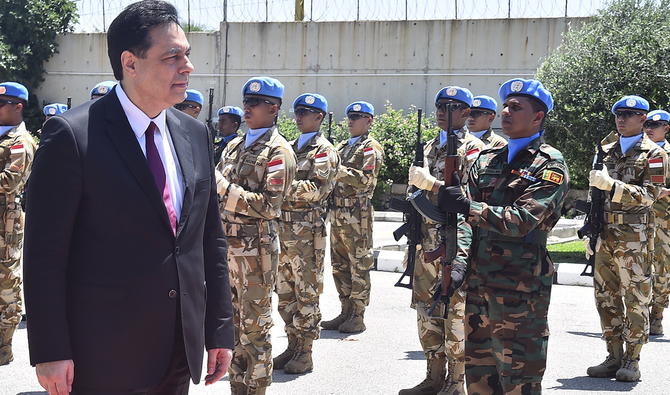

BEIRUT: Lebanon’s Prime Minister Hassan Diab on Wednesday repeated his backing for UN peacekeeping forces in the country, saying the troops were needed “in light of Israeli destabilization attempts.”
Diab visited the headquarters of the UN Interim Force in Lebanon (UNIFIL) in the southern border town of Naqoura amid a dispute between the government and Hassan Nasrallah, secretary-general of the Iran-backed Hezbollah, over the mission’s mandate.
Less than 12 hours before the Lebanese leader’s visit, Nasrallah accused the US and Israel of using the peacekeeping force to expand their interests.
“If they want to reduce or increase the number of UNIFIL soldiers, it does not make any difference. We are not against UNIFIL’s stay, but the Americans are mistaken if they consider this to be a pressure card against Lebanon. We believe that UNIFIL is an Israeli interest more than a Lebanese interest,” Nasrallah said.
Diab, accompanied by Defense Minister Zeina Akar and Armed Forces Commander Gen. Joseph Aoun, held a meeting with Maj. Gen. Stefano Del Col, UNIFIL force commander and head of the mission.
At a joint press conference, Diab stressed the need for “UNIFIL forces to cooperate with the Lebanese army” deployed in the volatile southern border region.
The Lebanese leader also called on the UN “ensure the implementation” of UN Security Council Resolution 1701, intended to resolve the 2006 Israel-Lebanon conflict.
Del Col said that “cooperation between UNIFIL and the Lebanese Armed Forces” had brought 14 years of peace in southern Lebanon, and called for all parties to “build on this long period of unprecedented stability.”
The peacekeeping chief said that he looked forward to working “with the government and the army to implement Resolution 1701, to address any outstanding issues, and to prevent and reduce tension.”
The UN Security Council is expected to renew UNIFIL’s mandate in August.
Hezbollah fears that the peacekeeping force’s mandate will be extended as a result of “US and Israeli pressure,” allowing it “freedom of movement” and the right to inspect private property in its area of operations.
Two days ago, residents of the nearby town of Blida protested after an attempt by a UN patrol to enter a private property. In another incident, residents of Mays Al-Jabal complained of “disturbances” caused by peacekeeping troops in the area.
Nasrallah said: “The Israelis want UNIFIL to have the right to raid and search private properties, and the Americans are pressuring Lebanon on this issue.”
A civilian UNIFIL source told Arab News that according to its mission, the UN force must inform the Lebanese army of its patrols.
“But what is happening is that UNIFIL conducts its patrols without notification,” the source said. “This is what happened in Blida.”
The source said that UN forces carry out 486 land, air and sea patrols daily, and have 10,500 soldiers to carry out these tasks, while the Lebanese army has no more than 5,000 troops in the area.
“The Lebanese army cannot keep up with all UNIFIL patrols,” the source said.
After a US call for a drastic reduction in the UN peacekeeping force’s budget, more than $1 million is believed to have been slashed on spending for the coming financial year, starting on July 1.
Forty-four countries took part in UNIFIL forces this year, three more than the previous year. European forces continue to dominate the command of the force’s operational areas.


