

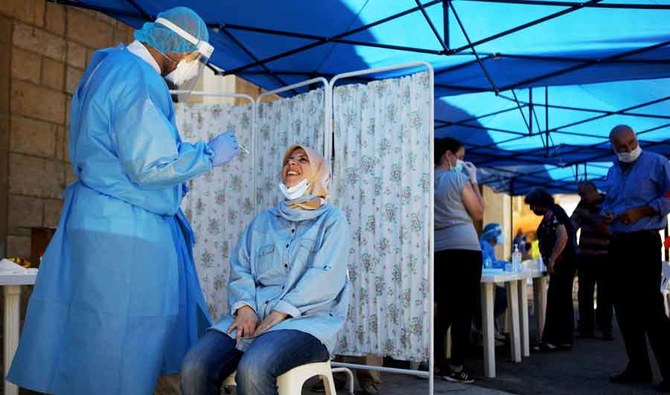
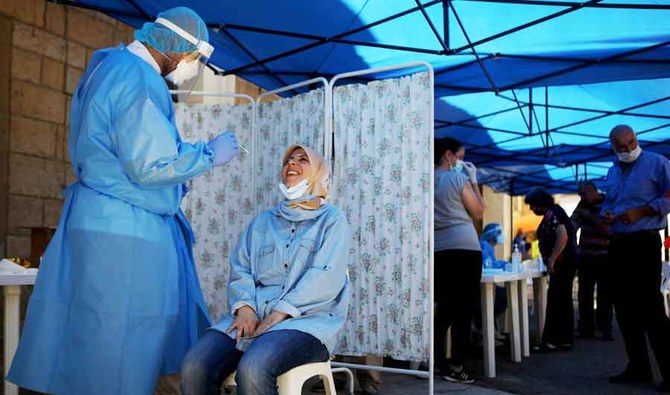
BEIRUT: A crackdown on any gatherings on Eid has been announced in Lebanon after 26 new COVID-19 cases were recorded during the past 24 hours, raising the total number of cases in the country to 1,086.
Lebanese Interior Minister Mohammed Fahmy has blocked the reopening of malls, entertainment and sports gatherings, and gyms, playgrounds and parks will also stay shut. Dar Al-Fatwa sources confirmed to Arab News that Eid prayers “will be held in mosques but with adherence to social distancing. The central Eid prayer in Beirut will be attended by Prime Minister Hassan Diab.”
Lebanon had eased its restrictions, calling for the population to adhere to preventive measures. But the scenes of people crowding into markets in Beirut and other regions without using face masks or adopting social distancing raised concerns.
In the markets popular perceptions of the need for wearing personal protection equipment varied hugely.
Saleh, a young man from the North Bekaa, said: “We do not have any infections. People live their lives naturally. Cafes opened and people smoke the forbidden hookah. Some people do not believe this disease exists.”
A woman in her 50s, who was following up a personal matter at the social security office and does not wear a mask, said: “Do you believe that there is corona disease? Do you know anyone who got it? I don’t know anyone. I think they are lying to us.”
Amid this state of denial, on Friday Health Minister Hamad Hassan visited Majdal Anjar, the border town with Syria which recently recorded an unprecedented increase in the number of COVID-19 cases.
FASTFACT
Lebanon had eased its restrictions, but the scenes of people crowding into markets in Beirut and other regions without using face masks or adopting social distancing raised concerns.
Hassan said: “If we do not take responsibility, then there is no doubt that the coronavirus will be disastrous. Overcrowding and social mixing cause a rapid spread of infection.”
The security forces cordoned off Majdal Anjar, together with the town of Mazboud in the province of Al-Kharoub on Mount Lebanon, because the number of infections had increased there.
Lebanon had also resumed returning Lebanese expatriates, especially students. Seven flights arrived from Istanbul, Riyadh, Dammam, Paris, Dubai and London.
The Minister of Health also said that “returning expatriates do not have the right to break the home quarantine imposed on them for 14 days and cause a danger to the country and its citizens.” He pointed out that “the cases that do not show symptoms are those that lead to the spread of the pandemic, and constitute the real danger.”
Hassan suggested that “we may go for herd immunity, but in a calm manner, and we may close the country completely when the number of beds in hospitals becomes insufficient, but the immunity tests that have been carried out do not indicate an outbreak or spread of the pandemic yet and we will not witness a second wave if we are careful and responsible.”
Dr. Abdul-Rahman Al-Bizri, an infectious diseases specialist and member of the Health Ministry’s crisis committee, said that “what is happening now is the result of lack of seriousness in dealing with this.”
He told Arab News that “The roots of the problem are clear. The return of people from abroad was mishandled. At first, there was discipline and things were acceptable. But later, we did not see good organization. When the authorities opened the country internally, it did not work to protect the interests of people by stressing the application of prevention measures. And the most dangerous group which the authorities ignored is foreign workers who live in crowded places where it is easy to transmit infection between them and to others.”
Al-Bizri stressed the importance of “re-organizing things before resuming flights from abroad to stop the current chaos.”
Information Minister Manal Abdel Samad confirmed after a session of the Council of Ministers on Thursday that “there is currently no decision to reopen Beirut airport, and the last flight for returnees will be on the 27th of this month. As for the resumption of flights, it is suspended indefinitely.”


