


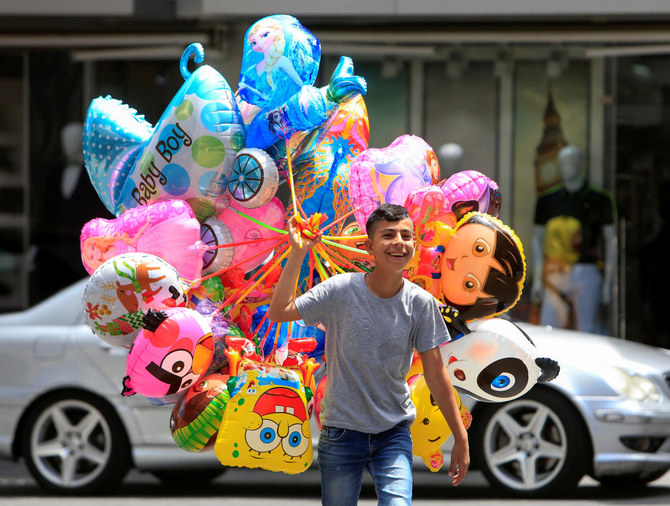


BEIRUT: Eid prayers were held in Lebanon’s mosques, as people celebrated the end of Ramadan amid measures to prevent the spread of coronavirus.
Movement in Beirut was limited to family visits, with parks and other entertainment facilities remaining closed. Most people refrained from visiting restaurants because of the ongoing economic crunch. Families with properties in the mountains preferred to spend their Eid holidays there in order to protect themselves against the virus.
Eid prayers were held in mosques, and the number of worshippers varied region-wise. Mosques abided by the decision of the Islamic Dar Al-Fatwa to maintain distance between worshippers, ensure that everyone wore masks, have worshippers bring their own prayer mats, and prevent handshakes and hugging.
Doctors expressed fears that social mixing during the holidays might boost the number of infections. On Sunday the Health Ministry confirmed 17 new COVID-19 cases, raising the total number to 1,114.
But economic concerns overshadowed other worries during Eid, and shopkeepers complained of a significant drop in purchasing activity.
“Business activities in markets before Eid remained minimum due to a decline in people’s purchasing power and the pandemic,” Tony Eid, head of the Beirut Traders Association, told Arab News. “Reopening markets gradually is better than continuous closure. We are facing several issues such as banks not issuing US dollars, and forex dealers are still on a strike forcing us to resort to devious ways to buy dollars. If we don’t do that the commercial sector will suffocate.”
Opinion
This section contains relevant reference points, placed in (Opinion field)
The third phase of the repatriation of Lebanese expatriates ended on Sunday. Citizens arrived on Sunday at Rafik Hariri International Airport from Riyadh, Frankfurt, Paris, Brussels, Abu Dhabi, Dubai, and London. On Saturday night, flights from Moscow, London, Abidjan, and Mozambique arrived. The government is currently not planning to start the fourth phase of the operations. The next phase will be based on the pandemic situation.
According to the Ministry of Health, the total number of COVID-19 cases among those coming from abroad is 193, while 6,393 people are in quarantine centers.
Prime Minister Hassan Diab offered Eid prayers at the Al-Amin Mosque in central Beirut. Former prime ministers, who oppose the current government, were absent from the scene.
Former Prime Minister Saad Hariri participated in Eid prayers at Imam Ali Mosque in Beirut’s Jdeideh Road district, which is loyal to the Future Movement. Many of the district’s people came out to greet Hariri and expressed their support for him.
In his Eid sermon Grand Mufti Sheikh Abdul Latif Derian criticized “the destruction and sabotage of public institutions” and called on the government to stop the country’s financial, banking, and economic collapse.
“Where have the billions (of liras) gone?” he said. “These should have been spent on safeguarding the interests of citizens, supplying them with power and water, on addressing the waste crisis, improving communications, and promoting agriculture, industry, and services. Why has the country accumulated public debt of $90 billion, $50 billion of which were wasted on electric power that is always out? Who is responsible for holding the depositors’ money? The ones who drained this money inform us every day that it has been lost forever.”
He said Lebanon should reach out to its Arab brothers, who were keen on the country’s safety, stability, and prosperity. “We will not abandon our Arab nationalism,” he added.
Sheikh Hassan Merheb, assistant general inspector at Dar Al-Fatwa, criticized those attempting to undo the policies of former Prime Minister Rafik Hariri. He said Beirut would remain faithful to him and to those following in his footsteps.
Grand Jaafari Mufti Sheikh Ahmad Kabalan said that the Lebanese formula, which was established on a “sectarian and tyrannical basis to serve the colonial and monopoliztic project,” had ended.
He also said that what the post-independence president, Bechara El-Khoury, and former Prime Minister Riyad Al-Solh did was no longer suitable for a state of citizenship because the country had collapsed due to the “corrupt constitution.”
He said that Lebanon must not listen to “the lying international community” and that “the International Monetary Fund is neither a charity nor independent from politics.”
The Lebanese head of the Maronite Catholic Church, Patriarch Bechara Al-Rahi, used his Sunday sermon to condemn attempts to involve Lebanon in the region’s wars. He said these destroyed Lebanon’s sovereignty and independence, or turned it into a battlefield.
He declared his refusal for “changing the face and heart of Lebanon and its pluralistic characteristic in order to preserve our identity.”


