

Seoul reopens mosques for Ramadan

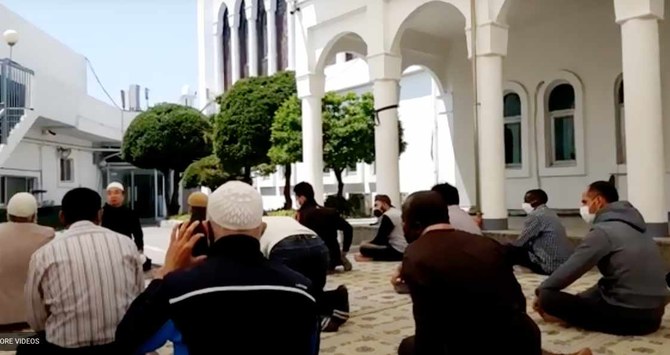
A screengrab from YouTube video channel shows Korean Muslims offering prayers outside the reopened Seoul Central Mosque on Wednesday. (Supplied)
Short Url
Updated 07 May 2020
Follow

Seoul reopens mosques for Ramadan

  • Move comes as South Korea reports zero new infections for third day

SEOUL: Several mosques reopened in South Korea on Wednesday following a decline in coronavirus cases across the country, officials told Arab News.

“We’re still concerned about the spread of the novel coronavirus, so over the next 10 days visitors will be allowed to offer prayers only outside the mosque,“ A. Rhaman Lee Ju-hwa, chief imam at the Korea Muslim Federation (KMF), said in a phone interview.

The federation banned Friday prayers at its religious facilities across the country to prevent the spread of coronavirus among South Korea’s 150,000 Muslims, who make up about 0.3 percent of the total population of 51.6 million.

However, the KMF said on Monday that mosques will be reopened for Friday and taraweeh congregational prayers with anti-virus measures observed at all times.

HIGHLIGHT

  • Worshippers must stay at least one meter away from each other to limit the spread of infection.

“All Muslims who come to the Seoul Central Mosque and mosques around the country should maintain conditions to prevent the spread of COVID-19, such as using hand sanitizers, wearing face masks and writing their names in the registry list,” it said.

Worshippers must also stay at least one meter away from each other to limit the spread of
infection.

Following the outbreak of the pandemic two months ago, the South Korean government asked religious communities to restrict mass gatherings and raised the national alert for the deadly respiratory disease to the highest level of “serious.”

With Ramadan starting on April 23, many are hoping to celebrate Eid — the festival to mark the end of the month — with special prayers at mosques.

“If all goes well, we will be able to hold a festival either on May 23 or 24,” Lee said.

Reopening of mosques, along with the flattening of the coronavirus curve, will boost confidence in the country.

On Wednesday, South Korea had the third consecutive day of zero, locally transmitted COVID-19 infections since the start of its “life quarantine” phase.

Only two more coronavirus cases have been reported, bringing the total number to 10,806, according to the Korea Centers for Disease Control and Prevention.

South Korea’s death toll stands at 255, with an overall fatality rate of 2.36 percent.


India rolls out free HPV vaccines to combat cervical cancer

Updated 6 sec ago
Follow

India rolls out free HPV vaccines to combat cervical cancer

  • Nationwide HPV vaccination campaign targets 11.5 million 14-year-old girls annually
  • India records about 80,000 cervical cancer deaths, 120,000 new cases every year 

NEW DELHI: Indian Prime Minister Narendra Modi launched a free HPV vaccination drive on Saturday for young girls across India, which has the world’s highest rate of cervical cancer deaths. 

India records around 120,000 new cases of cervical cancer annually and around 80,000 deaths. It is the second-most-common cancer among women in the country. 

India has the highest number of cervical cancer deaths, followed by China and Indonesia. The number of cases in India is the second highest globally, after China. 

With cervical cancer largely preventable through HPV vaccination and regular screening, the new campaign aims to vaccinate around 11.5 million 14-year-old Indian girls annually. 

“The prime minister launched the nationwide HPV vaccination campaign … describing it as a pivotal step toward empowering India’s ‘Nari Shakti’ (women power) and ensuring the health of mothers and daughters,” Modi’s office said in a statement. 

Under the campaign, a dose of HPV vaccine will be provided free of cost at all government health centers across the country for all 14-year-old girls, said Anupriya Satel, minister of state for health and family welfare. 

“This initiative is a historic step towards protecting our adolescent girls from serious diseases like cervical cancer,” she wrote on X. 

The launch event, which took place in the northern city of Ajmer, also saw a few young girls receiving the HPV vaccine on stage.

The vaccination is a “powerful preventive step that can save lives,” according to a statement from India’s Ministry of Health and Family Welfare, which also said that HPV vaccinations can help families “secure a healthier, cancer-free future for India’s daughters.”