

India rolls out free HPV vaccines to combat cervical cancer

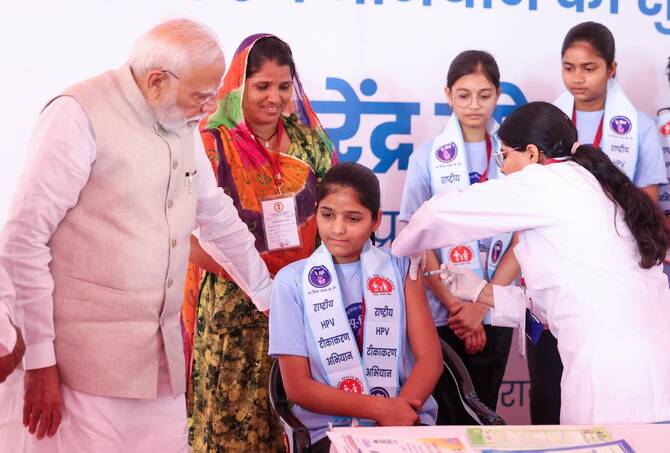
A young girl takes a shot of HPV vaccine in the presence of Prime Minister Narendra Modi in Ajmer, Rajasthan on Feb. 28, 2026. (Indian Ministry of Health)
Short Url
Updated 28 February 2026
Follow

India rolls out free HPV vaccines to combat cervical cancer

  • Nationwide HPV vaccination campaign targets 11.5 million 14-year-old girls annually
  • India records about 80,000 cervical cancer deaths, 120,000 new cases every year 

NEW DELHI: Indian Prime Minister Narendra Modi launched a free HPV vaccination drive on Saturday for young girls across India, which has the world’s highest rate of cervical cancer deaths. 

India records around 120,000 new cases of cervical cancer annually and around 80,000 deaths. It is the second-most-common cancer among women in the country. 

India has the highest number of cervical cancer deaths, followed by China and Indonesia. The number of cases in India is the second highest globally, after China. 

With cervical cancer largely preventable through HPV vaccination and regular screening, the new campaign aims to vaccinate around 11.5 million 14-year-old Indian girls annually. 

“The prime minister launched the nationwide HPV vaccination campaign … describing it as a pivotal step toward empowering India’s ‘Nari Shakti’ (women power) and ensuring the health of mothers and daughters,” Modi’s office said in a statement. 

Under the campaign, a dose of HPV vaccine will be provided free of cost at all government health centers across the country for all 14-year-old girls, said Anupriya Satel, minister of state for health and family welfare. 

“This initiative is a historic step towards protecting our adolescent girls from serious diseases like cervical cancer,” she wrote on X. 

The launch event, which took place in the northern city of Ajmer, also saw a few young girls receiving the HPV vaccine on stage.

The vaccination is a “powerful preventive step that can save lives,” according to a statement from India’s Ministry of Health and Family Welfare, which also said that HPV vaccinations can help families “secure a healthier, cancer-free future for India’s daughters.”


Most of Iranian women’s soccer team leave Australia

Updated 11 March 2026
Follow

Most of Iranian women’s soccer team leave Australia

GOLD COAST: The Iranian women’s soccer team left Australia without seven squad members after tearful protests of their departure outside Sydney Airport and frantic final efforts inside the terminal by Australian officials, who sought to ensure the women understood they were being offered asylum.

As the team’s flight time drew nearer and they passed through security late on Tuesday, each woman was taken aside to meet alone with officials who explained through interpreters that they could choose not to return to Iran.

Before the team traveled to the airport, seven women had accepted humanitarian visas allowing them to remain permanently in Australia and were ushered to a safe location by Australian police officers. 

One has since changed her mind, underscoring the tense and precarious nature of their decisions.

“In Australia, people are able to change their mind,” said Australian Home Affairs Minister Tony Burke, who had hours earlier posted photos of the seven women granted humanitarian visas to his social media accounts, their identities clearly visible.

After what Burke described as “emotional” meetings between the remaining women who reached the airport and Australian officials, the rest of the team declined offers of asylum and boarded their flight.

It was a dramatic conclusion to an episode that had gripped Australia since the Iranian team’s first game at the Asian Cup soccer tournament, when they remained silent during their national anthem.