


RIYADH: Saudi Arabia’s Ministry of Islamic Affairs, Dawah and Guidance has launched Ramadan iftar projects in a number of countries, which aim to provide meals for 1 million people during the holy month of Ramadan.
King Salman has approved an increase in funding to SR5 million ($1.3 million) for Ramadan iftar projects in 18 countries around the world.
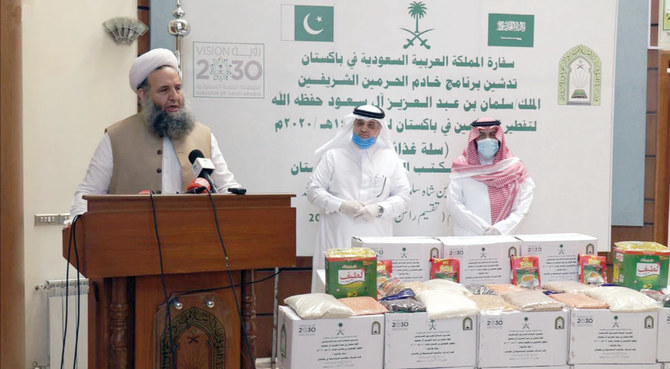
This year’s iftar project will be carried out through the distribution of food baskets in line with precautionary measures to prevent the spread of the coronavirus.
In Pakistan, Saudi Ambassador Nawaf bin Said Al-Malki and Pakistan’s Minister of Religious Affairs Noor-ul-Haq Qadri inaugurated the initiative in the capital, Islamabad.
Al-Maliki said that the program was within the framework of the support of the king in the service of Islamic action.
Qadri also thanked — on behalf of Pakistan’s Prime Minister Imran Khan, the government and its people — the king and crown prince for the support provided by the Kingdom to those in need in Pakistan.
In Jakarta, Indonesia, Saudi Ambassador Essam bin Abed Al-Thaqafi launched the iftar project, including the supply of food baskets to those fasting during the holy month.
Meanwhile, the Saudi Islamic Ministry, represented by the King Fahd Islamic Cultural Center in Buenos Aires, launched the program there.
Saudi Deputy Ambassador to Argentina Mohammed Al-Aidan said that it was part of a number of projects launched to help Muslims around the world during the holy month.
The director of the King Fahd Islamic Cultural Center, Ali bin Awadah Al-Shamrani, said that the program targeted more than 4,000 individuals by distributing 400 food baskets containing all the food requirements of families in the holy month. The center was working on distributing them according to precautionary measures to help prevent the spread of coronavirus.
The Ministry of Islamic Affairs, Dawah and Guidance, represented by the King Fahd Islamic Cultural Center in Sarajevo, launched the program in the presence of Saudi Ambassador to Bosnia and Herzegovina Hani bin Abdullah bin Mohammed Mominah.
The director of the King Fahd Cultural Center, Dr. Mohammed bin Hassan Al-Sheikh, said that given global health conditions this year, the program would be implemented through food baskets distributed to needy people in all regions of Bosnia and Herzegovina.
He indicated that the program would be implemented in the rest of the Balkan countries also covered by the program; it will be implemented in Croatia, Serbia, Macedonia, Albania, Kosovo and Montenegro, benefiting 60,000 individuals.


