RIYADH: One of the most pressing issues on people’s minds in Saudi Arabia during the coronavirus pandemic and the resulting cufews has been how to manage buying their groceries safely.
With that in mind, Arab News has compiled a list of expert recommendations on safe shopping, as well as tips on how to disinfect your groceries, and what items can and cannot be safely disinfected.
Getting groceries during curfew
The Interior Ministry recommends using a delivery app to have your groceries brought straight to you.
You can have groceries delivered directly from some supermarkets such as Danube and Panda, have them delivered via food delivery apps such as HungerStation and Carriage, or have them brought to you via a delivery service such as Mrsool and Nana Direct.
If you must get your groceries in person, residents are allowed to leave their homes between 9 a.m. and 5 p.m., as per the ministry’s new Ramadan curfew announcements.
If one is traveling by car, the ministry has imposed a two-person-per-car rule, and grocery stores are limiting the number of people who can be inside at any one time, so there might be a wait.
Shopping in person
If shopping in person, the Saudi Centers for Disease Control and Prevention (CDC) recommends that you practice social distancing even inside the supermarket, by keeping at least 6 feet away from other shoppers at all times.
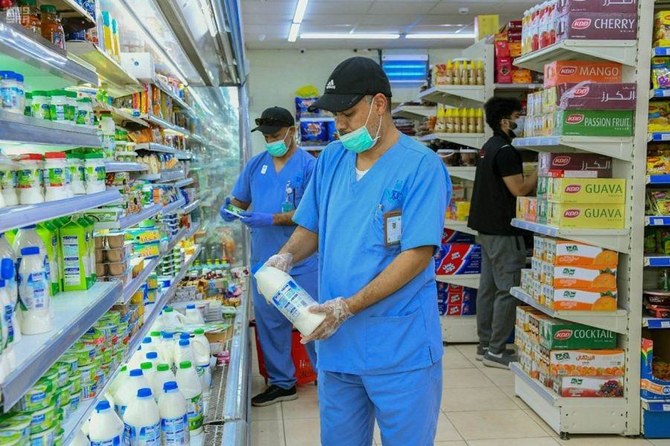
The CDC also recommends wearing a mask and gloves while you shop. Shoppers should be careful not to touch their face or phone while wearing gloves, to minimize the risk of infection.
It also recommends preparing a shopping list before going to the supermarket, and avoiding browsing, lingering and touching items you do not intend to buy. Taking exactly what you need and leaving quickly is the best way to shop in person.
Other recommendations include ignoring your phone while you shop, so as not to touch it with your gloved hands that can contaminate the device; using a cashless payment method to avoid touching money physically; and disinfecting your car boot as soon as you get home with the groceries.
Disinfecting groceries at home
Dr. Haya Zedan, an assistant professor of public health, described how she disinfects her groceries.
“My husband goes once a week to do the shopping, and when he comes back he leaves the groceries for me by the kitchen door,” she told Arab News.
“We’ve designated a specific countertop for grocery items, which is regularly disinfected after use.”
Zedan recommends discarding plastic bags and exterior packaging if possible. “We leave the plastic bags outside the house and throw them away immediately,” she said.
“Anything with packaging that can be thrown away, like boxes that contain smaller milk boxes or water bottles, we also discard.”
For packaging that cannot be discarded, such as plastic bags of pasta or glass bottles of juice, Zedan wipes it down with Clorox wipes or a designated towel sprayed with disinfectant, and leaves them to air dry. “Don’t forget to disinfect the sink afterward,” she said.
Fruit and vegetables should never be sprayed with bleach or disinfectant, but can safely be washed and scrubbed with regular soap and water.
“However, I recommend buying in small quantities because washed fruit and vegetables spoil faster,” she said.
Eggs can be carefully washed with normal soap and water, a few at a time to avoid cracking the shells.
Zedan said many might see her actions as over the top, but she would rather be safe than sorry.
“Aside from the fact that I have kids at home, a lot of why I’m overly careful with my groceries is for psychological reasons,” she added.
“It’s a scary time for everyone. Being able to ensure myself that everything is up to my own safety standards makes me feel like I have control over something.”


![]()

How to safely buy groceries in Saudi Arabia during the coronavirus pandemic
Short Url
https://arab.news/v5n68
How to safely buy groceries in Saudi Arabia during the coronavirus pandemic
- You can have groceries delivered directly from some supermarkets such as Danube and Panda
- The CDC recommends wearing a mask and gloves while you shop


Latest updates


Recommended


© 2026 SAUDI RESEARCH & PUBLISHING COMPANY, All Rights Reserved And subject to Terms of Use Agreement.