

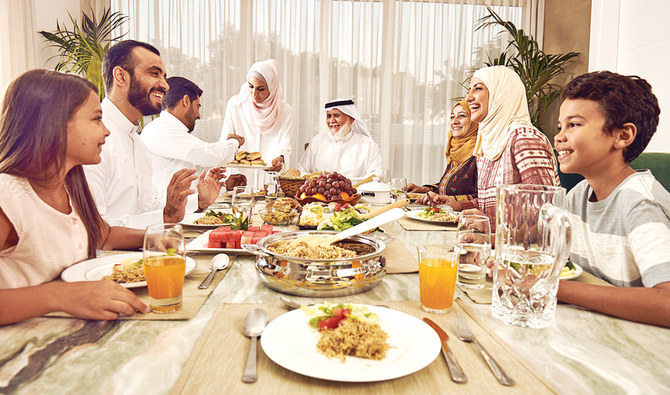

JEDDAH: With the first day of Ramadan over, many families found it difficult going without their social gatherings and not partaking in their traditions because of strict rules on social distancing amid the lockdown.
Every year, Saudis welcome the month of Ramadan with anticipation as the beauty of the month and its blessings inspire worshippers across the country and the Muslim world to perform acts of kindness, spread joy and be charitable. With the coronavirus disease (COVID-19) outbreak, almost all this has been stopped.
Um Mohammed, a resident of Jeddah, usually prepares a feast for iftar (breaking of the fast) on the first day of Ramadan for the whole family. She thinks about all her grandchildren’s preferences, prepares the different drinks early, and sets out a colorful variety of dishes covering the table from one end to the other.
This year though, as she spent her home isolation with her son and his family, it was difficult for Um Mohammed to accept the fact that she would not be seeing her family members and share a meal.
“For years, I’ve had my family for iftar on the first day, as well as good friends of the family. For some time, as the grandchildren got older and traveled to pursue their degrees abroad, the gatherings became smaller,” she said. “In recent years, they came back and I had them all under my roof and what a joy it was. Though it’s not a rare occasion in our household, Ramadan is special and my heart soars seeing how all my children and grandchildren are together again. This year is different and is extremely difficult, I finally have everyone here in Saudi and now with the coronavirus pandemic, it’s painful not having them over.”
“In all my years, I have never been in such a situation. I have lived through troubled times in Egypt, the Gulf War, my kids traveling for their own university degrees, my grandchildren too, and so much more, but this … this time it’s different and I can’t believe that we’re in isolation this way,” she said. “I understand it’s important to self-isolate, it’s necessary and naturally we’re all being careful as we want this pandemic to be over with and live our normal lives peacefully. Coronavirus has stolen our traditions, it is very surreal.”
Um Mohammed is not alone. Expats and Saudis alike have tried to keep their morale up as they spent the first day of the blessed month alone or with their immediate family. As many decorate their living rooms with lanterns and lights and delicious smells waft from the kitchens the fact remains that this Ramadan is one that “stole our traditions.”
Aya Alzubi, a Syrian-American resident in Saudi Arabia, misses her cousins with whom she usually spent her Ramadan. “What I miss most this Ramadan is being able to pray Taraweeh at the mosque and gathering with our families after iftar. We have a tradition in our family that we spend Ramadan together.”
Alzubi said that even if she were not meeting them after iftar they would catch up during Taraweeh. “Other than that I usually have the cousins that are my age spending a week or two at our house, staying up all night together, making sahoor (last meal) and iftar together,” she said.
Many friends and families take the time to greet one another and send the month’s blessings via text message, but the use of videocalling applications have surged in the past couple of weeks and many families communicated through various apps to see how their iftar was and catch up on a rather somber day.
“Sadly, it is never the same as actually seeing their lovely faces shine brightly during this holy month,” she said.
On a positive note, Alzubi suggested that this lockdown can also help make this Ramadan more fruitful. As she said: “We can spend this time trying to break our bad habits and form new better ones.”
Born and raised in Saudi Arabia, Ranum Ali recently moved to Pakistan for further studies and she is spending her first Ramadan away from her family. Despite the separation, Ali decided to decorate her house in Pakistan the same way she would decorate it in Jeddah.
“I put up little lights, some candles, and used bukhoor to make my house smell like home. Video calls and text messages are the only things that are keeping me in touch with them. I never thought I would appreciate small things like these so much.”
She drew a sentimental picture of all the things she will miss during this Ramadan, “Just being around my family, doing everything together. From helping Amma (my aunt) in the kitchen to fighting with my little sister over who will do the dishes, reading the Qur’an and listening to lectures with my father. For me, these were the things that had the essence of Ramadan.”
Fahd Naseem, who is currently quarantined with his family in Jeddah, said that he was lucky to be quarantined with his family. “Since we are all together it isn’t as sad for me as it is for some other people. One thing I did miss was going to Makkah and praying our first Taraweeh there, which is something we have been doing every year,” he said.
“The women in my house even walk into the room and greet each other as if they are meeting each other in a mosque,” he added jokingly.


