

Trump vows to rescue US oil amid further crude market turmoil

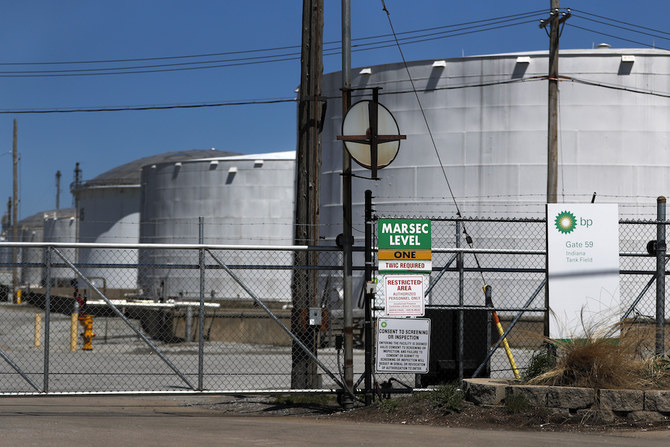
Petroleum storage tanks at the BP Indiana Tank Field. A global oversupply, reduced demand and lack of storage space lead to further turmoil on global crude markets Tuesday. (AP)
Short Url
Updated 22 April 2020
Follow

Trump vows to rescue US oil amid further crude market turmoil

  • President pledges funds to save industry jobs
  • OPEC talks amid convulsions in market

DUBAI: US President Donald Trump vowed on Tuesday to save the US oil industry and OPEC producers held “virtual” crisis talks amid continued convulsions on global crude markets.

As OPEC leaders tried to chart a way forward, Saudi Arabia pledged every effort to restore stability. “The Kingdom continues to closely monitor the situation in the oil markets and is prepare to take any additional measures in cooperation with OPEC+ and other producers,” a spokesman said.

Oil markets endured another day of record-setting declines after Monday’s “wipeout” of American oil. Brent crude, the Middle East benchmark, plunged to as low as $17.50 a barrel, the lowest level for two decades, before recovering to about $24.

*********

READ MORE: 

Has coronavirus ended the era of American oil dominance?

Focus: Oil, WTI’S moment of truth

All eyes on next month as US braces for oil-crash fallout

*********

West Texas Intermediate, the American standard savaged by markets on Monday when it traded at a $40 negative price for May delivery, climbed back into positive territory at just over $10 a barrel. Worryingly for US producers, however, WTI for June delivery fell by 43 percent to $11.50 a barrel.

Sources in the Saudi oil industry played down suggestions that OPEC would discuss further cuts on top of the historic reductions just over a week ago, but those may be implemented earlier than May, when they were scheduled.

Russia — the other key partner to the cuts package agreed by OPEC+ — did not take part in Tuesday’s talks,and Energy Minister Alexander Novak said there was “no need to dramatize” the American oil fall.

Trump said the US government would help American oil companies threatened with bankruptcy by the dramatic collapse of WTI. “We will never let the great US oil and gas industry down,” he said.

Opinion

This section contains relevant reference points, placed in (Opinion field)

“I have asked the secretary for energy and the secretary to the treasury to formulate a plan which will make funds available so that these very important companies and jobs will be secured long into the future.”

Monday’s collapse of WTI, sparked by the ending of a monthly contract and a lack of storage, was still being chewed over by energy experts.

“Some may dismiss Monday’s fall into negative WTI prices as a quirk of the futures market on the last day before a contract ended,” said Jim Burkhard, vice president and head of oil markets at IHS Markit consultancy. “But the fact that prices went this low at all reflects brutal market forces that will not disappear with the expiration of a single monthly contract.”

About 30 per cent of global oil demand has evaporated in the past month as big economies have locked down under the impact of the COVID-19 pandemic.

A Saudi energy official downplayed reports that a “flotilla” of super tankers was at sea heading to the US with a cargo of 50 million barrels of crude for delivery next month. The Kingdom had so far this month supplied only a relatively small amount of crude to US destinations, including the Motiva refinery in Texas, the official said.


Future Minerals Forum launches global index to track critical mineral supply chains 

Updated 29 sec ago
Follow

Future Minerals Forum launches global index to track critical mineral supply chains 

RIYADH: The Future Minerals Forum on Jan. 12 launched the “Future Minerals Index Report,” a first-of-its-kind global tool designed to measure and track progress in developing critical mineral value chains across producing, exporting, and consuming countries.  

The initiative aims to support the creation of more resilient and responsible supply chains and promote sustainable development worldwide.  

Khalid Al-Mudaifer, vice minister of industry and mineral resources for mining affairs, stated: “The Future Minerals Index Report is an unprecedented and essential document; it is an intellectual tool that highlights key trends in the mining and minerals sector, particularly in terms of insights and directions from sector stakeholders, including government leaders, global mining executives, experts, and interested parties.”   

He pointed out that the report is distinguished by its tracking of developments in mineral supplies and its provision of actionable recommendations to ensure the sustainable development of critical mineral value chains. 

Al-Mudaifer described the report as a new international benchmark that establishes a comprehensive baseline to measure the progress of governments, companies, and investors in enhancing more resilient and responsible mineral supply chains.   

He said it provides a clear picture of how global critical mineral markets are shaped by capital, risk, and trust dynamics. “It shows where investment is growing or shrinking and identifies the widening gap between resource availability and capital allocation. Based on this baseline, the report will monitor changes in risk perceptions, investment flows, and progress toward more resilient mineral value chains.”  

Ali Al-Mutairi, general supervisor of the Future Minerals Forum, emphasized the report’s importance and the attention it received at the forum due to its role in highlighting global trends in the mining sector.   

He explained that the report was prepared in partnership with McKinsey & Co. and in collaboration with other sector experts, including S&P Global Market Intelligence, Global AI, and GlobeScan.  

“It integrates stakeholder trends, data, market insights, and intelligence into a single reference that supports global mining and mineral sector decision-making,” he said.  

Jeffrey Lorsch, partner at McKinsey & Co., commented: “The Future Minerals Index Report, by integrating market data, stakeholder perspectives, and value chain standards, provides a strategic roadmap to help companies navigate volatility and unlock long-term growth opportunities.”  

The report is based on the “Future Minerals Framework,” developed with contributions from 47 experts across multilateral organizations, non-profits, and private companies. It was first introduced at the 2025 International Ministerial Meeting.   

The framework outlines key enablers for end-to-end value chains, including supportive policies and regulations, innovative financing solutions to secure and manage investments, multimodal infrastructure such as roads, railways, and ports to reduce costs and increase viability, and sustainability through strong environmental and social governance frameworks.   

It also includes talent development through education, training, R&D, technological modernization via updated geological data systems and global expertise partnerships, and geology through reliable, accessible geological data in producing, exporting, and consuming countries as a critical factor in attracting investment.  

The report highlighted the world’s urgent need to sustain mineral supplies, featuring contributions from leading industry figures.  

Robert Friedland, founder of Ivanhoe Mines, Ivanhoe Electric, and I-Pulse, stated that the electrification of energy systems, digitalization of the economy, and the rapid growth of artificial intelligence are converging toward a future that increasingly depends on minerals.   

He stressed: “You can’t reduce emissions, build computing systems, or transport energy without mining.”  

Bob Wilt, CEO of Ma’aden, said in the report: “We are not fully prepared to deliver the minerals the world needs. Our biggest challenges are not equipment, capital, or technology — but people.”  

Duncan Wanblad, CEO of Anglo American, noted that global copper demand is expected to grow by 75 percent to reach 56 million tonnes annually by 2050. To meet this demand and offset declines from aging mines, the sector will need to open approximately 60 new mines the size of Quellaveco within the next decade alone.  

Gustavo Pimenta, CEO of Vale, said in his contribution: “I can’t imagine a future without mining — at least not a sustainable one that balances economic development with environmental protection and social responsibility. Mining has become essential to everything.”  

The release of the Future Minerals Index Report coincides with the upcoming fifth edition of the Future Minerals Forum, being held from Jan. 13 to 15, 2026, in Riyadh under the patronage of the Custodian of the Two Holy Mosques, King Salman bin Abdulaziz Al Saud. The event is held under the theme “Minerals: Facing the Challenges of a New Era of Development.”  

The forum will host a wide range of ministers and CEOs from leading global mining companies, reflecting its stature as a global platform in the mining sector and a key event showcasing Saudi Arabia’s leadership in shaping the future of minerals regionally and internationally.