

Canada’s Trudeau warns virus restrictions could last weeks, months

1 / 5
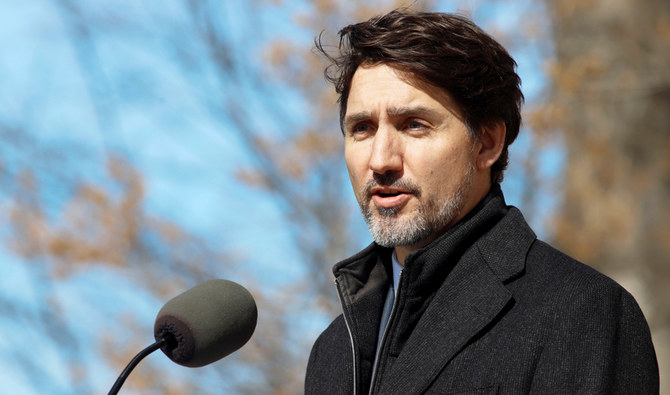
Canada's Prime Minister Justin Trudeau speaks to the media outside his home in Ottawa, Ontario, Canada March 16, 2020. (REUTERS)
2 / 5
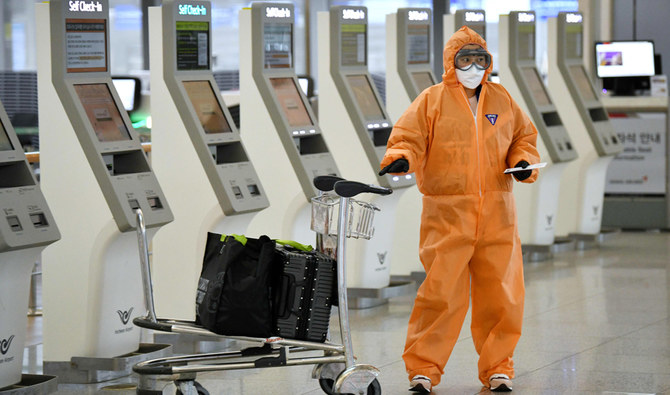
A passenger wearing protective clothing against the COVID-19 coronavirus uses a self check-in machine at Incheon international airport, west of Seoul, on March 17, 2020. (AFP)
3 / 5
A shopper walks through an aisle empty of pasta, rice, beans and soup, amid an atmosphere of growing numbers of coronavirus cases, at a Loblaws supermarket in Toronto, Ontario, Canada March 14, 2020. (REUTERS)
4 / 5
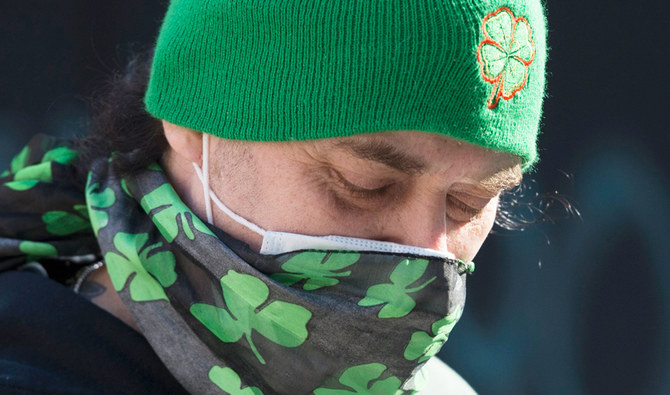
A man wears a mask and a hat with an Irish symbol of shamrock designs as he walks in downtown Vancouver, British Columbia, Tuesday, March 17, 2020. (AP)
5 / 5
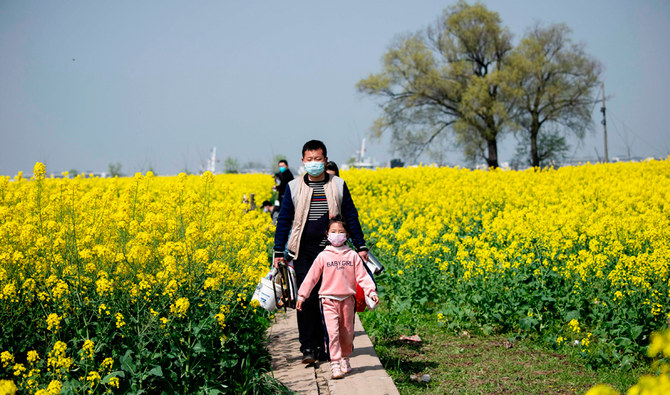
People wearing face masks walk along rapeseed farm where canola oil is taken in Jiujiang, Chinaís central Jiangxi province on March 14, 2020. (AFP)
Short Url
Updated 18 March 2020
Follow

Canada’s Trudeau warns virus restrictions could last weeks, months

  • The Emergency Measures Act has only been used once since the two World Wars

OTTAWA: Prime Minister Justin Trudeau on Tuesday urged Canadians to hunker down for possibly weeks or months of business closures and home-stay to prevent the spread of new coronavirus.
He said his government was preparing to roll out a new package of financial supports — worth Can$25 billion ($18 billion), according to public broadcaster CBC — to ease the burden on Canadians and their businesses.
His government is also considering using the Emergency Measures Act, an extremely rare measure.
“We don’t know exactly how long this is going to take,” Trudeau said of the health crisis.
“It could be weeks. It could be months,” he told a news conference outside his residence where he and his family are self-isolating after his wife Sophie tested positive for the COVID-19 illness.
“But we will be there, standing together to support Canadians in order to get through this extremely difficult time.”
According to public health officials, the number of cases in Canada has risen to nearly 600, including eight deaths. The latest fatalities, one in Ontario province and three in British Columbia, were recorded on Tuesday.
The Emergency Measures Act has only been used once since the two World Wars. It would allow the government to suspend civil liberties and impose restrictions on the movement of people and goods — which so far have been mostly voluntary.
Deputy Prime Minister Chrystia Freeland said turning to emergency measures would be a “last resort.”
“It’s a very serious step, which grants extraordinary powers to the federal government,” she acknowledged. “We would never introduce it without careful consultation.”

During the First and Second World Wars, it was used to intern thousands of recent immigrants labeled “enemy aliens.”
It was last used when it was still known as the War Measures Act and Trudeau’s father, then-prime minister Pierre Trudeau, invoked it to deploy soldiers during the 1970 October Crisis in Quebec province after the kidnappings of British and Quebec officials by the Front de Liberation du Quebec.
On Monday, Canada closed its border to most foreigners except Americans.
Airlines were ordered not to allow passengers with flu-like symptoms to board, while all inbound international flights will be redirected to airports in Montreal, Toronto, Calgary and Vancouver, where public health screenings will be stepped up.
On Tuesday WestJet, Canada’s second largest airline, announced it was suspending international flights, after flagship carrier Air Canada said it would soon halve its number of foreign flights.
Public broadcaster CBC said the aid package would be disbursed through existing programs such as employment insurance and a child tax benefit. The broadcaster cited an unnamed government official as saying: “People need rent money and groceries. Businesses need to bridge to better times.”
“As much as possible, stay home,” Trudeau urged on Tuesday. “Don’t go out unless you absolutely have to. Work remotely if you can. Let the kids run around a bit in the house.”
With young people not getting the message, Quebec province on Tuesday enlisted the help of artists and athletes including Samuel Piette, a player with Montreal Impact of Major League Soccer.
“This is not the time to have parties,” Quebec Premier Francois Legault said.


DR Congo city residents forced to adapt during year of M23 rule

Updated 58 min 29 sec ago
Follow

DR Congo city residents forced to adapt during year of M23 rule

  • Around one million Goma residents were holed up in their homes on Jan. 26, 2025, when the Congolese army and its allies were forced to pull out of the provincial capital

GOMA, DR Congo: They were caught under a barrage of fire and became trapped with “nowhere to go” after their city in the eastern Democratic Republic of Congo fell under the M23 armed group’s control a year ago.
Around one million Goma residents were holed up in their homes on January 26, 2025, when the Congolese army and its allies were forced to pull out of the provincial capital.
Hundreds of Rwandan soldiers had just poured across the border to fight alongside the M23 in a lightning offensive to seize the lakeside city.
Thousands of people were killed in the intense clashes.
Janvier Kamundu, whose name has been changed for security reasons, was sheltering from the fighting at home with his wife and children.
“Suddenly I heard my wife cry out. She fell, hit by a stray bullet,” he recalled.
Neighbors braved the gunfire to come and help, and a vehicle was found to transport his wife to hospital, ultimately saving her life.
Hospitals were overwhelmed with the wounded and bodies covered in white bags piled up at the morgues.
“She is slowly recovering, but it isn’t easy — she has a lot of wounds around her stomach,” Kamundu said.
Oppressive quiet
A year on, Goma residents endure “constant oppression” by the M23 group, government spokesman Patrick Muyaya said.
In the weeks that followed its capture, the streets emptied out at nightfall and the buzz evaporated from the bars that had once offered some respite in a region scarred by three decades of conflict.
Escaped prisoners, militia fighters and soldiers who had evaded capture roamed the city after dark, breaking into homes and threatening residents.
With the police and court system no longer functioning, the M23 eventually began to systematically cordon off neighborhoods in search of criminals.
By late May, several hundred men were sitting on the dark volcanic gravel covering the streets of Murambi village on Goma’s northern outskirts, watched over by members of the M23.
Local leaders and families are ordered to identify those they recognize as upstanding citizens. The others are detained.
Rough justice
But on the street, anyone deemed suspicious looking drew the M23’s ire.
People spoke of those who had been hauled off to the city sports stadium serving as an open-air prison for wearing dirty clothes or having an untidy beard.
An M23 spokesman invited reporters on several occasions to view the results of the operation — detainees separated into categories.
Desperate families crowded at the entrance, pleading to get their relatives released.
Those not cleared by testimony deemed reliable ended up at secret detention sites. NGO reports denounced torture and summary executions.
But, in time, residents and observers agreed that Goma’s streets were returning to relative safety.
With no independent justice system in place, opponents of the M23 faced repression, some accused of being in cahoots with the pro-government militia.
In October, the armed group — whose declared aim is to overthrow the government and end corruption — began appointing magistrates, but observers indicated there was little impartiality.
Despite parallel peace efforts backed by the United States and Qatar, the M23 launched a new offensive on the strategic town of Uvira near the Burundi border in December.
“These events have shown that the Rwandan president is not at all comfortable with peace processes,” Muyaya, the government spokesman, said.
‘Ideological training’
Most civil society representatives and rights campaigners had fled Goma before the M23 entered.
Civilians and former government combatants were forcibly recruited by the M23, which announced it had 7,000 new members in its ranks in September.
At the same time, the group began to impose taxes to finance its war effort but the city, already on its knees, has had no functioning banks for a year after the government ordered their closure to cut off the rebellion’s funding.
The airport remains inaccessible and trade between Goma and areas under government control has dwindled.
Civil servants were among the first to feel the blow of such cuts.
“There were about 200 agents here; around 20 left to work” in government-held areas, urban planning officer Claude Mumbere said.
“The others are here doing nothing,” added the officer, whose name has also been modified for security reasons.
Some had to undergo “ideological training” provided by the M23.
Mother-of-three Madeleine Mubuto’s husband lost his job.
“We had set aside a small amount of money at home that helped us at first, but after a year almost all of it is used up,” she said.
In the absence of cash, Rwanda’s currency is now used at Goma’s markets.
“Many are wondering how long this situation is going to last,” Kamundu said, adding: “We adapt because we have nowhere to go.”