


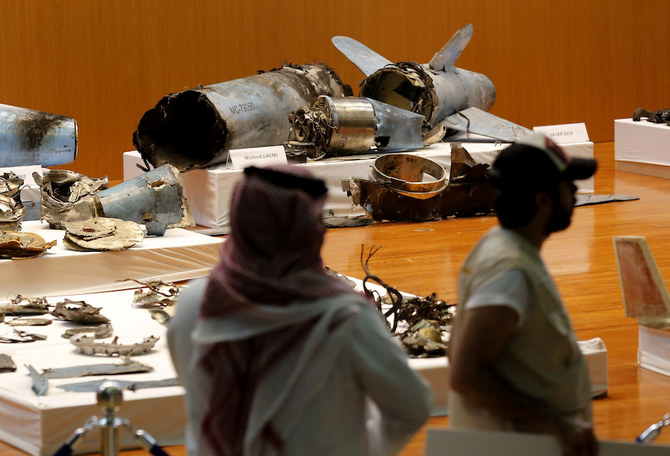

LONDON: A report by Conflict Armament Research (CAR) has linked the drones that targeted Saudi oilfields in September and Houthi drones in Yemen to Iranian drones recovered in Iraq and Afghanistan.
Analysis from CAR linked the unmanned aerial vehicles (UAVs) through a small instrument found in both devices.
The report, titled “Evolution of UAVs employed by Houthi forces in Yemen,” is based on field investigations by CAR teams that carried out physical analysis on nine UAVs and one engine recovered by the UAE’s Presidential Guard forces.
They were compared with Houthi bombs seized from the Iran-backed militia in Yemen and militants in Bahrain, as well as two varieties of Iranian UAVs.
Opinion
This section contains relevant reference points, placed in (Opinion field)
By comparing the recovered items, CAR discovered that a significant number of Houthi UAV components were identical or similar to improvised explosive device (IED) parts recovered in Yemen.
The report finds that matching components either originated in Iran or are linked to Tehran-backed supply networks active in the region.
Investigators also found that Houthi UAVs had components that were identical to Iranian-manufactured equipment.
CAR found a gyroscope in a Houthi drone that shared an almost-exact serial number to a gyroscope recovered from an Iranian-made UAV picked up by Daesh militants.

In this February 2017 photograph provided by Conflict Armament Research, a gyroscope recovered from a Qasef-1 drone is displayed in Abu Dhabi, United Arab Emirates. Such gyroscopes, a small instrument within drones that targeted the heart of Saudi Arabia's oil industry and those in the arsenal of Yemen's Houthi rebels, match components recovered in downed Iranian drones in Afghanistan and Iraq, two reports said. (AP/ File photo)
The gyroscopes are believed to be the same make as those found on drones that attacked Saudi Aramco oilfields.
A UN Security Council resolution prohibits arms transfers to the Houthis. Arab News contacted Iran’s mission to the UN for comment, but it did not respond.
A materiel and personnel exploitation expert, speaking on condition of anonymity, told Arab News that CAR’s findings make it “almost certain that Iran was involved in the attack on Saudi oilfields.”
The expert added: “CAR’s work is similar to counterterror bomb analysis. Governments use these techniques to find the source of a threat and neutralize it. It’s highly reliable and very rarely produces false links.”
Jonah Leff, CAR’s director of operations, said the increased sophistication of drones deployed by the Houthis allowed them to use UAVs “over longer distances and with greater explosive payloads.”
He added that analysis of Houthi drone components and other lethal items points to Iran as the “likely benefactor in their supply.”
UN: Houthis impeding humanitarian aid
Meanwhile, the US has threatened to cut aid to Houthi-held areas in Yemen amid UN claims that the militia is impeding the supply of medicines and food.
Documents obtained by the Associated Press reveal that the Houthis are only granting access to the UN on condition of a range of measures that aid agencies are rejecting because it would give the militia the ability to choose who gives aid, which could be exploited for terrorism.
A senior UN official said on condition of anonymity that the Houthis’ obstruction has hindered several programs that feed the near-starving population and protect displaced Yemenis.

Houthi rebels in Yemen have blocked half of the United Nations’ aid delivery programs in the war-torn country — a strong-arm tactic to force the agency to give them greater control over the massive humanitarian campaign, along with a cut of billions of dollars in foreign assistance. (AP)
Nutritional supplements have been denied to nearly 300,000 pregnant and nursing mothers and children aged 5 or under for six months.
Another UN official said this was because the Houthis “held beneficiaries hostage” to a demand that the UN gives the militia a 2 percent cut of its aid package.
On Tuesday, Washington’s envoy to the UN said the Houthis’ attempt to tax the UN and hinder aid projects could see the US cancel its funding to Sanaa and northern areas under the militia’s control.
Washington is “extremely concerned by mounting Houthi interference with the work of aid partners in northern Yemen, which limits the ability of the UN and other humanitarian organizations to deliver assistance to the most vulnerable Yemenis,” Kelly Craft said.


