

US investigation into Saudi Aramco attack says strikes came from north, ‘likely Iran’

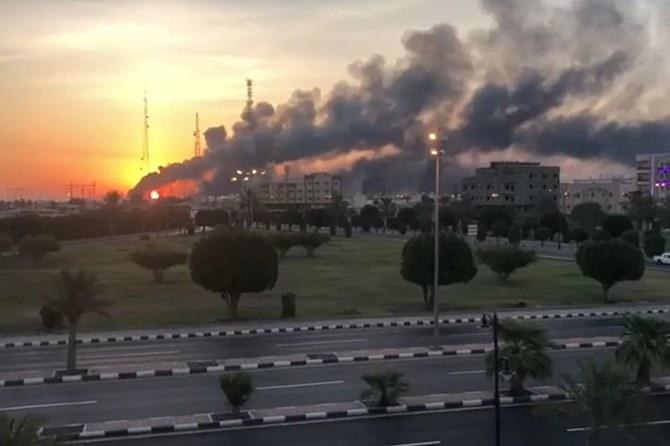
US said new evidence and analysis of weapons debris recovered from an attack on Saudi Aramco oil facilities on Sept. 14 indicates the strike likely came from the north - suggesting it was likely from Iran. (Screenshot/AFP)
Short Url
Updated 19 December 2019
Follow

US investigation into Saudi Aramco attack says strikes came from north, ‘likely Iran’

  • Report: US identified several similarities between drones used in attack and Iranian unmanned aircraft
  • 17-minute strike by 18 drones and three low-flying missiles caused a spike in oil prices

WASHINGTON: The US said new evidence and analysis of weapons debris recovered from an attack on Saudi Aramco oil facilities on Sept. 14 indicates the strike likely came from the north, reinforcing its earlier assessment that Iran was behind the offensive.
In an interim report of its investigation — seen by Reuters ahead of a presentation on Thursday to the UN Security Council — Washington assessed that before hitting its targets, one of the drones traversed a location approximately 200 km (124 miles) to the northwest of the attack site.
“This, in combination with the assessed 900 kilometer maximum range of the Unmanned Aerial Vehicle (UAV), indicates with high likelihood that the attack originated north of Abqaiq,” the interim report said, referring to the location of one of the Saudi Aramco oil facilities that were hit.


The rebirth of AlUla
Hegra, ancient city of the Nabataeans in Saudi Arabia’s historic AlUla Valley, is emerging from the mists of time to take its rightful place as one of the wonders of the world

Enter


keywords

It added the US had identified several similarities between the drones used in the raid and an Iranian designed and produced unmanned aircraft known as the IRN-05 UAV.
However, the report noted that the analysis of the weapons debris did not definitely reveal the origin of the strike that initially knocked out half of Saudi Arabia’s oil production.
“At this time, the US Intelligence Community has not identified any information from the recovered weapon systems used in the 14 September attacks on Saudi Arabia that definitively reveals an attack origin,” it said.
The new findings include freshly declassified information, a State Department official told Reuters.
The United States, European powers and Saudi Arabia blamed the Sept. 14 attack on Iran. Yemen’s Houthi militias claimed responsibility for the attacks, while Iran, which supports the Houthis, denied any involvement.
Reuters reported last month that Iran’s leadership approved the attacks but decided to stop short of a direct confrontation that could trigger a devastating US response. It opted instead to hit the Abqaiq and the Khurais oil plants in Saudi Arabia, according to three officials familiar with the meetings and a fourth close to Iran’s decision making.
According to the Reuters report a Middle East source, who was briefed by a country investigating the attack, said the launch site was the Ahvaz air base in southwest Iran, which is about 650 km north of Abqaiq.
Some of the craft flew over Iraq and Kuwait en route to the attack, according to a Western intelligence source cited by the report, giving Iran plausible deniability.
The 17-minute strike by 18 drones and three low-flying missiles caused a spike in oil prices, fires and damage and shut down more than 5% of global oil supply. Saudi Arabia said on Oct. 3 that it had fully restored oil output.
The US will present its findings to a closed-door session of the UN Security Council as it hopes to mobilize more support for its policy to isolate Iran and force it to the negotiating table for a new nuclear deal.
The report noted that Yemen’s Houthis “have not shown to be in possession, nor been assessed to be in possession” of the type of drones used in the attacks on the Aramco facilities.
Washington’s interim assessment also included several pictures of drone components including the engine identified by the United States as “closely resembling” or “nearly identical” to those that have been observed on other Iranian unmanned aerial vehicles.
It also provided pictures of a compass circuit board that was recovered from the attack with a marking that is likely indicating a potential manufacturing date written in the Persian calendar year, the report assessed.
The name of a company believed to be associated with Iran, SADRA, was also identified on a wiring harness label from the Sept. 14 wreckage, the report said.
US President Donald Trump last year withdrew from a 2015 nuclear deal between world powers and Iran and snapped back sanctions on Tehran with the aim of choking Iranian crude sales, the Islamic Republic’s main source of revenues.
As part of its ‘maximum pressure’ campaign, Washington has also sanctioned dozens of Iranian entities, companies and individuals in a bid to cut of Tehran’s revenue streams.


The rebirth of AlUla
Hegra, ancient city of the Nabataeans in Saudi Arabia’s historic AlUla Valley, is emerging from the mists of time to take its rightful place as one of the wonders of the world

Enter


keywords


Tunisia’s famed blue-and-white village threatened after record rains

Updated 57 min 37 sec ago
Follow

Tunisia’s famed blue-and-white village threatened after record rains

  • The one-time home of French philosopher Michel Foucault and writer Andre Gide, the village is protected under Tunisian preservation law, pending a UNESCO decision on its bid for World Heritage status

SIDI BOU SAID, Tunisia: Perched on a hill overlooking Carthage, Tunisia’s famed blue-and-white village of Sidi Bou Said now faces the threat of landslides, after record rainfall tore through parts of its slopes.
Last week, Tunisia saw its heaviest downpour in more than 70 years. The storm killed at least five people, with others still missing.
Narrow streets of this village north of Tunis — famed for its pink bougainvillea and studded wooden doors — were cut off by fallen trees, rocks and thick clay. Even more worryingly for residents, parts of the hillside have broken loose.
“The situation is delicate” and “requires urgent intervention,” Mounir Riabi, the regional director of civil defense in Tunis, recently told AFP.
“Some homes are threatened by imminent danger,” he said.
Authorities have banned heavy vehicles from driving into the village and ordered some businesses and institutions to close, such as the Ennejma Ezzahra museum.

- Scared -

Fifty-year-old Maya, who did not give her full name, said she was forced to leave her century-old family villa after the storm.
“Everything happened very fast,” she recalled. “I was with my mother and, suddenly, extremely violent torrents poured down.”
“I saw a mass of mud rushing toward the house, then the electricity cut off. I was really scared.”
Her Moorish-style villa sustained significant damage.
One worker on site, Said Ben Farhat, said waterlogged earth sliding from the hillside destroyed part of a kitchen wall.
“Another rainstorm and it will be a catastrophe,” he said.
Shop owners said the ban on heavy vehicles was another blow to their businesses, as they usually rely on tourist buses to bring in traffic.
When President Kais Saied visited the village on Wednesday, vendors were heard shouting: “We want to work.”
One trader, Mohamed Fedi, told AFP afterwards there were “no more customers.”
“We have closed shop,” he said, adding that the shops provide a livelihood to some 200 families.

- Highly unstable -

Beyond its famous architecture, the village also bears historical and spiritual significance.
The village was named after a 12th-century Sufi saint, Abu Said Al-Baji, who had established a religious center there. His shrine still sits atop the hill.
The one-time home of French philosopher Michel Foucault and writer Andre Gide, the village is protected under Tunisian preservation law, pending a UNESCO decision on its bid for World Heritage status.
Experts say solutions to help preserve Sidi Bou Said could include restricting new development, building more retaining walls and improving drainage to prevent runoff from accumulating.
Chokri Yaich, a geologist speaking to Tunisian radio Mosaique FM, said climate change has made protecting the hill increasingly urgent, warning of more storms like last week’s.
The hill’s clay-rich soil loses up to two thirds of its cohesion when saturated with water, making it highly unstable, Yaich explained.
He also pointed to marine erosion and the growing weight of urbanization, saying that construction had increased by about 40 percent over the past three decades.
For now, authorities have yet to announce a protection plan, leaving home and shop owners anxious, as the weather remains unpredictable.