

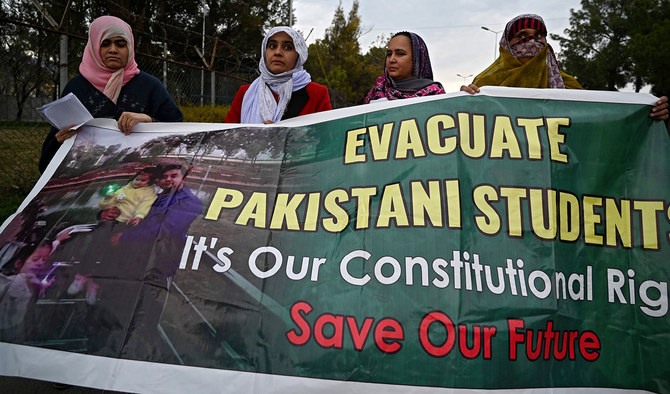

ISLAMABAD: Parents of Pakistani students in China gave a three-day ultimatum to the government on Wednesday to evacuate their loved ones from the coronavirus-hit country, warning to protest outside government offices in case the authorities failed to fulfill their demand.
The enraged parents heckled government functionaries at a meeting in Islamabad after the officials refused to evacuate students from China’s Wuhan city, the epicenter of the viral outbreak.
“We want the government to immediately evacuate our children from Wuhan. We don’t want to listen to their lame excuses anymore,” Muhammad Ashfaq, father of a student of medical sciences at the Wuhan University of Science and Technology, told Arab News.
About 500 parents gathered at a government-designated venue in Islamabad where Special Assistant to Prime Minister Imran Khan on Overseas Pakistanis Zulfiqar Bukhari and State Minister for National Health Services Dr. Zafar Mirza were scheduled to brief them about the well-being of their children stuck in China.
The worried parents and relatives of children asked the officials to bring the Pakistani students back to their country as soon as possible. They chanted slogans and booed the ministers off.
“We are giving them [the government] a three-day ultimatum to devise an evacuation plan,” Ashfaq said. “Otherwise, we will be left with no option but to stage sit-ins in front of government offices.”
Around 1,100 Pakistani students have been stranded in Hubei province, with the majority based in Wuhan, since the lockdown was enforced on Jan. 23. A total of 28,000 Pakistani students are enrolled in different Chinese universities, according to the foreign office.
“We are working very closely with your government to stop this virus from spreading here, and right now we are also looking after your community in China on a daily basis,” said the Chinese Ambassador to Pakistan, Yao Jing, while talking to Arab News. “We have to look after their concerns and tend to their difficulties for the time being. So far, you had six patients that have been confirmed but all of them have been cured and released.”
He added: “We are combating [the epidemic] in a very hard way and right now indications have shown that things are moving in the positive direction. At least we have less and less increased numbers of those confirmed and suspects [infected].”
However, the death toll from the coronavirus reached 2,004 on Wednesday while it has infected more than 75,000 people, with over 1,000 cases outside mainland China. No case of the virus has so far been confirmed in Pakistan, though it shares border with China.
The mounting death toll has raised concerns, with many students from Wuhan and their parents in Pakistan pleading with the authorities for weeks to get an evacuation started in the locked down areas.
After the viral outbreak, more than 20 countries moved to evacuate their citizens from China. But Pakistan’s government has refused to fly their nationals back from the quarantined cities in a bid to avoid the spread of virus.
“The government is consistently looking into the matter as to how we can protect our nationals in China from contracting the virus,” Dr. Zafar Mirza told the concerned parents at the briefing.
However, he plainly refused to evacuate the students from Wuhan city. “We will fly them back home at an appropriate time …. at this stage, it isn’t beneficial at all to evacuate them,” he said.
Mirza said the government was well aware of the parents’ concerns, but there are “host of reasons” for not bringing Pakistanis students back home.


