

Thai parliamentarian cherishes his roots in small Pakistani town

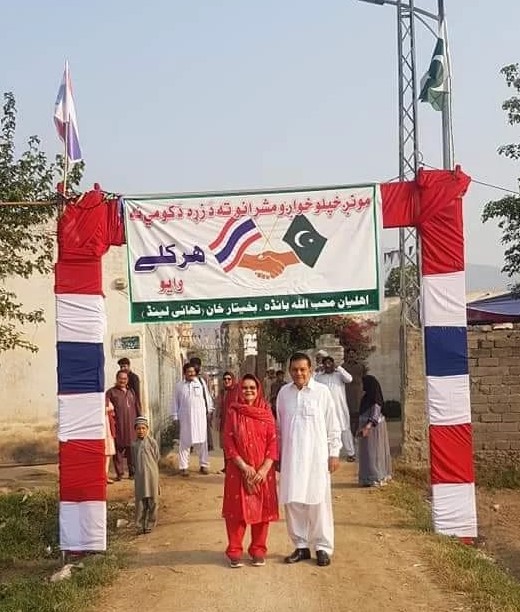
Sawab Khan Pathan and his wife pose for a photograph with a welcome banner raised for them in Adina village during their most recent visit to ancestral Swabi district in July 2019. (Supplied)
Short Url
Updated 12 February 2020
Follow

Thai parliamentarian cherishes his roots in small Pakistani town

  • Sawab Khan Pathan hails from Khyber Pakhtunkhwa's Swabi district
  • Elected to Thailand's National Assembly in 2019, he continues philanthropic work back home

PESHAWAR: Even when they reach foreign thrones of royalty, many a Pashtun will remember famous poetry verses reminding them to “recall the mountains of beautiful Pakhtunkhwa.” The words reverberate even thousands of miles away, in Thailand, where a man from Swabi has recently become a member of parliament. 

Sawab Khan Pathan devoted his life to social work in both his fatherland and the new country, which decades ago became his family’s home and in 2019 recognized his contributions by electing him to its highest legislative body.


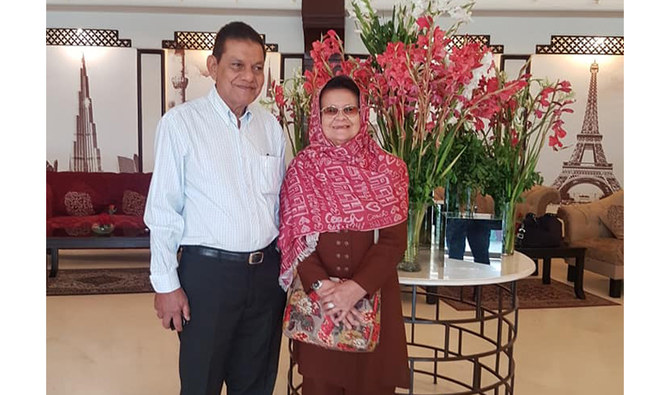
Sawab Khan Pathan poses for a photograph with his wife during their most recent visit to Islamabad in July 2019. (Supplied) 

During World War II, his father, Abdul Wahab, traveled with the British Indian Army as a hawaldar to Siam – today’s Thailand – to protect the Queen’s interests amid Japan’s invasion of Southeast Asia. He stayed there after the war, like many others who were unclear about their official belonging and citizenship following the partition of the Indian Subcontinent in 1947.

Wahab married and remained in Thailand, where his son Sawab Khan was born. The family’s husbandry business was going well, its members gained prominence and became involved in the local politics of Thap Sakae district in western Prachuap Khiri Khan province.

Wahab never returned to Khyber Pakhtunkhwa, but he kept it with him and made sure his son would speak the language of his ancestors.

“Thailand is my country. My family and I contribute there in many ways and this country and people have given us identity and trust,” Sawab Khan told Arab News over the phone from Thailand on Tuesday. “Our roots are in Pakistan, a country of magnificent culture, centuries-old history and great people,” the 70-year-old said in old, pre-partition Pashto.

The family now regularly visits their “ancestors’ soil,” he said.

According to Sawab Khan’s distant relative, Sadiq Muhammad, they also come with help when natural disasters strike like they did after an earthquake devastated Khyber Pakhtunkhwa in 2005 and floods in 2010.

“He is such nice and down to earth person and meets everyone with great warmth” Muhammad, a government school employee in Adina village in Swabi, told Arab News. “Whenever they come to the village, they actively participate in family functions and gatherings.”

As he now reached the Thai parliament, he is now also going to direct his energy to forge relations between Thailand and Pakistan, especially in the field of trade, Sawab Khan told Arab News.


Pakistan top military commander urges ‘multi-domain preparedness’ amid evolving security threats

Updated 9 sec ago
Follow

Pakistan top military commander urges ‘multi-domain preparedness’ amid evolving security threats

  • Asim Munir says Pakistan faces layered challenges spanning conventional, cyber, economic and information domains
  • His comments come against the backdrop of tensions with India, ongoing militant violence in western border regions

ISLAMABAD: Pakistan’s top military commander Field Marshal Asim Munir on Tuesday stressed the need for “multi-domain preparedness” to counter a broad spectrum of security challenges facing the country, saying they ranged from conventional military threats to cyber, economic and information warfare.

Pakistan’s security environment has remained volatile following a brief but intense conflict with India earlier this year, when the two nuclear-armed neighbors exchanged missile and artillery fire while deploying drones and fighter jets over four days before a ceasefire was brokered by the United States.

Pakistan has also been battling militant violence in its western provinces of Khyber Pakhtunkhwa and Balochistan, where authorities say armed groups operate from across the border in Afghanistan and receive backing from India. Both Kabul and New Delhi have rejected claims.

The military has also warned that disinformation constitutes a new form of security threat, prompting tighter regulations that critics say risk suppressing dissent. Munir also pointed to a “complex and evolving” global, regional and internal security landscape while addressing participants in the National Security and War Course at the National Defense University (NDU).

“These challenges span conventional, sub-conventional, intelligence, cyber, information, military, economic and other domains, requiring comprehensive multi-domain preparedness, continuous adaptation and synergy among all elements of national power,” he said, according to a military statement.

“Hostile elements increasingly employ indirect and ambiguous approaches, including the use of proxies to exploit internal fault lines, rather than overt confrontation,” he continued, adding that future leaders must be trained and remain alert to recognize, anticipate and counter these multi-layered challenges.

Munir also lauded the NDU for producing strategic thinkers who he said were capable of translating rigorous training and academic insight into effective policy formulation and operational outcomes.