New bid to find buyer for Air India slammed as ‘selling family silver’

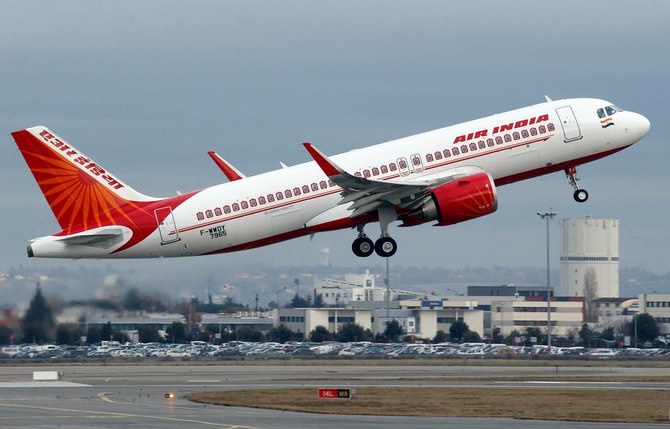
An Air India Airbus A320neo plane takes off in Colomiers near Toulouse, France. (Reuters)
Updated 28 January 2020
Follow

New bid to find buyer for Air India slammed as ‘selling family silver’

  • Indian government aims to offload entire stake in debt-ridden national carrier after failed 2018 sale attempt
  • Critics blame country’s struggling economy for decision to sell airline

NEW DELHI: Renewed government attempts to find a buyer for “debt trap” national carrier, Air India, have been slammed as “selling the family silver.”

Politicians from opposition and pro-government parties condemned the move by the Indian government to offload its entire stake in the flag-carrier airline, which comes more than a year after a failed bid to sell a controlling share.

A document released on Monday said that any bidder would have to absorb around $3.3 billion of debt along with other liabilities.

Speaking in New Delhi on Tuesday, Kapil Sibal, senior leader of India’s main opposition party, the Indian National Congress, said: “When governments don’t have money this is what they do.

“The government of India has no money; growth is less than 5 percent and millions of rupees are outstanding under several social schemes. This is what they will do, sell all the valuable assets we have.”

Derek O’Brien of the Trinamool Congress, the regional party ruling West Bengal, said in a video statement that “the government has decided to sell more family silver by selling 100 percent stake in Air India. You can well imagine how bad the economy (is).”

And on Twitter, Subramanian Swamy, parliamentarian from the ruling Bharatiya Janata Party (BJP), said: “This deal is wholly anti-national, and I will (be) forced to go to court. We cannot sell our family silver.”

Monday’s document gave the deadline for submission of initial expressions of interest in purchasing the airline as March 17. In 2018, the Indian government tried to sell 76 percent of the carrier but got no takers.

To justify the latest sale attempt, Aviation Minister Hardeep Singh Puri, said: “Despite infusing 30,500 crore rupees ($4.3 billion) in AI (Air India) since 2012, the airline has been running into losses year after year. Due to its accumulated debt of about 60,000 crore rupees, its financial position is very fragile.”

He described the company as being in a “debt trap” but added that it could be saved through privatization. “We have learnt lessons from the 2018 bid.”

Referring to critical comments from fellow BJP members, the minister said they were expressing their “personal opinion.”

Jitender Bhargava, former executive director of corporate communication at Air India, said the current offer would attract potential buyers.

“India is a growth market, so anybody would like to be part of it and take the advantage. The acquisition of Air India provides the fastest way to become a global carrier,” he told Arab News.

According to Bhargava, the move had nothing to do with the current state of the Indian economy. “All the important international carriers want to expand their footprints in India because of the potential of the Indian market. The government has taken a pragmatic view on the sale of the national carrier,” he said.

“Ownership of the airline does not matter, leadership matters. Once it came into the hands of the government, bureaucracy killed it,” added Bhargava, who authored “The Descent of Air India” chronicling the airline’s downfall. “Air India under the government’s ownership cannot run, cannot survive.”

He predicted that the carrier would become a marginal player if there was no change in ownership.

Air India has a fleet of 146 aircraft and employs around 21,000 people. It was founded by prominent industrialist J.R.D. Tata in 1932 and nationalized in 1953.


WHO chief says reasons US gave for withdrawing ‘untrue’

Updated 25 January 2026
Follow

WHO chief says reasons US gave for withdrawing ‘untrue’

  • US Secretary of State Marco Rubio and US Health Secretary Robert F. Kennedy Jr. announced in a joint statement Thursday that Washington had formally withdrawn from the WHO
  • And in a post on X, Tedros added: “Unfortunately, the reasons cited for the US decision to withdraw from WHO are untrue”

GENEVA: The head of the UN’s health agency on Saturday pushed back against Washington’s stated reasons for withdrawing from the World Health Organization, dismissing US criticism of the WHO as “untrue.”
Tedros Adhanom Ghebreyesus warned that US announcement this week that it had formally withdrawn from the WHO “makes both the US and the world less safe.”
And in a post on X, he added: “Unfortunately, the reasons cited for the US decision to withdraw from WHO are untrue.”
He insisted: “WHO has always engaged with the US, and all Member States, with full respect for their sovereignty.”
US Secretary of State Marco Rubio and US Health Secretary Robert F. Kennedy Jr. announced in a joint statement Thursday that Washington had formally withdrawn from the WHO.
They accused the agency, of numerous “failures during the Covid-19 pandemic” and of acting “repeatedly against the interests of the United States.”
The WHO has not yet confirmed that the US withdrawal has taken effect.

- ‘Trashed and tarnished’ -

The two US officials said the WHO had “trashed and tarnished” the United States, and had compromised its independence.
“The reverse is true,” the WHO said in a statement.
“As we do with every Member State, WHO has always sought to engage with the United States in good faith.”
The agency strenuously rejected the accusation from Rubio and Kennedy that its Covid response had “obstructed the timely and accurate sharing of critical information that could have saved American lives and then concealed those failures.”
Kennedy also suggested in a video posted to X Friday that the WHO was responsible for “the Americans who died alone in nursing homes (and) the small businesses that were destroyed by reckless mandates” to wear masks and get vaccinated.
The US withdrawal, he insisted, was about “protecting American sovereignty, and putting US public health back in the hands of the American people.”
Tedros warned on X that the statement “contains inaccurate information.”
“Throughout the pandemic, WHO acted quickly, shared all information it had rapidly and transparently with the world, and advised Member States on the basis of the best available evidence,” the agency said.
“WHO recommended the use of masks, vaccines and physical distancing, but at no stage recommended mask mandates, vaccine mandates or lockdowns,” it added.
“We supported sovereign governments to make decisions they believed were in the best interests of their people, but the decisions were theirs.”

- Withdrawal ‘raises issues’ -

The row came as Washington struggled to dislodge itself from the WHO, a year after US President Donald Trump signed an executive order to that effect.
The one-year withdrawal process reached completion on Thursday, but Kennedy and Rubio regretted in their statement that the UN health agency had “not approved our withdrawal and, in fact, claims that we owe it compensation.”
WHO has highlighted that when Washington joined the organization in 1948, it reserved the right to withdraw, as long as it gave one year’s notice and had met “its financial obligations to the organization in full for the current fiscal year.”
But Washington has not paid its 2024 or 2025 dues, and is behind around $260 million.
“The notification of withdrawal raises issues,” WHO said Saturday, adding that the topic would be examined during WHO’s Executive Board meeting next month and by the annual World Health Assembly meeting in May.
“We hope the US will return to active participation in WHO in the future,” Tedros said Saturday.
“Meanwhile, WHO remains steadfastly committed to working with all countries in pursuit of its core mission and constitutional mandate: the highest attainable standard of health as a fundamental right for all people.”