

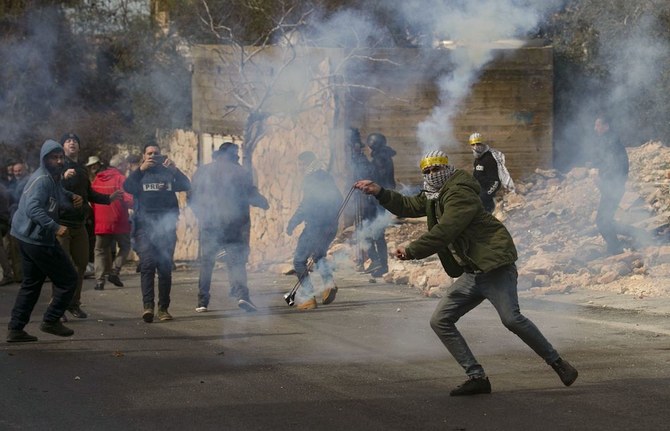

RAMALLAH: Palestinian leaders threatened Sunday to withdraw from key provisions of the Oslo Accords, which define arrangements with Israel, if US President Donald Trump announces his Middle East peace plan next week.
Trump was scheduled to unveil the plan ahead of his meeting in Washington this week with Israeli Prime Minister Benjamin Netanyahu.
Netanyahu, who has called Trump “the greatest friend that Israel has ever had,” said he hoped to “make history” in Washington this week.
But the Palestinian leadership was not invited to the talks and has rejected Trump’s initiative amid tensions with the US president over his recognition of Jerusalem as Israel’s undivided capital.
World powers have long agreed that Jerusalem’s fate should be settled through negotiations between Israel and the Palestinians.
Chief Palestinian negotiator Saeb Erekat told AFP that the Palestine Liberation Organization reserved the right “to withdraw from the interim agreement” of the Oslo pact if Trump unveils his plan.
The Trump initiative will turn Israel’s “temporary occupation (of Palestinian territory) into a permanent occupation,” Erekat said.
The Israeli-Palestinian Interim Agreement, signed in Washington in 1995, sought to put into practice the first Oslo peace deal agreed two years earlier.
Sometimes called Oslo II, the interim agreement set out the scope of Palestinian autonomy in the West Bank and Gaza.
The interim pact was only supposed to last five years while a permanent agreement was finalized but it has tacitly been rolled over for more than two decades.
Hamas leader Ismail Haniya warned Sunday Trump’s plan “will not pass” and could lead to renewed Palestinian resistance.
This “new plot aimed against Palestine is bound to fail” and could lead the Palestinians to a “new phase in their struggle” against Israel, the leader of the Gaza Strip’s Islamist movement said in a statement.
Haniya also called for talks in Cairo with other Palestinian factions, including Fatah — led by Palestinian president Mahmud Abbas — in order to form a common response to Trump’s plan.
Shortly after the release of Haniya’s statement, a rocket was fired from the Hamas-ruled Gaza Strip toward Israel, the Israeli army said.
Israel has occupied east Jerusalem and the West Bank since the 1967 Six-Day War.
More than 600,000 Israelis now live there in settlements considered illegal under international law.
The Trump administration last year announced that it no longer considered Israel’s settlement of civilians in the West Bank as “inconsistent with international law,” further outraging the Palestinians.
Trump’s peace initiative has been in the works since 2017, and its economic component was unveiled in June, calling for $50 billion in international investment in the Palestinian territories and neighboring Arab countries over 10 years.
Despite this apparent economic incentive, Palestinian leaders have made clear that they no longer recognize Washington’s historic role as mediator in the conflict, given Trump’s repeated backing of Israeli demands.
“The US administration will not find a single Palestinian who supports this project,” the Palestinian foreign ministry said in a statement on Sunday.
“Trump’s plan is the plot of the century to liquidate the Palestinian cause.”
Netanyahu’s political rival Benny Gantz has also received an invitation to attend the White House talks.
Gantz also showered Trump with praise during a news conference.
“I wish to thank President Trump for his dedication and determination in defending the security interests that both Israel and the US share,” Gantz said.
Trump’s planned separate meetings with Netanyahu and Gantz come a little more than a month before new Israeli elections, with polls showing Netanyahu’s right-wing Likud and Gantz’s centrist Blue and White party running neck-and-neck.
Israeli media speculated that Trump had chosen to unveil his plan in support of Netanyahu’s election bid — the third in a year, but the first since Netanyahu was charged with bribery, fraud and breach of trust in three separate corruption cases.
Netanyahu is seeking immunity from Israeli lawmakers through hearings due to start this week.
“Immediately after news of the [peace] plan was reported, it became plainly evident based on the reactions that this wasn’t a Trump plan, but a Bibi-Trump plot,” analyst Ben-Dror Yemini wrote in Sunday’s Yedioth Ahronoth newspaper.
“Yet another election ploy that was designed to extricate Netanyahu from the clutches of his immunity hearings.”


