JERUSALEM: US President Donald Trump will host Israeli Prime Minister Benjamin Netanyahu at the White House next week to discuss his long-awaited plans for Middle East peace, the White House said.
The Palestinians, who immediately condemned the move, were not invited to the Tuesday meeting.
Vice President Mike Pence first announced the invitation to right-wing Netanyahu and his main election rival, Benny Gantz, head of the centrist Blue and White party during a visit to Jerusalem to mark 75 years since the liberation of Auschwitz.
Speaking at the new US embassy in Jerusalem, Pence said Trump “asked me to extend an invitation to Prime Minister Netanyahu to come to the White House next week to discuss regional issues, as well as the prospect of peace here in the Holy Land.”
The White House said the meeting would be an “opportunity to discuss our shared regional and national security interests,” hailing the “strong” partnership between Israel and the United Sates.
Netanyahu welcomed the invitation, saying Trump “is seeking to give Israel the peace and security it deserves.”
“With such friends in the White House ... we should get as broad a consensus as possible around the efforts to achieve security and peace for the state of Israel,” he said.
Trump, whose team has long been working on the outlines of a secretive peace plan, has repeatedly boasted that he is the most pro-Israeli US president in history.
Trump tweeted later that he looked forward to the talks but that “reports about details and timing of our closely-held peace plan are purely speculative.”
Palestinian president Mahmud Abbas, whose administration is boycotting Trump, immediately rejected the US move.
“This step only reaffirms our absolute rejection of what the US administration has done so far, particularly the recognition of Jerusalem as Israel’s capital,” Abbas’s spokesman said in a statement.
Abbas cut off all ties with the US in December 2017 after Trump broke with decades of international consensus and recognized Jerusalem as Israel’s capital.
The Palestinians see the eastern part of the city as the capital of their future state and world powers have long agreed that Jerusalem’s fate should be settled via negotiations.
Trump came to power in 2017 promising to broker an Israeli-Palestinian peace deal, which he labelled the “ultimate deal.”
But he has since taken a series of decisions that outraged the Palestinians, including cutting hundreds of millions in aid and declaring that the US no longer considered Israel’s West Bank settlements illegal.
His plan for ending the Israeli-Palestinian conflict is believed to revolve around encouraging massive economic investment.
After many postponements, the peace initiative was expected in the autumn.
But it was delayed after September elections in Israel proved inconclusive, and it was not expected to be released until after the March 2 elections.
Israeli media discussed what they said were leaked outlines of the deal Thursday, saying the US had acquiesced to many key Israeli demands.
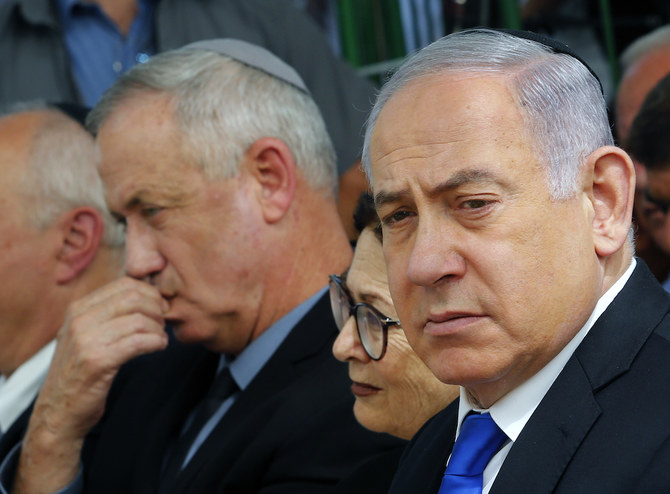
Pence was speaking shortly after visiting the Western Wall, the holiest place in Jerusalem at which Jews can pray, alongside Netanyahu and Gantz.
The Washington meeting comes little more than a month before new Israeli elections, with polls showing Netanyahu’s right-wing Likud and Gantz’s centrist Blue and White party neck-and-neck.
The meeting on Tuesday coincides with an expected session in the Israeli parliament to discuss Netanyahu’s potential immunity from prosecution over a series of corruption charges.
Israeli media speculated that Trump had chosen to announce the event in support of Netanyahu’s election bid — the third in a year.
Husam Zomlot, former head of the Palestinian mission in the US, told AFP that Trump hosting two Israeli leaders and no Palestinians showed the meeting was about influencing domestic Israeli politics, rather than a genuine attempt at peace.
“This is confirmation of their policy from the beginning — it is all about and for Israel.”


![]()

Palestinian Authority reiterates rejection of US peace initiative
Short Url
https://arab.news/6jeya
Palestinian Authority reiterates rejection of US peace initiative
- The Palestinians immediately condemned the move
- Trump's plan for ending the conflict is believed to revolve around encouraging massive economic investment


Latest updates


Recommended


© 2026 SAUDI RESEARCH & PUBLISHING COMPANY, All Rights Reserved And subject to Terms of Use Agreement.