Energy companies must manage their own transition to lower carbon sources, says Aramco director

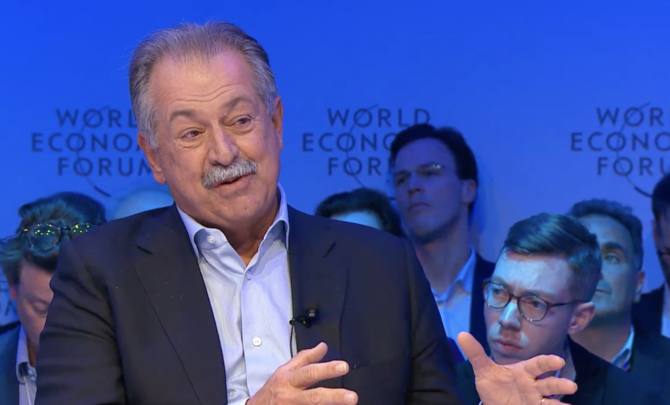
Speaking at the World Economic Forum during a panel on the growth of green energy, Aramco board member Andrew Liveris said the world “could do without” fossil fuels but that energy firms would need help in transitioning to cleaner fuels. (Screenshot: WEF)
Short Url
Updated 21 January 2020
Follow

Energy companies must manage their own transition to lower carbon sources, says Aramco director

  • Aramco board member Andrew Liveris said the world “could do without” fossil fuels
  • Also highlighted need for so-called “Big Oil” companies to think of themselves as energy companies

LONDON: Energy companies must move from fossil fuels to lower carbon sources but should be allowed to manage their own transitions, a Saudi Aramco director said in Davos on Tuesday

Speaking at the World Economic Forum during a panel on the growth of green energy, Aramco board member Andrew Liveris said the world “could do without” fossil fuels but that energy firms would need help in transitioning to cleaner fuels.

“The ecosystem that we’re living in — this planet — is strained to the limit. We have only one planet, the last time we checked, that we can live on. So, we have to do something about the humanity we have inhabited the planet with,” he said.

“Fossil fuels, the fuels of the 20th century, its days are numbered. They are not over, but they are transitioning to be over.”

Liveris said there were many ways to help that transition come about, including extensive financing, correct global regulation and legislation, as well as harnessing innovation. He also said climate accords, such as the Paris Agreement, had to be given more power.

------

READ MORE: Saudi Arabia joins club of Middle East’s ‘green energy’ leaders

------

“The swathe of available technologies to humanity today are building to put policies in place, from efficiency to alternatives to carbon, the hydrogen economy, all of these are things we can do to transition away from coal and oil, to natural gas and ultimately to electrification.

“What lacks (at the moment) is an alignment, a will and a purpose for all the various groups to get together and make that happen, in my new life (and role) I’m putting a lot of time into that,” he said.

The former chairman and CEO of Dow Chemical Company also highlighted the need for so-called “Big Oil” companies to think of themselves as energy companies.

“The term ‘Big Oil’ is almost a neanderthal term, I think we have to realise these companies are energy companies and these companies, like Saudi Aramco, have realised this is a time and a place that humanity is speaking,” he said.

“Communities are speaking and audiences around the world — including hopefully more shareholders — are basically voting with their feet and we are going to have to respond to that.”

“Let’s help ‘Big Oil’ truly become energy companies and manage their own transitions. They can afford it and they should be able to afford it.

“We can’t get there overnight, but there are ways to get there and we can.”

His views were echoed by another panelist Jennifer Morgan, executive director of Greenpeace, who said: “The private banks should stop investing in fossil fuels, they have been investing trillions into them, and move into investments in a low carbon, or zero carbon, infrastructure and renewable energies — you would have to put laws in place that do that.

“You would be powering the world with 100 percent renewable energy and you would put in place incentives and infrastructure to do that,” she said.

Outgoing Bank of England governor Mark Carney said he believed large-scale investment would be able to help the transition thanks to a shift in mindset about the need for greener energy in the financial sector.

“I think they are (listening), they’re listening to the realities, so these issues have moved very swiftly from being corporate responsibility issues or more niche issues within finance to become fundamental value drivers. I think we’re seeing a fundamental reshaping of the financial system,” he said.


First EU–Saudi roundtable on critical raw materials reflects shared policy commitment

Updated 16 January 2026
Follow

First EU–Saudi roundtable on critical raw materials reflects shared policy commitment

RIYADH: The EU–Saudi Arabia Business and Investment Dialogue on Advancing Critical Raw Materials Value Chains, held in Riyadh as part of the Future Minerals Forum, brought together senior policymakers, industry leaders, and investors to advance strategic cooperation across critical raw materials value chains.

Organized under a Team Europe approach by the EU–GCC Cooperation on Green Transition Project, in coordination with the EU Delegation to Saudi Arabia, the European Chamber of Commerce in the Kingdom and in close cooperation with FMF, the dialogue provided a high-level platform to explore European actions under the EU Critical Raw Materials Act and ResourceEU alongside the Kingdom’s aspirations for minerals, industrial, and investment priorities.

This is in line with Saudi Vision 2030 and broader regional ambitions across the GCC, MENA, and Africa.

ResourceEU is the EU’s new strategic action plan, launched in late 2025, to secure a reliable supply of critical raw materials like lithium, rare earths, and cobalt, reducing dependency on single suppliers, such as China, by boosting domestic extraction, processing, recycling, stockpiling, and strategic partnerships with resource-rich nations.

The first ever EU–Saudi roundtable on critical raw materials was opened by the bloc’s Ambassador to the Kingdom, Christophe Farnaud, together with Saudi Deputy Minister for Mining Development Turki Al-Babtain, turning policy alignment into concrete cooperation.

Farnaud underlined the central role of international cooperation in the implementation of the EU’s critical raw materials policy framework.

“As the European Union advances the implementation of its Critical Raw Materials policy, international cooperation is indispensable to building secure, diversified, and sustainable value chains. Saudi Arabia is a key partner in this effort. This dialogue reflects our shared commitment to translate policy alignment into concrete business and investment cooperation that supports the green and digital transitions,” said the ambassador.

Discussions focused on strengthening resilient, diversified, and responsible CRM supply chains that are essential to the green and digital transitions.

Participants explored concrete opportunities for EU–Saudi cooperation across the full value chain, including exploration, mining, and processing and refining, as well as recycling, downstream manufacturing, and the mobilization of private investment and sustainable finance, underpinned by high environmental, social, and governance standards.

From the Saudi side, the dialogue was framed as a key contribution to the Kingdom’s industrial transformation and long-term economic diversification agenda under Vision 2030, with a strong focus on responsible resource development and global market integration.

“Developing globally competitive mineral hubs and sustainable value chains is a central pillar of Saudi Vision 2030 and the Kingdom’s industrial transformation. Our engagement with the European Union through this dialogue to strengthen upstream and downstream integration, attract high-quality investment, and advance responsible mining and processing. Enhanced cooperation with the EU, capitalizing on the demand dynamics of the EU Critical Raw Materials Act, will be key to delivering long-term value for both sides,” said Al-Babtain.

Valere Moutarlier, deputy director-general for European industry decarbonization, and directorate-general for the internal market, industry, entrepreneurship and SMEs at European Commission, said the EU Critical Raw Materials Act and ResourceEU provided a clear framework to strengthen Europe’s resilience while deepening its cooperation with international partners.

“Cooperation with Saudi Arabia is essential to advancing secure, sustainable, and diversified critical raw materials value chains. Dialogues such as this play a key role in translating policy ambitions into concrete industrial and investment cooperation,” she added.