

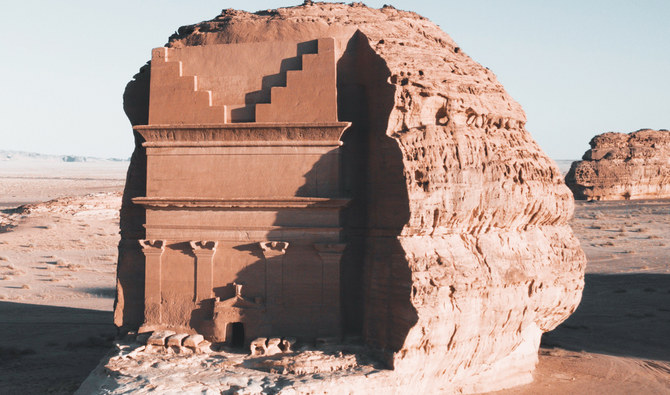

RIYADH: The Japanese Prime Minister Shinzo Abe’s tour of AlUla during his visit to Saudi Arabia casts a spotlight on the ancient Nabataean site as it prepares to open its doors to the public later this year.
AlUla, the last stop in Abe’s visit to the Kingdom before he continues his journey to the UAE and Oman, is full of archaeological treasures nestling amid beautiful desert landscapes.
Saudi Arabia’s move to open up Hegra city and the AlUla Valley is restoring a missing chapter in the history of the Arabian Peninsula and the entire world.
Bearing the name Mada’in Salih in the post- Islamic era, the lost city of Hegra was built by the Nabataeans, like its famous twin Petra in Jordan. They controlled the profitable trade routes that crossed the Arabian Peninsula from east to west and north to south from about the fourth century BC to 106 AD.
Arab News has created an interactive “The Rebirth of AlUla” — arabnews.com/alula — that dives deep into its history, blending compelling storytelling and journalism with stunning video footage, beautiful photography, animated graphics and rare footage and interviews - in both English and Japanese.
“The Rebirth of AlUla” throws light on the work of the Royal Commission for AlUla (RCU), established in 2017, which is working with the French Agency for AlUla Development (Afalula) on “the transformation of the AlUla region into a worldwide cultural and touristic destination.”
The site is currently hosting the second Winter at Tantora festival, a spectacular celebration of art, music and heritage that is drawing the world once again to AlUla from Dec. 19 to March 7.
Over 12 weekends of festivities, visitors are being treated to an eclectic mix of performers, including the Gipsy Kings, Lionel Richie, Enrique Iglesias, Craig David and Jamiroquai.
Returning to Winter at Tantora will be Italian tenor Andrea Bocelli, Greek pianist Yanni and Egyptian composer Omar Khairat.
The festival is also showcasing the newly constructed Maraya Concert Hall in AlUla, which is surrounded by mountains, combining modernism and antiquity.
The concert hall was built as an architectural extension of the environment that surrounds it at its site in Ashar, situated in the volcanic foothills of Harrat ‘Uwayrid.
In 2007, the Saudi Commission for Tourism and National Heritage, under its Secretary-General Prince Sultan bin Salman, nominated AlUla for listing as a UNESCO World Heritage site.
The application was accepted, and Hegra became the first World Heritage property to be inscribed in the Kingdom.
In an interview with Leaders magazine in February 2019, the RCU’s CEO Amr Al-Madani said AlUla is “full of archaeological treasures from the Dadanite, Nabataean, Roman and Islamic civilizations, nestled amongst the staggeringly beautiful desert landscapes.”
A cornerstone of Saudi Arabia’s Vision 2030 blueprint for the nation’s sustainable development, the project aims to create opportunities for the community and boost the local economy in AlUla.
Afalula will support the growth of infrastructure, archaeology and tourism in the area, with the aim of attracting 2 million visitors per year to the site by 2035, in the process creating 35,000 jobs for the residents of AlUla.
The RCU’s task is to contribute SR120 billion ($32 billion) to the Kingdom’s gross domestic product by 2035. It currently employs 374 people, of which 134 are based in AlUla.
The RCU is also engaging the local community through programs such as Hammaya, in which 2,500 residents will train to be advocates for AlUla’s natural and human heritage.
The emphasis on local identity and heritage is unmistakable. About a 45-minute drive from Hegra is the Sharaan Nature Reserve, a territory of 925 sq. km within AlUla that features some of the region’s most striking rock formations and desert habitats, managed by local rangers trained by international specialists.
“We’ve reintroduced Idmi gazelles, Nubian ibexes and red-necked ostriches into the reserve, and they’re thriving and doing well,” said Dr. Ahmed Al-Malki, head of the reserve.
The Arabian leopard may soon follow. In April this year, two cubs were born as part of a breeding program to preserve and eventually reintroduce the critically endangered species back into the wild in northwest Saudi Arabia.
Central to AlUla’s vision is the incorporation of art and cultural initiatives. The RCU’s cultural manifesto says: “AlUla will become known worldwide as a place to dream, where the greatest artists and thinkers of our time gather to stretch their creative capabilities and realize some of their most ambitious artworks and arts experiences — an evolving cultural crossroads for today and the future.”
Just as the caravans of antiquity once came to trade in this land, so AlUla, with an ancient Hegra reborn, will once again attract travelers from all corners of the world.

keywords


