

Turkey readying to give Libya military support

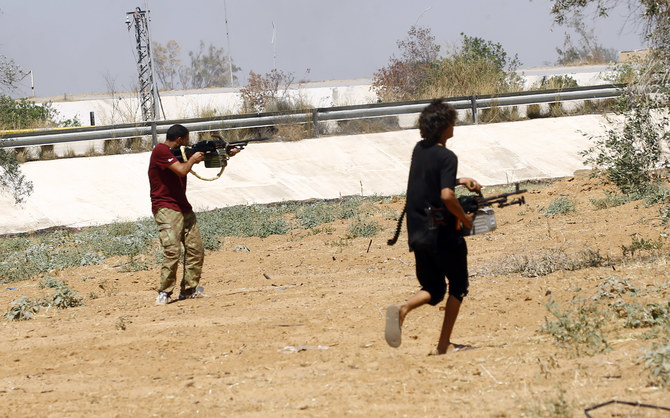
Fighters loyal to the internationally-recognized Libyan Government of National Accord (GNA) open fire from their position in the Al-Sawani area south of the Libyan capital Tripoli during clashes with forces loyal to strongman Khalifa Haftar. (AFP)
Short Url
Updated 26 December 2019
Follow

Turkey readying to give Libya military support

  • Turkey backs Tripoli administration in Libya, which has been split into rival political and military factions

ANKARA: Turkey is ready to give Libya military support, a spokesman for President Recep Tayyip Erdogan said, with the country’s Parliament readying to authorize troop deployment.

Turkey backs the government of Fayez Al-Serraj in Libya, which has been split into rival political and military factions since 2011 when ruler Muammar Gaddafi was ousted and killed. 

Al-Serraj’s Government of National Accord (GNA) has been battling the forces of veteran eastern commander Khalifa Haftar, who launched an offensive to seize Tripoli from fighters loyal to the GNA. 

Turkey and Libya recently signed a military cooperation deal. It includes provisions for a quick reaction force if requested by Tripoli.

Opinion

This section contains relevant reference points, placed in (Opinion field)

“We will continue to support the internationally recognized Libyan government. This support may be in terms of military training, or other areas, such as political support,” presidential spokesman Ibrahim Kalin said after Omer Celik, a spokesman for the ruling Justice and Development Party, said the country would use hard power instruments to protect its national interests if necessary.

The military cooperation deal has been criticized by the Turkish opposition, which said further military supplies to the GNA breach a UN arms embargo.  

But Erdogan pledged Sunday to intensify military backing to Libya along with ground, air and marine options. Some Turkish media have reported that the government may establish a military base in Libya to support its operations.

“It is important not to confuse Erdogan’s rhetoric and the physical reality of the actions he has taken lately,” Jalel Harchaoui, a Libya expert at the Netherlands Institute of International Relations, told Arab News. “Those are two very different things.”

He recalled that Turkey sent around 60 national intelligence officers to operate combat drones in Libya during the summer, in violation of the arms embargo.

HIGHLIGHT

The Turkish opposition has criticized military cooperation deal, saying military supplies to the Tripoli administration breach a UN arms embargo.

He said that the operation, although clandestine, helped the GNA to survive. “However, that Turkish mission stopped almost entirely in the second half of October. After the defense accord was signed on November 27, the mission has been partially resumed. But it is now a much more timid, much smaller version of summer’s operation. Very few airstrikes are being carried out by the Turks on behalf of Libya’s internationally recognized government.”

Ankara was only talking about possibly sending government troops, he said, but none of it had happened.

“Turkey’s intervention right now is much smaller than three or four months ago. And even back then, the Turkish military intervention was remarkably smaller than the Emiratis’ own military intervention, which now involves airstrikes conducted using fighter jets on a routine basis. Overall, since April, the total number of Emirati drone strikes has been three times as large as the Turkish drone strikes in Libya.”

Harchaoui said that Ankara seemed “deeply interested” in attempting some sort of diplomatic entente, particularly with Russia.

Russia has said it is concerned about the possibility of Turkey deploying troops in Libya. Russian President Vladimir Putin is visiting Turkey next month, with the two nations expected to launch an important Libya initiative.

Erdogan said Wednesday he had discussed with his Tunisian counterpart, President Kais Saied, possible steps and cooperation to establish a cease-fire in Libya.

In a news conference alongside Saied, Erdogan said he believed Tunisia would have “valuable and constructive” contributions to establishing stability in Libya.


Trump says ‘hopefully’ no need for military action against Iran

Updated 30 January 2026
Follow

Trump says ‘hopefully’ no need for military action against Iran

  • US president said he is speaking with Iran and left open the possibility of avoiding a military operation
  • An Iranian military spokesman warned Tehran’s response to any US action would not be limited

PARIS: US President Donald Trump said on Thursday he hoped to avoid military action against Iran, which has threatened to strike American bases and aircraft carriers in response to any attack.
Trump said he is speaking with Iran and left open the possibility of avoiding a military operation after earlier warning time was “running out” for Tehran as the United States sends a large naval fleet to the region.
When asked if he would have talks with Iran, Trump told reporters: “I have had and I am planning on it.”
“We have a group headed out to a place called Iran, and hopefully we won’t have to use it,” the US president added, while speaking to media at the premiere of a documentary about his wife Melania.
As Brussels and Washington dialed up their rhetoric and Iran issued stark threats this week, UN chief Antonio Guterres has called for nuclear negotiations to “avoid a crisis that could have devastating consequences in the region.”
An Iranian military spokesman warned Tehran’s response to any US action would not be limited — as it was in June last year when American planes and missiles briefly joined Israel’s short air war against Iran — but would be a decisive response “delivered instantly.”
Brig. Gen. Mohammad Akraminia told state television US aircraft carriers have “serious vulnerabilities” and that numerous American bases in the Gulf region are “within the range of our medium-range missiles.”
“If such a miscalculation is made by the Americans, it will certainly not unfold the way Trump imagines — carrying out a quick operation and then, two hours later, tweeting that the operation is over,” he said.
An official in the Gulf, where states host US military sites, said that fears of a US strike on Iran are “very clear.”
“It would bring the region into chaos, it would hurt the economy not just in the region but in the US and cause oil and gas prices to skyrocket,” the official added.
‘Protests crushed in blood’
Qatar’s leader Sheikh Tamim bin Hamad Al-Thani and Iran’s President Masoud Pezeshkian held a call to discuss “efforts being made to de-escalate tensions and establish stability,” the Qatar News Agency (QNA) reported.
The European Union, meanwhile, piled on the pressure by designating the Islamic Revolutionary Guard Corps (IRGC) a “terrorist organization” over a deadly crackdown on recent mass protests.
“’Terrorist’ is indeed how you call a regime that crushes its own people’s protests in blood,” said EU chief Ursula von der Leyen, welcoming the “overdue” decision.
Though largely symbolic, the EU decision has already drawn a warning from Tehran.
Iran’s military slammed “the illogical, irresponsible and spite-driven action of the European Union,” alleging the bloc was acting out of “obedience” to Tehran’s arch-foes the United States and Israel.
Iranian officials have blamed the recent protest wave on the two countries, claiming their agents spurred “riots” and a “terrorist operation” that hijacked peaceful rallies sparked over economic grievances.
Rights groups have said thousands of people were killed during the protests by security forces, including the IRGC — the ideological arm of Tehran’s military.
In Tehran on Thursday, citizens expressed grim resignation.
“I think the war is inevitable and a change must happen. It can be for worse, or better. I am not sure,” said a 29-year-old waitress, speaking on condition of anonymity for fear of reprisals.
“I am not in favor of war. I just want something to happen that would result in something better.”
Another 29-year-old woman, an unemployed resident of an upscale neighborhood in northern Tehran, said: “I believe that life has highs and lows and we are now at the lowest point.”
Trump had threatened military action if protesters were killed in the anti-government demonstrations that erupted in late December and peaked on January 8 and 9.
But his more recent statements have turned to Iran’s nuclear program, which the West believes is aimed at making an atomic bomb.
On Wednesday, he said “time is running out” for Tehran to make a deal, warning the US naval strike group that arrived in Middle East waters on Monday was “ready, willing and able” to hit Iran.
Conflicting tolls
The US-based Human Rights Activists News Agency (HRANA) said it has confirmed 6,479 people were killed in the protests, as Internet restrictions imposed on January 8 continue to slow verification.
But rights groups warn the toll is likely far higher, with estimates in the tens of thousands.
Iranian authorities acknowledge that thousands were killed during the protests, giving a toll of more than 3,000 deaths, but say the majority were members of the security forces or bystanders killed by “rioters.”
Billboards and banners have gone up in the capital Tehran to bolster the authorities’ messages. One massive poster appears to show an American aircraft carrier being destroyed.