

Turkey’s Erdogan says discussed Libya ceasefire with Tunisian president

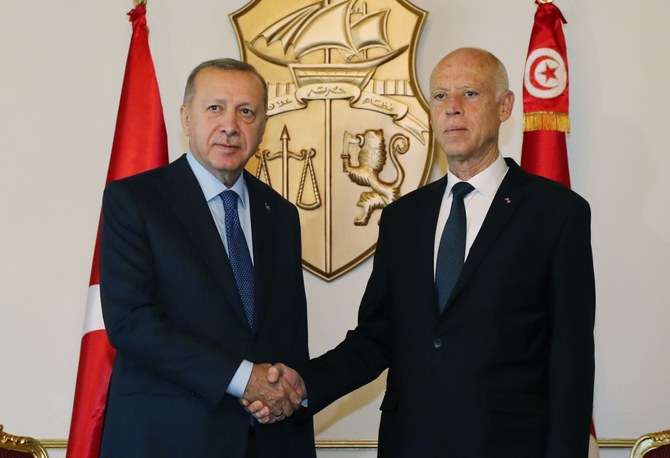
Turkish President Recep Tayyip Erdogan, left, shakes hands with Tunisian President Kais Saied during a welcoming ceremony in Tunis, on December 25, 2019. (AFP)
Short Url
Updated 25 December 2019
Follow

Turkey’s Erdogan says discussed Libya ceasefire with Tunisian president

  • The visit comes as Turkey has ramped up efforts to strike deals with nations on the Mediterranean
  • The visit is the first by a head of state to Tunisia since the election of President Kais Saied in October

ANKARA: Turkish President Tayyip Erdogan said on Wednesday he had discussed with his Tunisian counterpart Kais Saied possible steps and cooperation to establish a ceasefire in Libya.
Erdogan arrived in Tunis earlier on Wednesday on a surprise visit for talks with Saied, the Turkish presidency said, without providing further details.
In a news conference alongside Saied, Erdogan said he believed Tunisia would have "valuable and constructive" contributions to establishing stability in Libya, and added that a ceasefire must be established as soon as possible. 

The visit comes as Turkey has ramped up efforts to strike deals with nations on the Mediterranean, where Ankara has been at odds with Greece over resources off the coast of the divided island of Cyprus.

Last month, Turkey signed a maritime delimitation agreement with Libya’s internationally recognized government, a move that enraged Greece. Athens says the deal violates international law, but Ankara says it aims to protect its rights in the region and is in full compliance with maritime laws.

In a statement, Erdogan’s office said he was accompanied by his foreign and defense ministers, as well as his intelligence chief. It provided no further details on the content or purpose of the talks.

The visit is the first by a head of state to Tunisia since the election of President Kais Saied in October, after Tunisian parliamentary elections.

As part of its expanded cooperation with Tunisia’s neighbor Libya, Ankara also signed a military-cooperation deal with Fayez Al-Serraj’s Tripoli-based Government of National Accord (GNA).

Erdogan has said Turkey may deploy troops in support of the GNA, which has been fighting off a months-long offensive by Khalifa Haftar’s forces to the east of the country.

On Tuesday, Presidential Spokesman Ibrahim Kalin said Turkey may need to draft a bill to send troops into Libya and added the parliament was currently working on it.

Ankara’s possible deployment into Libya has also alarmed Russia, which said it was very concerned by such a prospect.

Turkey has already sent military supplies to the GNA despite a United Nations arms embargo, according to a UN report seen by Reuters last month.


Lebanon’s government approves a deal to transfer Syrian prisoners back to Syria

Updated 5 sec ago
Follow

Lebanon’s government approves a deal to transfer Syrian prisoners back to Syria

  • Lebanon and Syria have a complicated history with grievances on both sides
  • A key obstacle to warming relations has been the fate of about 2,000 Syrians in Lebanese prisons

BEIRUT: Lebanon’s Cabinet on Friday approved an agreement to transfer Syrian prisoners serving their sentences in Lebanon back to their home country.
The issue of prisoners has been a sore point as the neighboring countries seek to recalibrate their relations following the ouster of former Syrian President Bashar Assad in a lightning offensive by Islamist-led insurgents in December 2024. Former insurgent leader Ahmad Al-Sharaa is now Syria’s interim president.
Lebanon and Syria have a complicated history with grievances on both sides. Many Lebanese resent the decades-long occupation of their country by Syrian forces that ended in 2005. Many Syrians resent the role played by the Lebanese militant group Hezbollah when it entered Syria’s civil war in defense of Assad’s government.
A key obstacle to warming relations has been the fate of about 2,000 Syrians in Lebanese prisons, including some 800 held over attacks and shootings, many without trial. Damascus had asked Beirut to hand them over to continue their prison terms in Syria, but Lebanese judicial officials said Beirut would not release any attackers and that each must be studied and resolved separately.
The deal approved Friday appeared to resolve that tension. Lebanese Information Minister Paul Morcos said other issues remain to be resolved between the two countries, including the fate of Lebanese believed to have been disappeared into Syrian prisons during Assad’s rule and the demarcation of the border between the two countries.
Lebanon’s Deputy Prime Minister Tarek Mitri told reporters after the Cabinet meeting that about 300 prisoners would be transferred as a result of the agreement.
Protesters gathered in a square below the government palace in downtown Beirut ahead of the Cabinet vote to call for amnesty for Lebanese prisoners, including some who joined militant groups fighting against Assad in Syria. Some of the protesters called for the release of Sunni cleric Ahmad Al-Assir, imprisoned for his role in 2013 clashes that killed 18 Lebanese army soldiers.
“The state found solutions for the Syrian youth who are heroes and belong to the Syrian revolution who have been imprisoned for 12 years,” said protester Khaled Al- Bobbo. “But in the same files there are also Lebanese detainees. ... We demand that just as they found solutions for the Syrians, they must also find solutions for the people of this country.”