

Anti-corruption protest leaders snub talks with Lebanon’s new prime minister

Lebanese demonstrators argue with a PML representative, right, outside in the neighborhood of Tallet Al-Khayat in Beirut on Sunday. (AFP)
Short Url
Updated 23 December 2019
Follow

Anti-corruption protest leaders snub talks with Lebanon’s new prime minister

  • The incoming prime minister faces a number of hurdles, including a boycott by influential political blocs that refused to nominate him because of the backing he received from the Free Patriotic Movement, Hezbollah, the Amal Movement and their allies

BEIRUT: Protest leaders in Lebanon boycotted talks on Sunday with incoming prime minister Hassan Diab as demonstrators took to the streets again to demand an end to government corruption and a clear-out of the political elite.

Protesters took to the streets again on Sunday, the 67th day of the protests against Lebanon’s leadership. 

Demonstrators traveled by bus from Tripoli, Saida, Tyre and Nabatieh, and gathered in Martyrs’ Square in the heart of Beirut under the slogan “Sunday of Determination.”


The rebirth of AlUla
Hegra, ancient city of the Nabataeans in Saudi Arabia’s historic AlUla Valley, is emerging from the mists of time to take its rightful place as one of the wonders of the world

Enter


keywords

Activist Mahmoud Fakih told Arab News: “Diab’s office is calling on activists to meet him. Since the first day, we said that there is no leadership for the revolution and that every single protester is a leader in his own right.”


He added: “Our demands are clear and do not need to be transmitted in person to the prime minister designate. We do not want to be represented in the government. We want an independent rescue government.”

According to one protester, Diab said that he “wants to form a government of a limited number of ministers from independents. If a government would be formed in this way why would we reject it and obstruct its path?”

Riot police intervened to prevent any clash between rival groups of activists following the meeting, while Diab’s office announced that talks with protesters would be suspended.

In Martyrs’ Square, protesters erected a huge Christmas tree, ornamenting it with the demands of the revolution, and chanting: “All means all of them and Diab is one of them.”

Opinion

This section contains relevant reference points, placed in (Opinion field)

A source close to Diab told Arab News that the incoming leader will refrain from issuing media statements or giving interviews in coming weeks and will focus on forming a new government.

In his most recent statement, Diab said that he intends to form a limited government of 20 ministers that will “fight corruption, and boost economic and financial recovery.”

In a Sunday sermon, Bechara Al-Rahi, the Maronite Patriarch, urged all political parties to “cooperate with the prime minister-designate and facilitate the formation of a rescue emergency government.”

Lebanon has had a caretaker government since Oct. 29, when Saad Hariri resigned as prime minister after nearly two weeks of protests. 
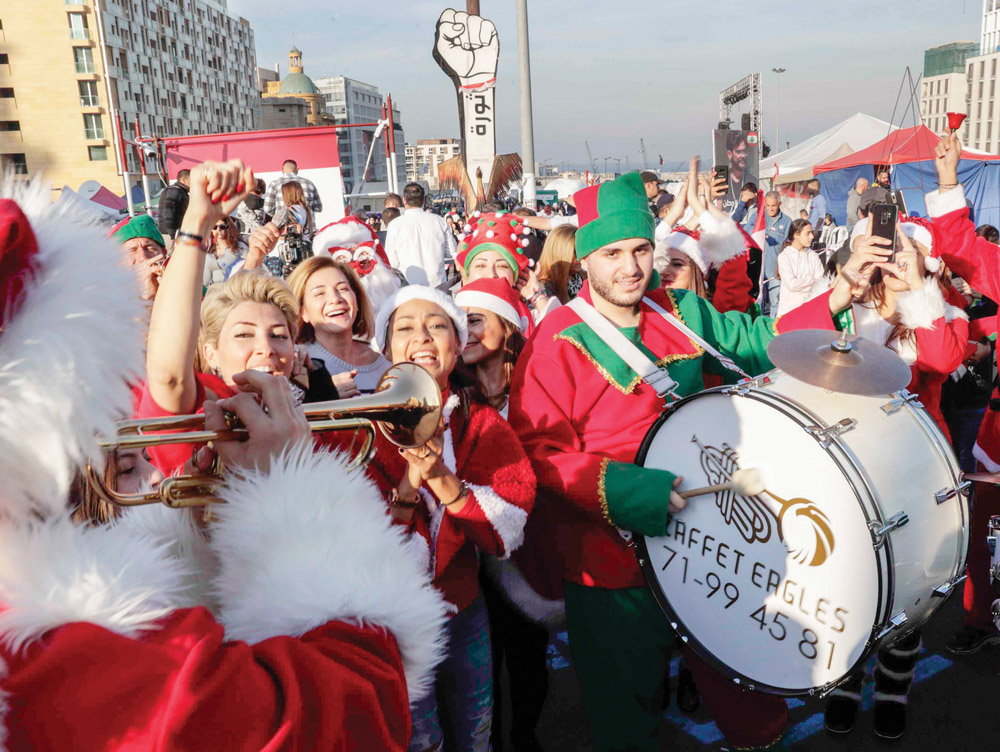


Protesters cheer and play music in Beirut as they take to the streets again on Sunday to demand an end to corruption and a clear-out of the political elite. (AFP)

Diab, a university professor and former education minister, has been nominated to replace Hariri, and began consultations on Saturday with parliamentary blocs to discuss the shape of a future government.

He hoped to hold talks with leaders of the civil movement “to listen to their demands.” However, only four junior activists turned up to the meeting. Diab faces significant hurdles, including a boycott by influential political blocs that refused to nominate him because of the backing he received from the Free Patriotic Movement, Hezbollah, the Amal party and their allies.

He is also opposed by pro-Hariri Sunnis, and protesters who view the whole political elite as corrupt. Diab said he would form a limited government of 20 ministers to “fight corruption, and boost economic and financial recovery.”

Mass protests began in Lebanon on Oct. 17 and led to former Prime Minister Saad Hariri’s government resigning two weeks later. Since then the country has been gripped by political deadlock amid a worsening economic and unemployment crisis.


Last Christians gather in ruins of Turkiye’s quake-hit Antakya

Updated 25 December 2025
Follow

Last Christians gather in ruins of Turkiye’s quake-hit Antakya

  • Saint Peter’s, one of the world’s oldest rock churches, is a sacred rallying point for the isolated Christians still left in quake-hit Antakya in southeastern Turkiye

ANTAKYA: Saint Peter’s, one of the world’s oldest rock churches, is a sacred rallying point for the isolated Christians still left in quake-hit Antakya in southeastern Turkiye, the city known in ancient times as Antioch.
“Since the earthquake, our community has scattered,” said worshipper Mari Ibri.
“Those who remain are trying to regroup. We each had our own church but, like mine, they have been destroyed.”
The landscape around the cave remains scarred by the disaster nearly three years ago, when two earthquakes devastated Hatay province on February 6, 2023 and its jewel, Antakya, the gateway to Syria.
Sad fields of rubble and the silhouettes of cracked, abandoned buildings still scar the city — all enveloped in the ever-present grey dust.
Since the earthquakes, Antakya city has emptied and the Christian community has shrunk from 350 families to fewer than 90, Father Dimitri Dogum told AFP.
“Before, Christmas at our house was grandiose,” Ibri recalled.
“Our churches were full. People came from everywhere.”
Ibri’s own church in the city center was rendered inaccessible by the earthquakes.
Now she and other worshippers gather at the cave on December 24 — Christmas Eve in some Christian calendars.
It is here, they believe, that Peter, the disciple Jesus assigned to found the Christian church, held his first religious service in the 1st century.
The rock church was later enlarged and 11th-century crusaders added a pale stone facade.
It is now a museum, opened to the faithful only on rare occasions.
Christmas Eve is one.
The morning sun was still glowing red in the sky when Fadi Hurigil, leader of Antakya’s Orthodox Christian community, and his assistants prepared the service.
They draped the stone altar and unpacked candles, holy oil, chalices and plastic chairs.
Out in front they placed figurines of Christ and three saints near a bottle of rough red wine, bread baskets and presents for the children.
The sound system played a recording of the bells of Saint Peter and Paul church, which now stands empty in Antakya city center.
“That was my church,” said Ibri, crossing herself. “They recorded the peals.”
Around one hundred worshippers soon squeezed into the incense-filled cave and at least as many congregated outside.
A large police contingent looked on. Sniffer dogs had already inspected the cave and esplanade.
“It’s normal,” said Iliye, a 72-year-old from Iskenderun, 60 kilometers (40 miles) further north. “We’re a minority. It’s to protect us.”
The slow chanting of Orthodox hymns heralded the start of the two-hour service, conducted entirely in chants sung in Arabic and Turkish by Dogum and another cleric.
“It’s very moving for us to be here in the world’s first cave church, where the first disciples gathered,” the priest said.
“There used to be crowds here,” he added.
“In 2022, there were at least 750 people outside, Christians and non-Christians alike.”
Since the earthquakes, the gathering has been much smaller, although it is now starting to grow again.
At the end of the service, when Christmas carols fill the air, Dogum and Hurigil cut a huge rectangular cake.
The Nativity scene at its center — Mary, baby Jesus, the ox and the ass — was edged with whipped cream.
“There’s the religious dimension but it’s also important that people can gather here again,” a worshipper said.
“After February 6, our fellow citizens scattered. But they’re starting to come back. We’re happy about that.”