


Thousands protest against new PM, close roads in Lebanon

1 / 4
An anti-government protester carries a Lebanese national flag during a rally in Martyrs' Square in Beirut, Lebanon, Sunday, Dec. 22, 2019. (AP)
2 / 4
Lebanese anti-government demonstrators chant slogans, outside the home of Lebanon's prime-minister designate, in the neighbourhood of Tallet al-Khayat, Beirut on December 22, 2019. (AFP)
3 / 4
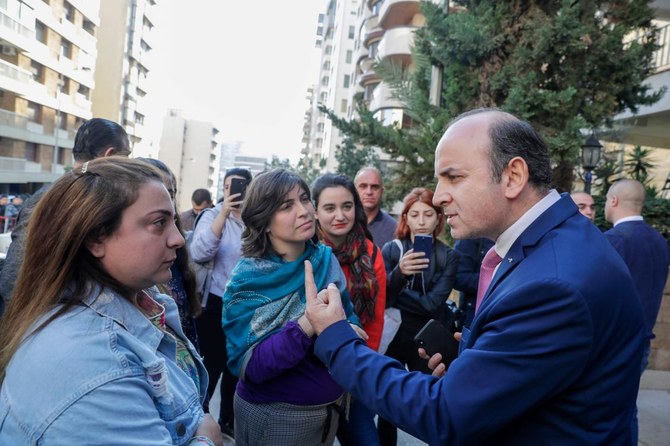
Lebanese anti-government demonstrators (L) argue with a representative of the popular movement (R), outside the home of Lebanon's prime-minister designate, in the neighbourhood of Tallet al-Khayat in the Lebanese capital Beirut on December 22, 2019. (AFP)
4 / 4
Lebanese anti-government demonstrators (L) argue with a representative of the popular movement (R), outside the home of Lebanon's prime-minister designate, in the neighbourhood of Tallet al-Khayat in the Lebanese capital Beirut on December 22, 2019. (AFP)
Short Url
Updated 23 December 2019
Follow

Thousands protest against new PM, close roads in Lebanon

  • A small crowd of protesters rallied outside Diab’s house and slammed visitors who claimed to represent the country’s leaderless movement
  • The few who heeded Diab’s calls for talks included largely unknown individuals not recognized as representatives of the protest movement

BEIRUT: Thousands of protesters demonstrated in central Beirut and elsewhere in Lebanon on Sunday against the country’s new prime minister, saying he should abandon the post because he is a member of the ruling elite.
After sunset, protesters closed several roads and highways in Beirut and other parts of the country to rally against the nomination of Hassan Diab, who was backed by the militant Hezbollah group and its allies and failed to win the backing of the main Sunni Muslim groups.
The protesters, many of whom came from northern Lebanon and the eastern Bekaa Valley, also gathered in Beirut’s central Martyrs Square, one of the key places of the protests which have been underway for more than two months.
They later marched toward the parliament building guarded by scores of riot police. Unlike last week, when scuffles were reported between protesters and policemen outside the parliament, there was no violence on Sunday.
Prime Minister-designate Diab, a university professor and former education minister, will have the task of steering Lebanon out of its worst economic and financial crisis in decades. He’s also taking office against the backdrop of ongoing nationwide protests against the country’s ruling elite that the protesters blame for widespread corruption and mismanagement.
Former Prime Minister Saad Hariri, the head of the largest Sunni group in Lebanon, resigned on Oct. 29, meeting a key demand of the protesters. According to Lebanon’s power-sharing system, the prime minister has to be a Sunni.
“We are not convinced by their choice,” protester Hanaa Saleh said about Diab’s nomination. “We don’t believe this movie.”
Diab has vowed his government will not include politicians and will only consist of independents and experts.

In Washington, a State Department spokesperson said that US Undersecretary of State for Political Affairs David Hale had encouraged Lebanese leaders during his two-day visit last week “to put aside partisan interests and support formation of a government committed to and capable of undertaking meaningful, sustained reforms.”
Hale “reaffirmed America’s longstanding partnership and enduring commitment to a secure, stable, and prosperous Lebanon,” said Morgan Ortagus.


German parliament speaker visits Gaza

Updated 3 sec ago
Follow

German parliament speaker visits Gaza

BERLIN: The speaker of Germany’s lower house of parliament briefly visited the Israeli-controlled part of the Gaza Strip on Thursday, the body told AFP.
Julia Kloeckner spent “about an hour in the part of Gaza controlled by Israeli army forces,” parliament said, becoming the first German official to visit the territory since Hamas’s attack on Israel in October 2023 that sparked the devastating war.
Since the start of the conflict, Israel has drastically restricted access to the densely populated coastal strip.
In a statement shared by her office, Kloeckner said it was essential for politicians to have access to “reliable assessments of the situation” in Gaza.
“I expressly welcome the fact that Israel has now, for the first time, granted me, a parliamentary observer, access to the Gaza Strip,” she said.
However, she was only able to gain a “limited insight” into the situation on the ground during her trip, she said.
Kloeckner appealed to Israel to “continue on this path of openness” and emphasized that the so-called yellow line, which designates Israeli military zones inside the Gaza Strip, must “not become a permanent barrier.”
The German foreign ministry did not immediately respond to a request for comment from AFP.
Germany has been one of Israel’s staunchest supporters as the European power seeks to atone for the legacy of the Holocaust.
But in recent months, Chancellor Friedrich Merz has occasionally delivered sharp critiques of Israeli policy as German public opinion turns against Israel’s actions in Gaza.
In August, Germany imposed a partial arms embargo on Israel, which was lifted in November after the announcement of what has proved to be a fragile ceasefire for Gaza.
Merz visited Israel in December and reaffirmed Germany’s support.
But in a sign of lingering tension, Germany’s foreign ministry on Wednesday criticized Israeli plans to tighten control over the occupied West Bank as a step toward “de facto annexation.”