

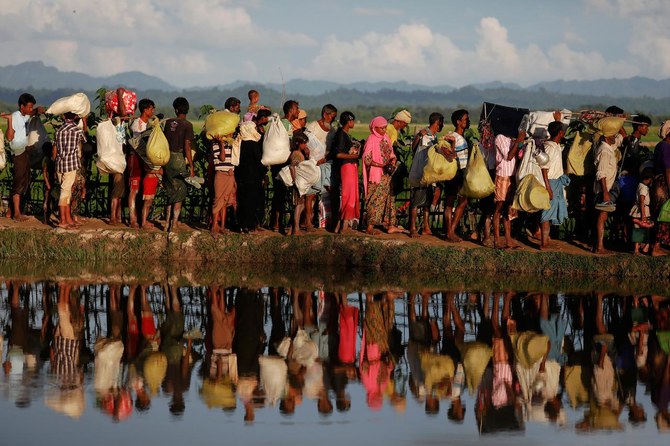

DHAKA: Bangladesh’s top commander, Gen. Aziz Ahmed, began his four-day visit to Myanmar on Sunday amid uncertainty surrounding the repatriation of more than 1 million Rohingya refugees from the country.
He is expected to hold talks with the deputy chief of Myanmar’s armed forces and its army chief, Vice-Senior Gen. Soe Win, a statement issued by the Inter Services Public Relations Department said.
“You know that the army plays a very important role in Myanmar. Under such circumstances, if our army chief visits the country, it will be good for us. And through this, another line of negotiation will open. We welcome this,” A K Abdul Momen, Bangladesh’s foreign minister, told reporters in Dhaka in the last week of November when news of Ahmed’s visit broke out.
“(The visit) will not go against us. It will go in our favour. Myanmar is not our enemy. It is our friend,” he added.
Top among the issues to be discussed are training programs, goodwill visits, increasing mutual cooperation and the repatriation of forcibly displaced Myanmar citizens from Bangladesh.
Ahmed is visiting Myanmar at a time when the International Court of Justice (ICJ) is set to begin proceedings against Myanmar on Tuesday over accusations of genocide against the Rohingya.
However, authorities in Bangladesh considered the visit as a “new line of communication” in a bid to facilitate the Rohingya repatriation.
“We want to resolve problems through negotiations. It is Myanmar that has created the Rohingya crisis. Its solution also depends on Myanmar. We are conducting our activities in different ways so that the Rohingya people can go back home and live in a dignified manner,” Momen said.
Experts, however, were divided over the army chief’s visit to Myanmar.
Helal Morshed, a retired army officer, said that it is a “prefixed visit,” so there is no chance to tag it with the ICJ hearing.
“Since the army plays an important role in Myanmar politics, the army chief knows the ground realities more than anyone. I think both the army chiefs will discuss the Rohingya repatriation issue in a pragmatic way,” Morshed told Arab News, adding that Myanmar could also “contribute politically” in finding a solution to the crisis.
Ambassador Munshi Faiz Ahmad, chairman of the Bangladesh Institute of International and Strategic Studies, said that Bangladesh is engaged with a “continuous diplomatic and military relationship” with Myanmar despite the Rohingya refugee crisis.
“The army chief’s visit will also help us to assert and clear out our opinions over the Rohingya repatriation issues,” Ahmad told Arab News.
He added that the visit could also help both the countries resolve the border crisis which involves human trafficking and drug smuggling.
“Human trafficking, drug smuggling and Rohingya refugees all became interrelated issue at this moment,” Ahmed said, adding that it is true that a few members of the Myanmar army “are responsible for the atrocities on Rohingyas, but the army as a whole cannot be blamed for this.”
Another veteran diplomat, requesting anonymity, said: “It would be great if Bangladesh would defer its army chief’s visit to Myanmar by one week.”
He said that in order to support Bangladesh, all 57 members of the Organization of Islamic Cooperation (OIC) have lodged an appeal at the ICJ and “Myanmar should not do anything which may weaken the OIC’s move.
“Now, Myanmar may claim that both the countries are engaged in a bilateral relationship at the military level too. In this context, Myanmar can say that there is nothing wrong.”
Bangladesh’s former army chief Gen. Iqbal Karim Bhuiyan visited Myanmar in 2014 to discuss issues including trans-border crimes and human trafficking between the two countries.
Since August 2017, in the wake of military attacks, thousands of Rohingya fled their homeland Rakhine in Myanmar and took shelter in Bangladesh’s Cox's Bazar. Hundreds have died since.
The UN has described the crisis as a “textbook example” of ethnic cleansing.


