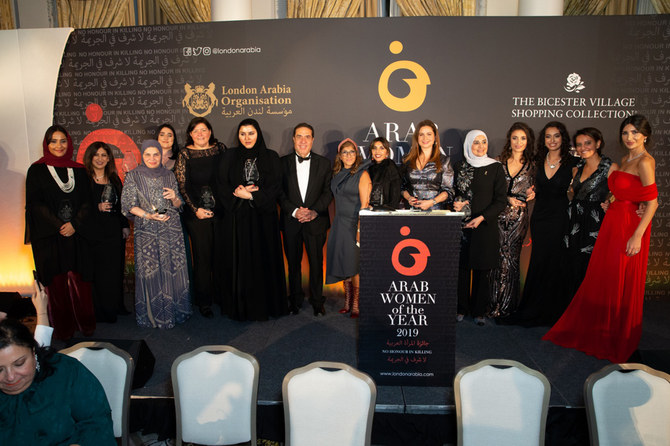


LONDON: Remarkable Arab women who have made a positive impact on society through their work and vision were feted at the 2019 Arab Women of the Year Awards in London on Wednesday November 27.
The glittering event at the Langham Hotel was hosted by Alice Abdel Aziz, a social-media influencer and entrepreneur from Lebanon. This year a special award was presented to women fighting to end the scourge of ‘honor’ killings.
In his opening speech, Omar Bdour, CEO of the London Arabia Organization and the Arab Women of the Year Awards said: “As a society, we are now used to watching news about honor killings and just flicking to the next story. The shock has worn off. However, in August, another honor crime shocked the Arab world … Israa Ghrayeb.” Bdour was referring to the 21-year-old Palestinian who was reportedly beaten to death in Bethlehem after she posted a selfie with her fiancé a day before they were supposed to get engaged.
“The needless cruelty of her murder made me question how and why this was still happening,” Bdour continued. “While the case of Israa has made international headlines, so-called honor killings happen around the world at an alarming rate, often with little press and no justice for the victims.
“A dangerous conclusion often drawn is that honor killings are a part of Islam and Islamic society. People who know me know that I am not a religious person and I am not here to defend Islam. But the idea that honor-based violence is inspired by Islam is totally wrong and fits with negative Islamophobic tropes, and we often see this clearly in unhelpful media coverage of these crimes.
“We must also acknowledge that honor killings are not sanctioned by Islam,” he continued. “So-called honor killings are forbidden and, like other religions, are considered murder.”
Rana Husseini, a Jordanian author and journalist who wrote the book “Murder in the name of Honor,” received the Achievement in Social Impact award in recognition for her work in fighting to put an end to this horrific crime.
“I have been working on the issue of so called honor crimes for over 25 years — advocating against them and reporting on women killed in the name of family honor. A lot of laws have changed and people’s minds have started to shift towards rejecting these murders,” she told Arab News at the event. “There has been more positive acceptance of people like me and others working on this topic.”
I asked if she ever felt in danger because of her work.
“Early on in my career — but now the situation has changed,” she said. “People are becoming more open to addressing issues such as violence against women. For the longest time it was not acceptable to talk about this issue in our part of the world — or indeed in other countries. ‘Violence against women’ was considered to be a family or ‘domestic’ matter. So there has been a great change.
“There are many women fighting in Bahrain and Kuwait and Yemen and countries across the world against honor crimes,” she continued. “In the past, the UN used to use generic phrases like ‘Violence against women.’ Now they are much more specific about what that means. They talk about bride burning, so-called honor killings, female genital mutilation or denial of mobility. All these crimes are now being addressed individually.”
Husseini said that when she first started to cover honor crimes it was difficult to convince people she was reporting the truth.
“People would say ‘This doesn’t happen,’ or ‘You are exaggerating,’ or ‘You are trying to tarnish the image and reputation of Jordan.’ But I always believed in myself and what I was doing and that I was the voice of these women who unfortunately did not live long enough to fulfill their dreams,” she explained. “I have tried to help in my capacity as a good citizen, journalist and human-rights activist.”
Sheikha Al-Nafisi and Sundus Hussein, from the Kuwaiti civil action group ‘Abolish Article 153,’ received the Campaign for Social Change Award on behalf of their fellow activists. Article 153 is part of the Kuwaiti penal code, Hussein explained. “It states that if a man walks in and sees his wife with someone in a compromising situation — in fact, whether it’s his wife, sister, mother, aunt or any female kin — and he kills her, it is considered a misdemeanor as opposed to murder. He can choose between two punishments: three years in jail, or payment of a (fine) equivalent to ($774). This is not, in fact, an Arab law, it is a Napoleonic law — a French law that came to the Arab world and was tribalized. A bill to abolish this law has now been given urgent status in the parliament.”
Al-Nafisi said: “We have been fighting to abolish Article 153 in Kuwait for the past five years. It is important that we continue to push to make this actually happen and that the article is abolished. This is a heinous crime. This law shouldn’t exist – it’s an embarrassment. This award gives us more recognition and legitimacy when it comes to talking to ministers, members of parliament and decision makers. It means that people will listen more and acknowledge there is a need recognized by the international community.”
The group is also looking to tackle other discriminatory legislation, Al-Nafisi added: “Violence against women in any form has to be stopped. It will take a while, but as long as we are consistent and keep pushing, we will get there.”
Saudi Arabia was represented by HH Dania Al-Saud, who received the Achievement in Special Needs Education Award for her work as director of the Genius Center, which provides day care for disabled children in Riyadh.
“I am very thankful for this award,” she told Arab News. “I am a psychologist and my passion is to help (children with) special needs. I dedicate this award to them. I want society to love them and give them more education. I don’t want them to be outside of our society — I want them to be included with everyone else. I want everyone to deal with special needs kids as though they were their own children. It is my job — and everyone’s responsibility — to raise awareness about special needs children and to understand the abilities they have.”
The other exceptional women who were awarded included: HE Rym Abdulla Al-Falasy from the UAE for Achievement in Family Support; Tunisian tennis player Ons Jabeur for Achievement in Sport; Lujaina Darwish (Oman), chairperson of Mohsin Haider Darwish LLC, for Achievement in Business; Presenter, producer and film journalist, Raya Abirached (Lebanon) for Achievement in Television; Ahdeya Ahmed, president of the Bahrain Journalists Association, for Achievement in Journalism; Kuwaiti Minister of State for Economic Affairs HE Mariam Al-Aqeel for Achievement in Economic Development and Leadership; HE Najat Vallaud-Belkacem (France/Morocco), CEO of Ipsos Global Affairs, for Achievement in Global Gender Equality; and the multi-instrumentalist Ayoub sisters from Egypt for Achievement in Cultural Exchange.