


BEIRUT: Cries were heard in the town of Khaldeh, south of Beirut, on the night of Nov. 12. They were different from the sounds that have become the background noise of the Lebanese Revolution.
A soldier had killed Alaa Abou Fakher, a local official from the Progressive Socialist Party headed by Walid Jumblatt, a political leader of Lebanon’s Druze community, marking the third death in 27 consecutive days of protests.
The killing has escalated tensions that were already running high amid a nationwide protest movement that started off as a reaction to proposed new taxes before morphing into a veritable “people power” movement.
Protesters are demanding changes to Lebanon’s sectarian system of government, calls that have prompted the resignation of Prime Minister Saad Hariri and will likely lead to more departures.
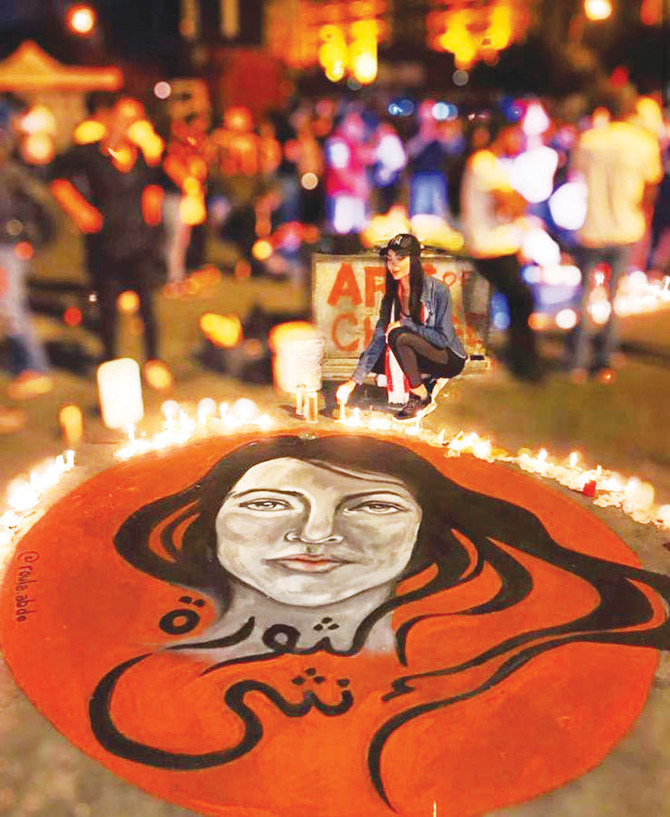
Meanwhile, what blankets the revolution’s walls of Martyrs’ Square; the ring (the tunnel linking west Beirut to east Beirut); the ESCWA (the UN Economic and Social Commission for West Asia) boundary wall; the area next to Parliament; throughout Tripoli; and in countless other places is another form of protest: Art.
“The art we were trying to express has documented almost all the incidents of the revolution so far, day by day,” said Said Fouad Mahmoud, a graffiti artist who has been practicing for 11 years. “Some people are good with speech, others with song, and we raise our voices with drawings. I drew pictures of the moments that affected me the most: The role of the female in the revolution; the guy cleaning with one leg; and the first day of the revolution, with the flag and the fire.”

Graffiti by Farah N Hamdan. (Supplied)
Many of the progressive-graffiti-laden walls fall under the umbrella of Iman Nasreddine Assaf’s Art of Change initiative, which she founded in May in partnership with local Beirut-based NGO Ahla Fawda and UK-based Where There’s Walls.
“Our purpose is to promote urban art to more than just the graffiti scene in order to spread important messages throughout the community,” said Assaf. “Our revolution walls are in support of, and part of, the demonstration and revolution. They are expressing people’s pain and demands and the impact has been strong. Art is the international language that touches all.”
Art has emerged as a favored medium of the revolutionaries to convey their political message. To this end, Art of Thawra (Art of Revolution), an Instagram page, is collecting and showcasing relevant artworks produced during the 2019 protests.
VIEW OUR GALLERY: Lebanon's revolution walls
“There’s been a drastic increase in street art during this revolution,” said Mahmoud. “People are trying to send messages through their paintings. The art indicates how civilized people have been during the protests and how peaceful the revolution has been until now. I hope it will remain peaceful until the end. If it does, then it means art played a major role in this revolution because art is peace in itself.”
Lebanon’s contemporary art community has issued numerous statements regarding the closures of spaces, programs and exhibitions as artists, curators, and gallerists participate in protests for non-sectarian unity. Beirut’s art community had just assembled for the Home Works event when the protests began on Oct. 17.
The message from the organizers, Ashkal Alwan, postponing the event stated: “Artistic and cultural institutions and initiatives are in no way isolated from broader civic, political, economic, and ideological context but rather shaped as a result of and in response to historical events and their repercussions.”
On Oct. 25 the Beirut Art Center sent out a similar statement: “In solidarity with and participation in the popular uprisings taking place across Lebanon against the current systems of power, we the undersigned cultural organizations and structures collectively commit to Open Strike, and call for our colleagues in the cultural sector to join us.”
Another artistic expression of solidarity is visible at leading Lebanese art dealer Saleh Barakat’s space in the Clemenceau area of Beirut. On Nov. 8 he opened a show featuring an installation by Palestinian Beirut-based artist Abdul Rahman Katanani.
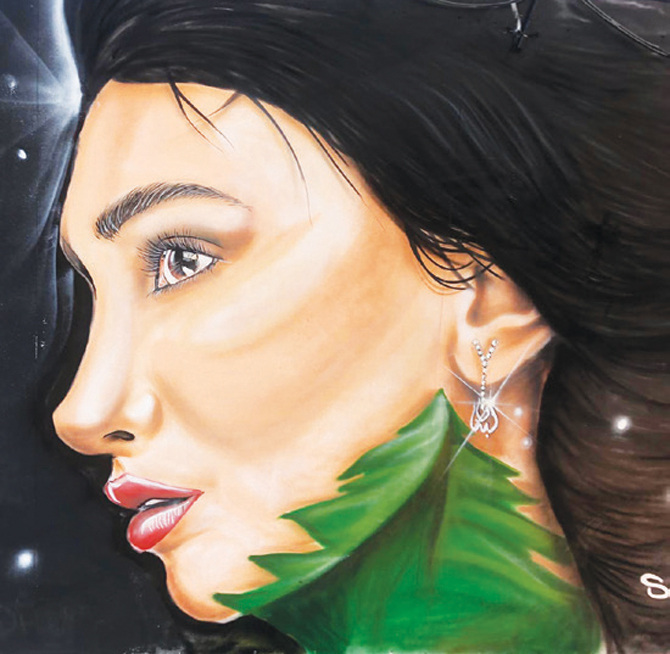
Graffiti by Said Fouad Mahmoud. (Supplied)
A series of temporary abodes made using painted scrap metal and wood, and surrounded by barbed wire — much like the surroundings of the Sabra refugee camp where the artist lives — were stationed throughout the gallery.
Katanani’s immersive and precarious installation, on view until Jan. 4, asks the question: What future awaits Lebanon?
“Many are now trying to figure out a good balance between getting their work done and participating in the public upheaval,” said Basel Dalloul, founder and director of the Dalloul Foundation. “Cultural production in all its forms can and will be one of the economic drivers of a future Lebanon.”
Ayman Baalbaki, one of Lebanon’s most recognized painters, “is not involved in creating art right now,” said Barakat. “He is going to all of the protests and is completely involved in the need for political change.”
The design duo David Raffoul and Nicolas Moussallem, whose studio goes by the name David/Nicolas, said in a statement: “What’s happening today is very important for all of us Lebanese who would like a brighter and honest future where corruption is not surrounding us.
“We are trying to work but it is not easy. Right now we are focused on how we can help our country.
“On the other hand, creativity is stronger because the revolution gives you such a push.
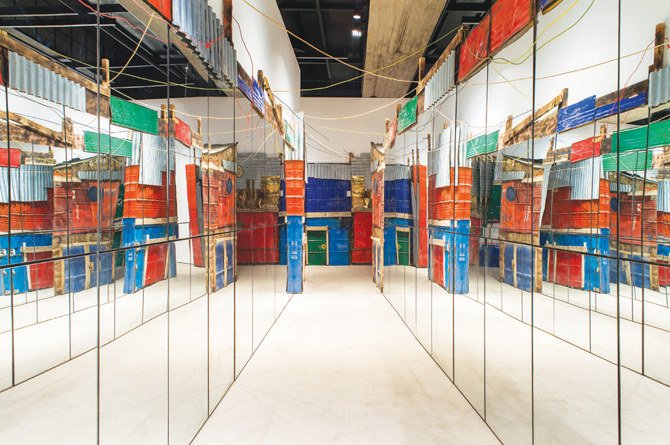
An installation by artist Abdul Rahman Katanani at Beirut's Saleh Barakat Gallery. (Supplied)
"Most places are closed and open spontaneously. Thank goodness for social media, so that we can show what we are doing to the world.”
Marwan Sahmarani, a Lebanese painter known for his bold abstract canvases replete with their gestural brushstrokes and vibrant coloring, noted the difficulty of working during a time of turmoil.
“It’s a disturbing moment for everyone,” he said. “There are many feelings, good and bad. I divide my time when needed between my studio and the street. But what do I paint that can be relevant now and not fall into a journalistic rendering of current events?”
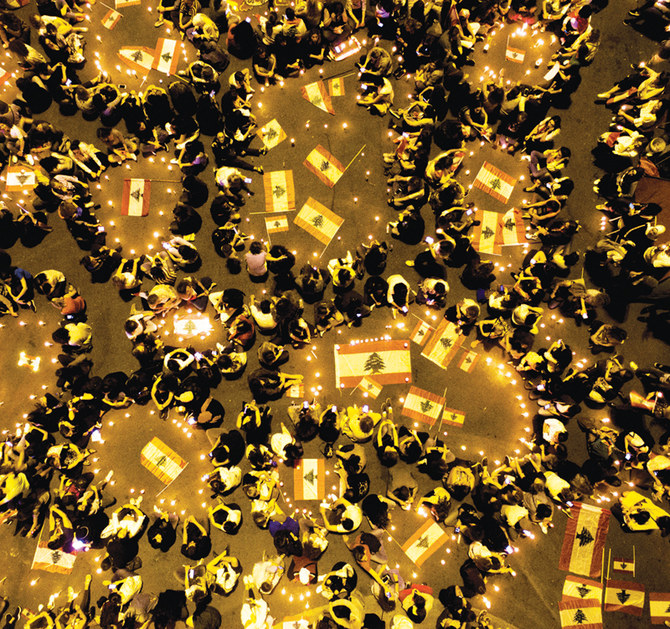
Individuals in the creative scene have joined hands in camaraderie to produce several initiatives in solidarity with the protesters. One is Nour Al-Thawra, staged by Sara Beydoun, founder of Lebanese fashion house and social enterprise Sara’s Bag, and her friend Mariana Wehbe.
On the evening of Nov. 6, a group of Lebanese women gathered in Martyrs' Square, each carrying a lighted candle. “Let’s light a candle for the strength we have shown and the resilience that will never die,” wrote Beydoun on her Instagram account. “Bring a candle and your peaceful prayer and let’s combine all of our strengths to light up Martyrs’ Square.”
Beydon told Arab News: “We all want one thing — the Lebanon we dream of.”
Wehbe agreed. “Sarah and I have been on the ground since day one,” she said. “Like every Lebanese woman from this revolution, each one of us is trying to find her way to help, support and move this forward.”
The candle-bearing crowd of women, which the pair turned into a moving video that went viral, was driven by the need to create a “peaceful symbolic prayer.”
“It was a prayer for our country, for our future, for unity, no matter where you come from and what your religious beliefs are,” said Wehbe. “It is a symbol of unity and protection for love, compassion and for our home, Lebanon.”


