Colombia defense minister quits amid firestorm over deaths

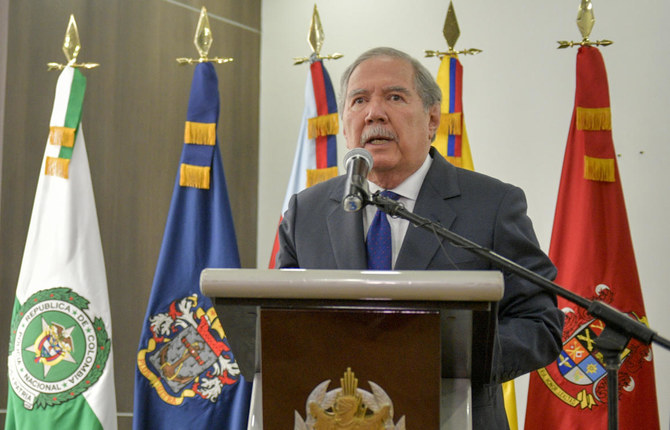
Botero presented his resignation on November 6, 2019, after being object of a lot of criticism regarding security policies. (File/AFP)
Updated 07 November 2019
Follow

Colombia defense minister quits amid firestorm over deaths

  • Guillermo Botero submitted a resignation letter to President Iván Duque
  • The former minister has been facing mounting criticism over his handling of several incidents

BOGOTA: Colombia’s defense minister resigned Wednesday after coming under fire for failing to disclose the deaths of several minors in a military operation against dissidents belonging to the nation’s once largest guerrilla.

Guillermo Botero submitted a resignation letter to President Iván Duque, touting his achievements in reducing crime while stating that the current “political circumstances” had compelled him to step down.

“I’ve accepted the resignation,” Duque announced on Twitter. “I want to thank him for his commitment, sacrifice and leadership.”

The former minister has been facing mounting criticism over his handling of several incidents highlighting Colombia’s ongoing struggle to defeat illegal armed groups without repeating past errors and rights abuses.

On Tuesday, Sen. Roy Barreras accused Botero of neglecting to inform the public that at least seven minors had been killed in a military operation against dissidents with the former Revolutionary Armed Forces of Colombia during a heated debate in congress.

Botero described the accusations as “speculative information” and the military denied it knew that minors were present.

Nonetheless, the chief prosecutor’s office confirmed Wednesday that eight minors died in the late August operation in San Vicente del Caguán, a region once controlled by the rebels, who signed a historic peace accord ending Latin America’s longest-running conflict in 2016.

“I’m convinced the minister withheld information not just from Colombians but from the president,” Barreras said Wednesday. “This is a wake-up call for the government, demanding they redirect the national agenda.”

The outrage over the deaths follows a number of other incidents raising concerns about the military’s conduct and their response to a growing tide of violence against indigenous communities and social leaders.

In one recent incident, a man living in the violence-plagued region of Cauca was killed in what the military has described as an operation against dissident guerrillas but which nearby residents contend was a homicide.

Two separate massacres in Cauca in late October, including one that left five indigenous leaders dead, outraged Colombians and underlined continuing security threats in regions where remnant illegal armed groups are battling over territory and lucrative drug routes.

Legislators debated removing Botero back in June, following revelations that an army general had commanded troops to double the number of leftist guerrillas and criminals killed, captured or forced to surrender in combat. The guidelines raised concerns about a heightened risk of civilian casualties.

Colombia’s military has been blamed for as many as 5,000 extrajudicial killings at the heights of the country’s armed conflict in the mid-2000s as troops under pressure by top commanders inflated body counts, in some cases dressing up civilians as guerrillas in exchange for extra pay and other perks.

What became known as the “false positives” scandal cast a dark shadow over the military’s record of battleground victories.

Botero first denied the existence of the new guidelines, but the military later announced it was retracting the order.

“This is clearly somebody who should have never been appointed to that position,” said José Miguel Vivanco, Americas director of Human Rights Watch. “I’m frankly surprised that he survived for so long.”


The man killed by a US Border Patrol officer in Minneapolis was an ICU nurse, family says

Alex J. Pretti, the man who was shot by a federal officer in Minneapolis on Saturday, Jan. 24, 2026. (AP)
Updated 9 sec ago
Follow

The man killed by a US Border Patrol officer in Minneapolis was an ICU nurse, family says

  • Family members said Pretti owned a handgun and had a permit to carry a concealed handgun in Minnesota. They said they had never known him to carry it

MINNEAPOLIS: Family members say the man killed by a US Border Patrol officer in Minneapolis on Saturday was an intensive care nurse at a VA hospital who cared deeply about people and was upset by President Donald Trump’s immigration crackdown in his city.
Alex Jeffrey Pretti, 37, was an avid outdoorsman who enjoyed getting in adventures with Joule, his beloved Catahoula Leopard dog who also recently died. He worked for the US Department of Veterans Affairs and had participated in protests following the Jan. 7 killing of Renee Good by an Immigration and Customs officer .
“He cared about people deeply and he was very upset with what was happening in Minneapolis and throughout the United States with ICE, as millions of other people are upset,” said Michael Pretti, Alex’s father. “He thought it was terrible, you know, kidnapping children, just grabbing people off the street. He cared about those people, and he knew it was wrong, so he did participate in protests.”
Pretti was a US citizen, born in Illinois. Like Good, court records showed he had no criminal record and his family said he had never had any interactions with law enforcement beyond a handful of traffic tickets.
In a recent conversation with their son, his parents, who live in Colorado, told him to be careful when protesting.
“We had this discussion with him two weeks ago or so, you know, that go ahead and protest, but do not engage, do not do anything stupid, basically,” Michael Pretti said. “And he said he knows that. He knew that.”
The Department of Homeland Security said that the man was shot after he “approached” Border Patrol officers with a 9 mm semiautomatic handgun. Officials did not specify if Pretti brandished the gun. In bystander videos of the shooting that emerged soon after, Pretti is seen with a phone in his hand but none appears to show him with a visible weapon.
Family members said Pretti owned a handgun and had a permit to carry a concealed handgun in Minnesota. They said they had never known him to carry it.
Alex Pretti’s family struggles for information about what happened
The family first learned of the shooting when they were called by an Associated Press reporter. They watched the video and said the man killed appeared to be their son. They then tried reaching out to officials in Minnesota.
“I can’t get any information from anybody,” Michael Pretti said Saturday. “The police, they said call Border Patrol, Border Patrol’s closed, the hospitals won’t answer any questions.”
Eventually, the family called the Hennepin County Medical Examiner, who they said confirmed had a body matching the name and description of their son.
As of Saturday evening, the family said they had still not heard from anyone at a federal law enforcement agency about their son’s death.
Alex Pretti grew up in Green Bay, Wisconsin, where he played football, baseball and ran track for Preble High School. He was a Boy Scout and sang in the Green Bay Boy Choir.
After graduation, he went to the University of Minnesota, graduating in 2011 with a bachelor’s degree in biology, society and the environment, according to the family. He worked as a research scientist before returning to school to become a registered nurse.
Alex Pretti had protested before
Pretti’s ex-wife, Rachel N. Canoun, said she was not surprised he would have been involved in protesting Trump’s immigration crackdown. She said she had not spoken to him since they divorced more than two years ago and she moved to another state.
She said he was a Democratic voter and that he had participated in the wave of street protests following the killing of George Floyd by a Minneapolis police officer in 2020, not far from the couple’s neighborhood. She described him a someone who might shout at law enforcement officers at a protest, but she had never known him to be physically confrontational.
“These kinds of things, you know, he felt the injustice to it,” Canoun said. “So it doesn’t surprise me that he would be involved.”
Canoun said Pretti got a permit to carry a concealed firearm about three years ago and that he owned at least one semiautomatic handgun when they separated.
“He didn’t carry it around me, because it made me uncomfortable,” she said.
Pretti had ‘a great heart’
Pretti lived in a four-unit condominium building about 2 miles (3.2 kilometers) from where he was shot. Neighbors described him as quiet and warmhearted.
“He’s a wonderful person,” said Sue Gitar, who lived downstairs from Pretti and said he moved into the building about three years ago. “He has a great heart.”
If there was something suspicious going on in the neighborhood, or when they worried the building might have a gas leak, he would jump in to help.
Pretti lived alone and worked long hours as a nurse, but he was not a loner, his neighbors said, and would sometimes have friends over.
His neighbors knew he had guns — he’d occasionally take a rifle to shoot at a gun range — but were surprised at the idea that he might carry a pistol on the streets.
“I never thought of him as a person who carried a gun,” said Gitar.
Pretti was also passionate about the outdoors
A competitive bicycle racer who lavished care on his new Audi, Pretti had also been deeply attached to his dog, who died about a year ago.
His parents said their last conversation with their son was a couple days before his death. They talked about repairs he had done to the garage door of his home. The worker was a Latino man, and they said with all that was happening in Minneapolis he gave the man a $100 tip.
Pretti’s mother said her son cared immensely about the direction the county was headed, especially the Trump administration’s rollback of environmental regulations.
“He hated that, you know, people were just trashing the land,” Susan Pretti said. “He was an outdoorsman. He took his dog everywhere he went. You know, he loved this country, but he hated what people were doing to it.”