Traders hope for US-China trade deal and an improving economy

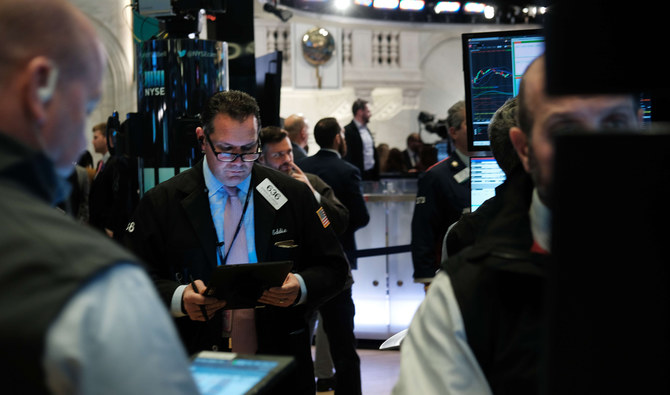
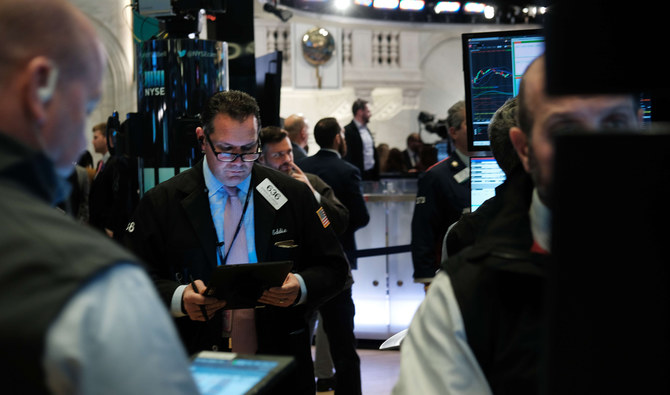
Traders work on the floor of the New York Stock Exchange (NYSE) on November 04, 2019 in New York City. (Getty Images/AFP)
Updated 05 November 2019
Follow

Traders hope for US-China trade deal and an improving economy

  • “There is growing enthusiasm over a trade deal, as progress is being made in these talks”: economist

NEW YORK: Wall Street’s three main indexes opened at record highs on Monday, buoyed by hopes of a US-China trade deal and an improving domestic economy.

Washington and Beijing said on Friday they had made progress in defusing an economically damaging trade war, with US officials indicating that a deal could be signed this month.

Adding to the optimism, Commerce Secretary Wilbur Ross said on Sunday licenses for US companies to sell components to China’s Huawei Technologies Co. would come “very shortly” and that there was no reason a trade deal could not be on track to be signed this month.

“There is growing enthusiasm over a trade deal, as progress is being made in these talks,” said Peter Cardillo, chief market economist at Spartan Capital Securities in New York.

“Investors are betting that some sort of a deal is on its way, not a whole deal but something that will at least avoid a recession. And markets can live with that,” he added. Trade sensitive chipmakers including Intel Corp, Micron Technology and Nvidia Corp. rose between 0.7 percent and 2 percent in premarket trading.

US-listed Chinese stocks such as online games and media provider NetEase Inc, Internet search provider Baidu Inc. and e-commerce firm JD.Com were also up between 1.6 percent and 3.6 percent.

The S&P 500 and Nasdaq index hit record highs in the previous session after data showed US jobs growth slowed less than expected in October, easing concerns about the fallout of the trade war on domestic economy.

A robust third quarter earnings season has also added to an upbeat mood, with about 76 percent of the 356 S&P 500 companies that have reported results so far beating profit expectations, according to Refinitiv data.

FASTFACT

US-listed Chinese stocks such as online games and media provider NetEase Inc, Internet search provider Baidu Inc. and e-commerce firm JD.Com were also up between 1.6 percent and 3.6 percent.

Companies such as Uber Technologies Inc, Qualcomm Inc, Walt Disney Co. and CVS Health Corp. are set to report results this week.

Fresh economic data is expected to show US factory orders falling 0.5 percent in September compared to a 0.1 percent drop in August.

Dow e-minis were up 178 points, or 0.65 percent. S&P 500 e-minis were up 19.25 points, or 0.63 percent and Nasdaq 100 e-minis were up 65.25 points, or 0.8 percent.

Under Armor Inc. slid 14.6 percent as it lowered its full-year revenue forecast for a second straight time, a day after it confirmed a federal probe related to its accounting practices.

McDonald’s Corp. fell 1.7 percent after the fast-food giant dismissed CEO Steve Easterbrook over a recent consensual relationship with an employee, which the board determined violated company policy.

US-listed shares of Tesla rival Nio Inc. jumped 9.2 percent as it reported a 25 percent jump in vehicle deliveries in October. With nearly 363,000 shares traded before the bell, it was among the most actively-traded US stocks. 


Saudi Arabia, Japan trade rises 38% between 2016 and 2024, minister says

Updated 11 January 2026
Follow

Saudi Arabia, Japan trade rises 38% between 2016 and 2024, minister says

RIYADH: Trade between Saudi Arabia and Japan has increased by 38 percent between 2016 and 2024 to reach SR138 billion ($36 billion), the Kingdom’s investment minister revealed.

Speaking at the Saudi-Japanese Ministerial Investment Forum 2026, Khalid Al-Falih explained that this makes the Asian country the Kingdom’s third-largest trading partner, according to Asharq Bloomberg.

This falls in line with the fact that Saudi Arabia has been a very important country for Japan from the viewpoint of its energy security, having been a stable supplier of crude oil for many years.

It also aligns well with how Japan is fully committed to supporting Vision 2030 by sharing its knowledge and advanced technologies.

“This trade is dominated by the Kingdom's exports of energy products, specifically oil, gas, and their derivatives. We certainly look forward to the Saudi private sector increasing trade with Japan, particularly in high-tech Japanese products,” Al-Falih said.

He added: “As for investment, Japanese investment in the Kingdom is good and strong, but we look forward to raising the level of Japanese investments in the Kingdom. Today, the Kingdom offers promising opportunities for Japanese companies in several fields, including the traditional sector that links the two economies: energy.”

The minister went on to note that additional sectors that both countries can also collaborate in include green and blue hydrogen, investments in advanced industries, health, food security, innovation, entrepreneurship, among others.

During his speech, Al-Falih shed light on how the Kingdom’s pavilion at Expo 2025 in Osaka achieved remarkable success, with the exhibition receiving more than 3 million visitors, reflecting the Japanese public’s interest in Saudi Arabia.

“The pavilion also organized approximately 700 new business events, several each day, including 88 major investment events led by the Ministry of Investment. Today, as we prepare for the upcoming Expo 2030, we look forward to building upon Japan’s achievements,” he said.

The minister added: “During our visit to Japan, we agreed to establish a partnership to transfer the remarkable Japanese experience from Expo Osaka 2025 to Expo Riyadh 2030. I am certain that the Japanese pavilion at Expo Riyadh will rival the Saudi pavilion at Expo Osaka in terms of organization, innovation, and visitor turnout.”

Al-Falih also shed light on how Saudi-Japanese relations celebrated their 70th anniversary last year, and today marks the 71st year of these relations as well as how they have flourished over the decades, moving from one strategic level to an even higher one.