Southeast Asian leaders meet under US-China trade war cloud

A draft final statement for the ASEAN summit says the leaders would express ‘deep concern over the rising trade tensions and on-going protectionist and anti-globalization sentiments.’ (AFP)
Updated 02 November 2019
Follow

Southeast Asian leaders meet under US-China trade war cloud

  • Mahathir Mohamad: ‘We don’t want to go into a trade war. But sometimes when they’re unnice to us, we have to be unnice to them’
  • Export reliant Southeast Asian states are at the sharp end of the US-China trade war

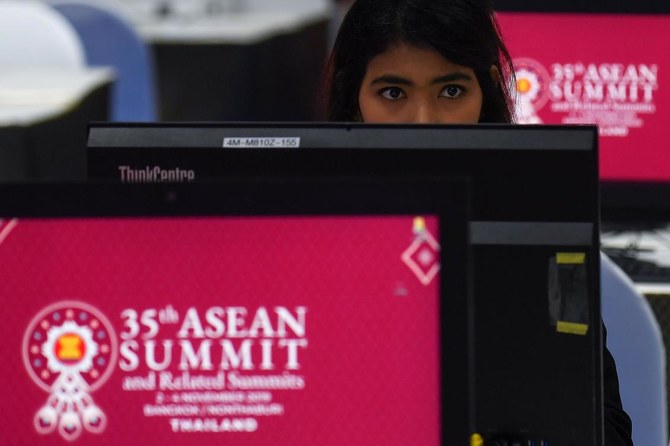
BANGKOK: Southeast Asian countries must stick together in the face of a trade war started by US President Donald Trump, Malaysia’s veteran leader said on Saturday at the start of a regional summit held in the shadow of US-China tensions.
But as leaders of the 10-member Association of Southeast Asian Nations (ASEAN) met in Bangkok, there was no sign they had yet finalized a planned trade deal backed by China that could create the world’s biggest free trade area.
“We don’t want to go into a trade war. But sometimes when they’re unnice to us, we have to be unnice to them,” Mahathir Mohamad, Malaysia’s outspoken 94-year-old prime minister told a business summit on the sidelines of the main meeting.
In an obvious reference to Trump, whose administration began raising tariffs on Chinese imports with the goal of reducing the US trade deficit, Mahathir said “If the person is not there, maybe there will be a change.”
A draft final statement for the ASEAN summit seen by Reuters said the leaders would express “deep concern over the rising trade tensions and on-going protectionist and anti-globalization sentiments.”
Trade would be the main topic, diplomats said, with little discussion expected on perennial regional problems such as maritime disputes with China over the South China Sea and the plight of Rohingya refugees driven from Myanmar.
“We want global economic peace,” said Arin Jira, chairman of the ASEAN Business Advisory Council, a body set up by member states.
Export reliant Southeast Asian states are at the sharp end of the trade war, with growth expected to slow to its lowest in five years this year. They are also worried at increasing Chinese influence in a region whose population of more than 620 million is still less than half of China’s.
The United States, an important trade partner, is sending a delegation to the meetings. But the downgrading of its delegation compared to those in previous years and to those of other countries has concerned those who saw Washington as a security counterweight to Beijing.
Instead of President Donald Trump or Vice President Mike Pence, the United States will be represented by Commerce Secretary Wilbur Ross and White House national security adviser Robert O’Brien. China is sending its premier, Li Keqiang.
“This signals that the US is a lesser player in our area,” Kantathi Suphamongkhon, former Thai foreign minister told Reuters.
Southeast Asian states had hoped to make progress toward finalizing the Regional Comprehensive Economic Partnership (RCEP) — comprising 16 countries that account for a third of global gross domestic product and nearly half the world’s population.
But that was unclear after a scheduled news conference was canceled late on Friday. A major sticking point has been demands from India, which is worried about a potential flood of Chinese imports.
“The finalization of the RCEP negotiation has become a key test for ASEAN’s capacity to deliver on its often-cited centrality,” Marty Natalegawa, a former Indonesian foreign minister, told Reuters.
Human rights groups said they did not expect the Southeast Asian countries would do much to address problems such as the Rohingya refugees or discuss questions such as the growing authoritarianism in some member states.
“ASEAN will go far. ASEAN will endure,” was the jingle played repeatedly on the conference sound system. “Our neighborhood becomes brotherhood,” it said.


Blacklisted naphtha tanker from Russia enters Venezuelan waters while another diverts, ship data shows

Updated 56 min 28 sec ago
Follow

Blacklisted naphtha tanker from Russia enters Venezuelan waters while another diverts, ship data shows

  • Under U.S. sanctions related to Russia, the ship has a different sanctions profile than Skipper, the tanker that was seized by the U.S. on December 10

HOUSTON: A tanker subject to U.S. sanctions carrying some 300,000 barrels of naphtha from Russia entered Venezuelan waters late ​on Thursday, while another began redirecting course in the Atlantic Ocean, ship tracking data showed, a reflection of diverging last-minute decisions by ship owners after President Donald Trump ordered a "blockade" of oil tankers under sanctions bound for the OPEC country earlier this week.
The move ramped up pressure on Venezuelan president Nicolas Maduro by targeting the country's main source of income and followed the seizure by the U.S. of an oil tanker off the coast of Venezuela earlier in December.
Vessels that were not subject to sanctions began setting sail on Wednesday from Venezuelan waters after a week's pause, helping drain the country's mounting crude stocks.

HIGHLIGHTS

• Trump's 'blockade' aims to halt sanctioned oil tankers to Venezuela

• Hyperion's sanctions profile differs from seized Skipper tanker

• Venezuela condemns US actions as violating international law

Gambia-flagged medium tanker Hyperion docked on Friday at Amuay ‌Bay on Venezuela's ‌western coast, according to LSEG ship tracking data. It loaded near ‌Murmansk ⁠in ​Russia in ‌late November.
Under U.S. sanctions related to Russia, the ship has a different sanctions profile than Skipper, the tanker that was seized by the U.S. on December 10.
The U.S. can only seize vessels outside of its jurisdiction, or vessels that aren't heading to or from the country, if Washington has placed them under sanctions for links to groups it designates as terrorist, said David Tannenbaum, a director at consulting firm Blackstone Compliance Services that specializes in sanctions and anti-money laundering compliance.
Skipper, formerly called the Adisa, was under sanctions for what the U.S. says was involvement in Iranian oil trading that generated ⁠revenue for Iranian groups it has designated as foreign terrorist organizations.
With the Hyperion, though, sanctions were imposed to reduce Russian revenues from energy because of ‌its war with Ukraine.
"The Hyperion doesn't have known ties to ‍terrorism, and therefore unless they can prove it's subject ‍to the jurisdiction of the U.S., Washington can't grab it extraterritorially," said Tannenbaum, who previously worked with the ‍U.S. Treasury's Office of Foreign Assets Control that administers and enforces economic and trade sanctions.

REDIRECTS AND U-TURNS
The Angola-flagged Agate, another medium tanker under sanctions that loaded in Russia and had been sailing toward the Caribbean, was seen redirecting on Friday, according to LSEG ship tracking. The vessel was pointing towards Africa, but had not yet signaled a new destination.
Oman-flagged Garnet, also under sanctions ​and loaded in Russia, continued on its track, signaling the Caribbean as its destination on Friday.
Benin-flagged tanker Boltaris, under sanctions and carrying some 300,000 barrels of Russian naphtha bound for Venezuela, made ⁠a U-turn earlier this month and was heading for Europe without having discharged, according to LSEG vessel monitoring data.
Two very large crude carriers not subject to sanctions set sail for China on Thursday from Venezuela, according to sources familiar with Venezuela's oil export operations, marking only the second and third tankers unrelated to Chevron to depart the country since the U.S. seized Skipper.
The American oil major, which has continued to ship Venezuelan crude under a U.S. authorization, exported a crude cargo on Thursday bound for the U.S., LSEG data showed.
Secretary of State Marco Rubio on Friday said the U.S. was not concerned about the four vessels that sailed from Venezuela on Thursday, as those were not ships under sanctions.
"Sanctioned boats, we have the capabilities necessary to enforce our laws. We'll have a judicial order, we'll execute on those orders and there's nothing that will impede us from being able to do that," Rubio said.
Venezuela's government ‌called Trump's blockade a "grotesque threat" in a statement on Tuesday, saying it violates international law, free commerce and the right of free navigation.