

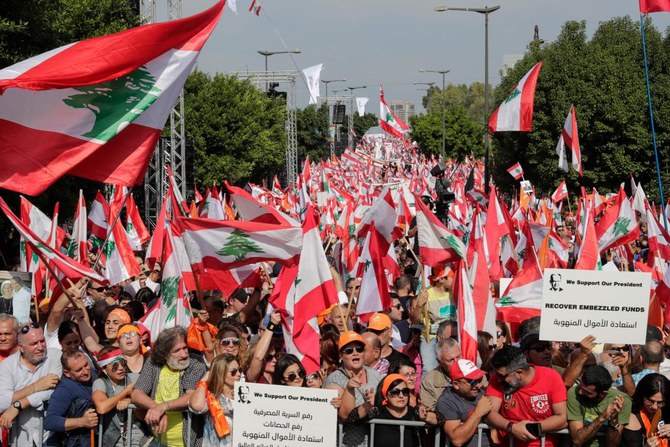
Aoun tells thousands of supporters Lebanon must unite behind reforms

Supporters of Lebanese President Michel Aoun wave national flags and orange-coloured banners during a counter-protest near the presidential palace in Baabda on November 3, 2019. (File/AFP)
Updated 09 November 2019
Follow

Aoun tells thousands of supporters Lebanon must unite behind reforms

  • Fans of the president waved large Lebanese flags and orange-coloured banners of the political party he founded, the Free Patriotic Movement
  • Gathering runs counter to the mass protests that have gripped the country, calling for ruling class to step down

BAABDA, Lebanon: Lebanon’s president Sunday called on citizens to unite behind reforms, after more than two weeks of nationwide anti-graft protests that brought down the government.
Embattled President Michel Aoun addressed thousands of his supporters thronging the road outside the presidential palace, ahead of more mass anti-government protests planned in Beirut in the afternoon.
Unprecedented cross-sectarian demonstrations have gripped Lebanon since Oct. 17, demanding a complete overhaul of a political system deemed inefficient and corrupt.

Opinion

This section contains relevant reference points, placed in (Opinion field)

The cabinet stepped down on Tuesday, but protesters have said this was not enough and pledged to meet for another demonstration Sunday afternoon in Beirut.
In a live televised address beamed to his fans and around the nation, Aoun called on supporters and protesters alike to rally behind a plan for reforms.
“I call on you all to unite,” the Maronite Christian state leader said, warning against having “one protest against another.”
The 84-year-old president said a roadmap had been drawn up to tackle corruption, redress the economy, and put together a civil government.
“It won’t be easy, and we want your efforts,” he said, leaning on a pulpit inside the palace in the town of Baabda outside Beirut.
Protesters have called for an end to Aoun’s tenure, as well as drastic change to a political system dominated by the same figures and families since the end of the 1975-1990 civil war.
“All of them means all of them,” has become a popular chant calling for all political leaders to step down.
Outside the palace, an AFP correspondent saw Aoun’s supporters chanting, some brandishing the orange-colored banners of his political party, the Free Patriotic Movement.
“We are here, General. We won’t abandon you as long as we live,” one poster read, referring to the army’s youngest-ever commander in chief during the civil conflict.
Aoun’s supporters said they backed the overall demands of protesters nationwide, but insisted the president was the only man able to bring about reforms.
“General Aoun is a reformist and sincere man — not corrupt nor a thief,” said one supporter who gave her name as Diana.
“There has been corruption in the state for 30 years,” she said.
“The president isn’t responsible. He’s trying to fight against graft.”
Along with its allies including powerful Shiite movement Hezbollah, Aoun’s political party holds the majority in parliament.
The FPM is now headed by his son-in-law Gibran Bassil, who has emerged as one of the most reviled figures in the protests.
Before the cabinet resigned on Tuesday, Bassil was foreign minister.
A proposed tax on calls via free phone applications such as Whatsapp triggered protests last month.
But they soon morphed into a huge nationwide movement to denounce a raft of woes including a lack of basic services, a failing economy, and rampant sectarianism.
On Tuesday, prime minister Saad Hariri — a Sunni Muslim — announced his government would be stepping down.
But it is still unclear what a new cabinet will look like, and if it will include independent technocrats as demanded by demonstrators.
After around two weeks of closure, banks and some schools re-opened this week.
But protesters have vowed to press ahead with their demands and — after numbers dwindled amid rain in recent days — were set to make a broad stand on Sunday afternoon in Beirut’s main square.
On Saturday night, thousands of anti-government protesters had flocked together in the impoverished northern city of Tripoli to keep the popular movement alive.
Several said they had traveled to the Sunni-majority city from other parts of the country, inspired by the after-dark street parties that earned it the title “bride of the revolution.”
More than 25 percent of Lebanese citizens live in poverty, the World Bank says.
The country’s economic growth has stalled in recent years in the wake of repeated political crises, compounded by an eight-year civil war in neighboring Syria.


Refugees, migrants in Lebanon find rare sanctuary from Israeli strikes in Beirut church 

Updated 07 March 2026
Follow

Refugees, migrants in Lebanon find rare sanctuary from Israeli strikes in Beirut church 

  • Beirut church offers safe haven for displaced migrants, refugees
  • Many refugees lived through 2024 war, but are now more vulnerable

BEIRUT: When Israeli strikes began pummelling Beirut’s southern suburbs early on Monday, Sudanese refugee Ridina Muhammad and her family ​had no choice but to flee home on foot, eventually reaching the only shelter that would accept them: a church.
Eight months pregnant, Muhammad, 32, walked with her husband and three children for hours in the dark streets until they found a car to take them to the St. Joseph Tabaris Parish, which has opened its doors to refugees and migrants.
They are among 300,000 people displaced across Lebanon this week by heavy Israeli strikes, launched in response to a rocket and drone attackinto Israel by the Lebanese armed group Hezbollah.
Just 100,000 of the displaced are in government shelters. Others are staying ‌with relatives ‌or sleeping in the streets. But migrants and refugees say government ​shelters ‌were ⁠never an option ​for ⁠them, saying they were turned away during the last war between Hezbollah and Israel.
Muhammad’s oldest daughter, now seven, stopped speaking after the 2024 war.
This time, they are even more vulnerable: their home was destroyed in this week’s strikes and Muhammad is due to give birth at the end of the month.
“I don’t know if there’s a doctor or not, but I’m really scared about it because I haven’t prepared any clothes for the baby, nor arranged a hospital, and I don’t know where to go,” she told ⁠Reuters as her younger daughter leaned against her pregnant belly.
Muhammad ‌said she was registered with the United Nations’ refugee agency (UNHCR) ‌but had not received support.
“Us, as refugees, why did we ​register with the UN, if they are not ‌helping us in the most difficult times?” she said.
Dalal Harb, a spokesperson for UNHCR ‌Lebanon, said the agency had mobilized but reaching everyone immediately was extremely challenging given the scale and speed of displacement. The UNHCR operation in Lebanon is currently only around 14 percent funded, she said.
The Jesuit Refugee Service (JRS), which helped the church host displaced in 2024, is doing so again.
Michael Petro, JRS’ Emergency Shelter Director, said the church was ‌full within the first day of strikes, with 140 people from South Sudan, Ethiopia, Bangladesh, and other countries sheltering there.
“There are many, many more ⁠people coming than there ⁠were in 2024, and we have fewer and fewer places to put them,” he said.
Petro said he was told weeks ago that government shelters would be open to migrants if war erupted.
But when the strikes began and even Lebanese struggled to find shelter, the policy seemed to change, he said.
“We’re hearing from hotlines up to government officials and ministries that migrants are not welcome,” Petro said.
Lebanon’s Minister for Social Affairs Haneen Sayyed did not respond to a request for comment. On Thursday, Sayyed said Beirut shelters were full.
When Israeli strikes began, Othman Yahyeh Dawood, a 41-year-old Sudanese man, put his two young sons on his motorcycle.
They drove 75 kilometers (46 miles) from the southern Lebanese town of Nabatieh to St. Joseph’s, where they had sheltered in 2024.
“I know the area ​is safe and there are people who ​will welcome us,” he said.
“We don’t know where to go; there’s war there (in the south), war here (in Beirut), war in Sudan, and nowhere else to go,” he said.