Film Review: ‘Bitter Chestnut’ explores a contemporary quandary

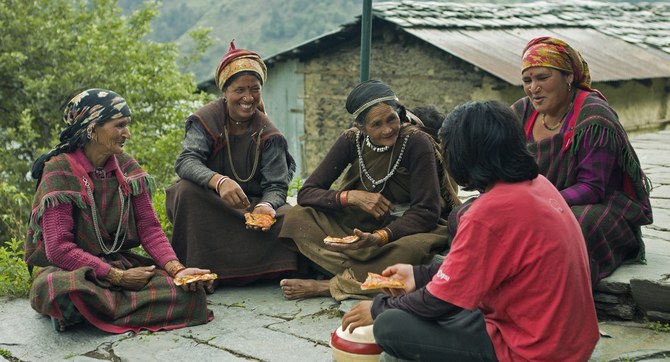
The story is set after Operation Blue Star. (Supplied)
Updated 07 October 2019
Follow

Film Review: ‘Bitter Chestnut’ explores a contemporary quandary

CHENNAI: It can be fascinating when a filmmaker surprises us by transcending genres. While Indian Director Gurvinder Singh told us in his debut 2011 feature “Alms for a Blind Horse” (which premiered at Venice) about the struggles of a village against land grabs and ruthless industrialization, his second outing in 2015, “The Fourth Direction,” took Cannes by storm.

The story is set after Operation Blue Star (when the Indian military stormed the Golden Temple in Amritsar to flush out militants), and examines the dilemma of a people caught between the excesses of government forces and rebels.

In his latest foray into cinema, “Bitter Chestnut” (“Khanaur”), which had its world premiere at the 24th Busan International Film Festival, Singh completely changes track. This time, he takes us to the tranquil environs of the Himalayas, to a small but idyllic town called Bir. There, 17-year-old Kishan (Kishan Katwal) works in a little cafe run by an elderly woman from Kerala, played by Monisha Mukundan.
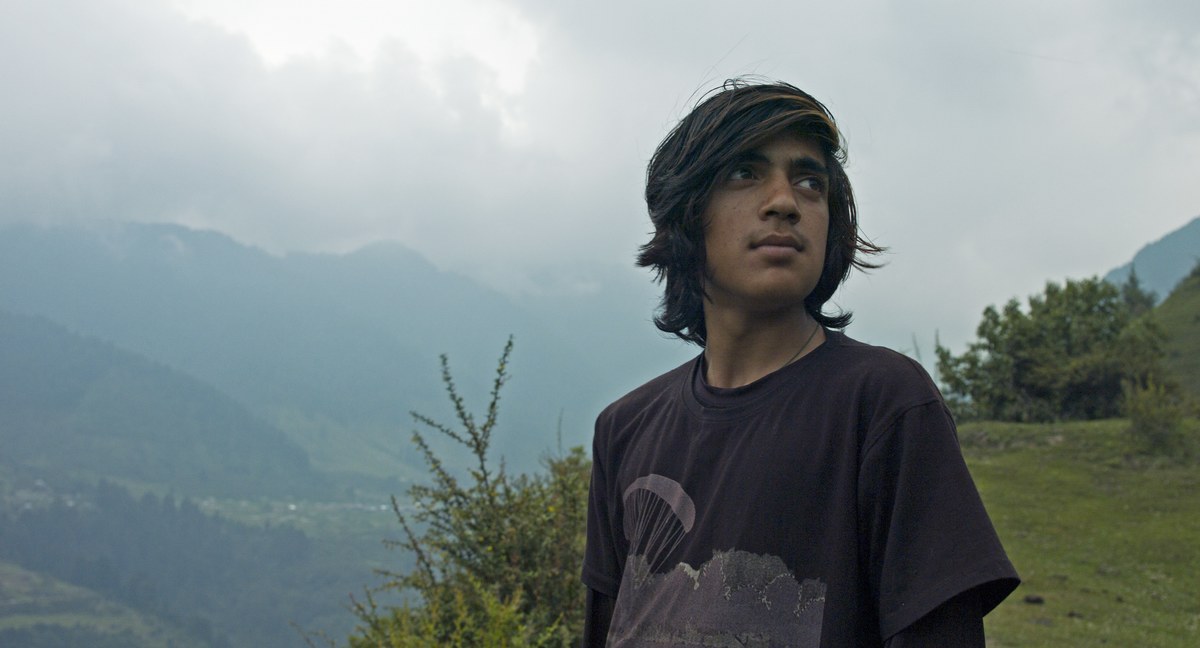
She, like some others, have left the hustle and bustle of city life for peace and quiet. The tourists who stop by at Bir (a center for paragliding) are her only source of diversion, maybe distraction. Her motherly instincts are etched sharply when we see her relationship with Kishan, who has left behind his family in Baragraan, many miles away. 

Kishan is torn between his desire to explore new frontiers, a fresh lifestyle with a job in the city, and the demand of his family to take up its traditional profession of carpentry. He cannot decide, his dreams to move away clashing with his own insecurities of a life he has no clue about.

He watches how guests at the cafe seem distraught and disgruntled with the modern, urban existence. He contrasts this with his own life, amidst a people who have learnt to live with a multitude of cultures and in perfect harmony with nature. 
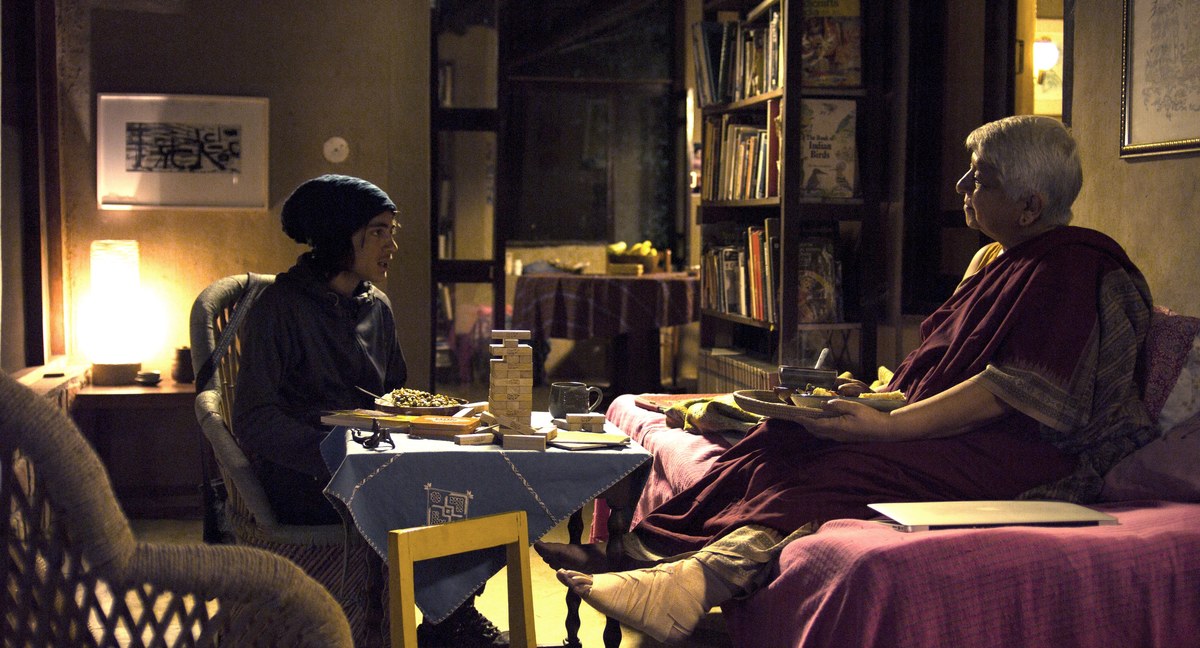
In 100 minutes, Singh explores a giant of an idea — the conflict between tradition and modernism — by using non-professionals. Katwal actually works in the cafe, his parents are his own, and Mukundan lives in Bir. It could not have been easy to direct such a group to narrate a story that tugs at your heart.

For all those used to Hollywood cinema’s pace, Singh’s latest outing may seem stretched and ponderous, but “Bitter Chestnut” hides a spirited message. 


Lina Gazzaz traces growth, memory and resilience at Art Basel Qatar 

Updated 30 January 2026
Follow

Lina Gazzaz traces growth, memory and resilience at Art Basel Qatar 

  • The Saudi artist presents ‘Tracing Lines of Growth’ at the fair’s inaugural edition 

DUBAI: Saudi artist Lina Gazzaz will present a major solo exhibition via Hafez Gallery at the inaugural edition of Art Basel Qatar, which runs Feb. 3 to 7. “Tracing Lines of Growth” is a body of work that transmutes botanical fragments into meditations on resilience, memory and becoming. 

Hafez Gallery, which was founded in Jeddah, frames the show as part of its mission to elevate underrepresented regional practices within global conversations. Gazzaz’s biography reinforces that reach. Based in Jeddah and trained in the United States, she works across sculpture, installation, painting and video, and has exhibited in Saudi Arabia, the US, Lebanon, the UK, Germany, the UAEand Brazil. Her experimental practice bridges organic material and conceptual inquiry to probe ecological kinship, cultural memory and temporal rhythm. 

 Saudi artist Lina Gazzaz. (Supplied)

“Tracing Lines of Growth” is a collection rooted in long-term inquiry. “I started to think about it in 2014,” Gazzaz told Arab News, describing a project that has evolved from her initial simple line drawings through research, experimentation and material interrogation. 

What began as tracing the lines of Royal Palm crown shafts became an extended engagement with the palm’s physiology, its cultural significance and its symbolic afterlives. During the COVID-19 pandemic, she went deeper into that exploration, translating weathered crown shafts into “lyrical instruments of time.” 

Each fragment of “Tracing Lines of Growth” is treated as a cache of human and ecological narratives. Gazzaz describes a feeling of working with materials that “have witnessed civilization,”attributing to them a deep collective memory. 

Hafez Gallery’s presentation text frames the palm as a cipher — its vascular routes once pulsing with sap transformed into calligraphic marks that summon the bodies of ouds, desert dunes and scripted traces rooted in Qur’anic and biblical lore. 

Detail of Gazzaz's work. (Supplied)

“Today, the palm has evolved into a symbol of the land and its people. Throughout the Arabian Peninsula, it is still one of the few agricultural exports; and plays an integral role in the livelihood of agrarian communities,” said Gazzaz. 

The sculptures’ rippling ribs and vaulted folds, stitched with red thread, evoke what the artist hears and sees in the wood. “Each individual line represents a story, and it’s narrating humanity’s story,” she said. 

The works’ stitching is described in the gallery’s materials as “meticulous.” It emphasizes linear pathways and punctuates the sculptures with the “suggestion of life’s energy moving through the dormant material.” 

“(I used) fine red thread — the color of life and energy — to narrate the longevity of growth, embodying themes of balance, fragility, music, transformation and movement. The collection is about the continuous existence in different forms and interaction; within the concept of time,” Gazzaz explained. 

Hand-stitching, in Gazzaz’s practice, highlights her insistence on care and repair, and the human labor that converts cast-off organic forms into carriers of narratives. 

Gazzaz describes her practice as a marriage between rigorous research and intuitive making. “I am a search-based artist... Sometimes I cannot stop searching,” she said. “During the search and finding more and more, and diving more and more, the subconscious starts to collaborate with you too, because of your intention. After all the research, I go with the flow. I don’t plan... I go with the flow, and I listen to it.” 

The artist is far from done with this particular project. “I am now beginning to explore the piece with glass,” she noted. 

Art Basel Qatar’s curatorial theme for its inaugural year is “Becoming.” For Gazzaz, ‘becoming’ is evident in the material and conceptual transformations she stages: discarded palm fragments reconstituted into scores of lived time, stitched lines reactivated as narratives.  

“It’s about balance. It’s about fragility. It’s about resilience,” she said.