





BEIRUT: Celebrations of Saudi National Day held on Sunday at the Saudi Embassy in Lebanon was marked by the positive exchange of solidarity messages.
The political, cultural, social and diplomatic crowd that attended expressed Lebanon’s solidarity with Saudi Arabia against any attempt to harm the Kingdom’s sovereignty.
Saudi Ambassador Walid bin Abdullah Bukhari chose the square of the National Museum in Beirut as the location for the celebration.
In a speech, Bukhari said: “Your sincere love for my country has repeatedly shown the depth and solidity of ties between Lebanon and Saudi Arabia, based on goodness, peace, justice and brotherhood.”
He said the square was chosen as “it represents the unity of all Lebanese brothers, in their different sects, and their devotion for their coexistence history.”
“Today, we celebrate the past of a glorious nation and its bright present, reflected in the era of King Salman by an insightful vision and firm positions dealing with crucial issues on the local, regional and international levels and giving the Kingdom its true status: A pioneer on the Arab, Islamic and international levels.
“Saudi National Day this year is being celebrated in light of exceptional developments in the region and numerous challenges facing the Arab countries, with Saudi Arabia on top of that list, as it still is a victim of aggressions with clear objectives and intentions.”
The envoy added that “the cowardly attack on the vital oil installations does not only target the Kingdom but the whole world. It is an attack on the global energy supply for international markets.”
Bukhari reiterated his country’s condemnation of the attack. “It targets the global energy supply, and is a continuation of the previous attacks against the Kingdom, with arms of Iranian origin,” he said.
We are also looking forward to maintaining the Saudi-Lebanese relationship.
Alain Aoun Lebanese MP
He recalled the words of King Abdul Aziz, who said: “Lebanon is part of us. I protect its independence myself and will not allow anything to harm it.”
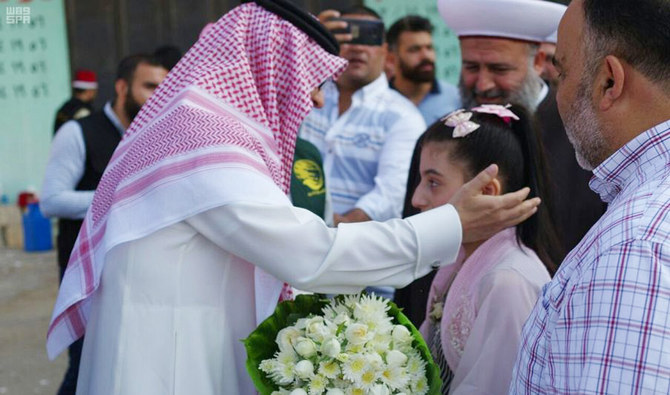
The celebration continued with fireworks lighting up the skies above Beirut. Children of Saudis residing in Lebanon also attended the event. They walked down the red carpet that covered the road leading to the National Museum, with green scarves around their necks, emblazoned with the countries’ flags.
A Saudi folk dance group performed the traditional Ardah dance. Lebanese poet Talal Haidar delivered some popular recitations. Photos of King Salman and Lebanese President Michel Aoun were hung up on the museum’s walls, where a visual presentation was displayed.
Aoun was represented by Lebanese Tourism Minister Avedis Guidanian, Parliament Speaker Nabih Berri by MP Ali Bazzi and Prime Minister Saad Hariri by MP Bahia Hariri.
Former Lebanese Prime Minister Tammam Salam told Arab News: “The organization of this celebration outside the National Museum in Beirut is very important for the historical relationship between Saudi Arabia and Lebanon. Today, we hope for this relationship to keep growing in favor of both countries.”
Bahia Hariri told Arab News: “We hope that stability will keep reigning in Saudi Arabia, and for the Kingdom to continue supporting the whole Arab region and its stability.”
Free Patriotic Movement MP Alain Aoun told Arab News: “We hope Lebanon remains an intersection point for friendly countries, including Saudi Arabia. We are also looking forward to maintaining the Saudi-Lebanese relationship.”
Minister Akram Chehayeb told Arab News: “The Kingdom has always been the main and permanent supporter of Lebanon, on all levels and during the good and bad times. The Kingdom represents the Islamic Arab center in the Arab world. We hope it overcomes the difficult situation in the Arab Gulf, and comes out victorious and gracious.”


