

Pompeo heads to Saudi Arabia as US official says Aramco attacks came from ‘Iranian soil’

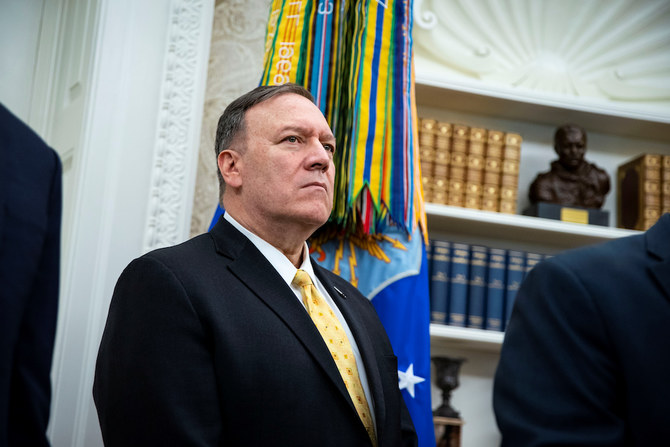
Secretary of State Mike Pompeo listens as Donald Trump meets with Bahrain Crown Prince Salman bin Hamad Al-Khalifa during a meeting in the Oval Office of the White House in Washington Monday. (Reuters)
Updated 17 September 2019
Follow

Pompeo heads to Saudi Arabia as US official says Aramco attacks came from ‘Iranian soil’

  • Official tells AFP that cruise missiles were involved in attacks on Abqaiq and Khurais
  • Vice President Mike Pence says United States evaluating evidence on the attacks

WASHINGTON: The United States has concluded that the weekend attack on Saudi oil facilities was launched from Iranian soil and cruise missiles were involved, a US official told AFP on Tuesday.

The comments come as Secretary of State Mike Pompeo headed to the Kingdom Tuesday amid heightened tensions after the strikes.

The official, who declined to be identified, said the United States was gathering evidence about the attack to present to the international community, notably European allies, at the UN General Assembly next week.

Asked if Washington was certain that the missiles had been launched from Iranian soil, the official answered: "Yes."

US intelligence services have the capability of determining where the missiles were launched from, the official said, declining, however, to say how many were fired.

"I will not get into that kind of details," the official said.

On Tuesday, Crown Prince Mohammed bin Salman spoke with UK prime minister Boris Johnson over the phone, with Johnson assuring the prince of the importance of a “collective global response” to the Aramco attack.

The weekend strikes on Abqaiq -- the world's largest oil processing facility – and the Khurais oil field in eastern Saudi Arabia have roiled global energy markets.

Yemen's Iran-backed-Houthi militants claimed responsibility for Saturday's attacks but Saudi Arabia accused Iran and President Donald Trump also singled out Tehran.

"Certainly, it would look to most like it was Iran," Trump said Monday.

The president said the United States wanted to help its Saudi ally but he wanted to avoid a war.

US Vice President Mike Pence said on Tuesday the United States was evaluating evidence on the attacks on Saudi oil facilities and stands read to defend its interests and allies in the Middle East. If Iran conducted Saturday's attacks to pressure Trump to back off his sanctions regime against Tehran, they will fail, Pence said. 

Tensions between Iran and the United States and its allies have threatened to boil over since May last year when Trump abandoned a 2015 nuclear deal and began reimposing sanctions in its campaign of "maximum pressure."


Defense Minister Prince Khalid bin Salman inaugurates 3rd World Defense Show in Riyadh

Updated 09 February 2026
Follow

Defense Minister Prince Khalid bin Salman inaugurates 3rd World Defense Show in Riyadh

  • Organized by the General Authority for Military Industries (GAMI), the five-day event will run until February 12
  • Prince Khalid launched several key initiatives, including the launch of several defense firms and signing of cooperation deals
  • The show is also serving as a launchpad for cutting-edge security technologies across various government sectors

RIYADH: Minister of Defense Prince Khalid bin Salman inaugurated the third edition of the World Defense Show (WDS) on Sunday on behalf of Crown Prince Mohammed bin Salman.

Organized by the General Authority for Military Industries (GAMI), the five-day event will run until February 12, showcasing the Kingdom’s rapid strides toward strategic independence and technological leadership in the defense sector.

The 2026 edition features a purpose-built venue with a 2,700-meter runway for live air and land demonstrations, underscoring the show’s status as a premier global defense event.

GAMI Governor Ahmad Al-Ohali emphasized that the show reflects Saudi Arabia's commitment to localizing over 50 percent of military spending in line with Vision 2030, fostering an integrated ecosystem where government bodies and international partners collaborate on innovation.

The event brings together official delegations, government entities, and leading international companies specializing in the defense and security sectors. (SPA)

Strategic agreements and major launches

The opening day witnessed significant activity at the Saudi Arabian Military Industries (SAMI) Group pavilion, where Prince Khalid launched several key initiatives:

New entities: The inauguration of SAMI Land Company, SAMI Autonomous Company, and the SAMI Land Industrial Complex.

Supply chain: The unveiling of the SAMI Local Content Program (RUKN) and the HEET Program.

International cooperation: A memorandum of understanding was signed between the Saudi General Authority for Defense Development and the Korean Agency for Defense Development to cooperate on advanced military research.

Defense deals: The Minister signed cooperation agreements with Slovakia, Malaysia, and Somalia.

Defense Minister Prince Khalid signed cooperation agreements with Slovakia, Malaysia, and Somalia. (SPA)

Technological debuts & innovations

The show is also serving as a launchpad for cutting-edge security technologies across various government sectors:

AI-Powered Lucid Gravity: Public Security debuted its advanced Lucid Gravity electric security vehicle at the Ministry of Interior's pavilion. The vehicle integrates state-of-the-art artificial intelligence and specialized security equipment designed to accelerate emergency response times and support field operations.

Public Security’s advanced Lucid Gravity electric security vehicle is displayed at the Ministry of Interior’s pavilion. (SPA)

This high-tech addition highlights Public Security’s shift toward smart, sustainable security solutions. By leveraging predictive intelligence and advanced command-and-control systems, the Lucid Gravity exemplifies the ministry’s commitment to protecting the Kingdom through integrated technological innovation and sustainable mobility.

Smart Helmet: Also at the Ministry of Interior’s pavilion, the General Directorate of Civil Defense unveiled its smart helmet. Designed to revolutionize public safety and emergency response, the helmet features day-and-night cameras and specialized sensors to detect hazardous materials in hard-to-reach locations.

The device serves as a mobile command node, delivering live video feeds directly to command-and-control centers. By enabling real-time data analysis and faster decision-making, the smart helmet significantly reduces incident response times and enhances personnel safety in high-risk environments.

The smart helmet features day-and-night cameras and specialized sensors to detect hazardous materials in hard-to-reach locations. (SPA)

Border Security: The General Directorate of Border Guard (GDBG) showcased an integrated security system featuring radar and thermal cameras capable of detecting drones and classifying moving targets to protect critical infrastructure.

It also functions as an early warning system for critical facilities and border areas and is fully integrated with command and control systems.

Border Guard's ntegrated security system features radar and thermal cameras capable of detecting drones and classifying moving targets to protect critical infrastructure. (SPA)

Counter-Terrorism: The Islamic Military Counter Terrorism Coalition (IMCTC) presented a comprehensive framework integrating intellectual, media, and military domains to combat extremism and terror financing.

Visitors are briefed on specialized programs designed to raise the readiness of national personnel and foster sustainable institutional cooperation among member states to combat extremism. On the event’s opening day, the pavilion hosted high-level delegations, including ministers, military leaders, and ambassadors who reviewed the coalition's pivotal role in coordinating international security efforts and commended its initiatives that support regional and global stability.

A view of the Islamic Military Counter Terrorism Coalition pavilion. (SPA)

Meteorology: The National Center for Meteorology (NCM) displayed advanced weather systems essential for ensuring the safety of the event's air shows and military operations.

At its dedicated pavilion, the NCM is showcasing its latest advanced meteorological technologies and systems. These solutions serve both the military and civilian sectors, providing accurate data to support beneficiary entities' operational processes and highlighting the center's pivotal role in national security and safety.

NCM's latest meteorological technologies and systems serve both the military and civilian sectors

World Defense Show CEO Andrew Pearcey noted that participation is expected to surpass previous records, reflecting the event's growing importance on the international stage. The show continues through February 12.