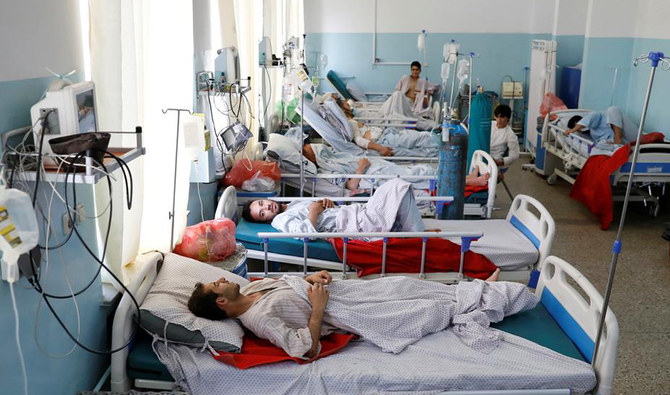
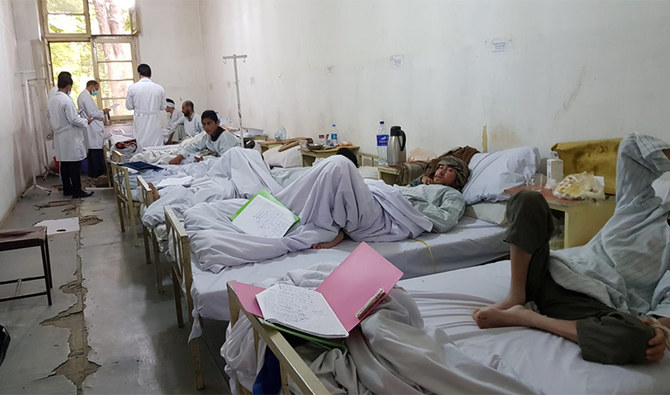
PESHAWAR: Afghan nationals on Tuesday praised the Pakistani government for setting up an advanced medical facility at Zero Point on Torkham border crossing, saying it would serve many people who required medical assistance in their country.
Syed Bilal Hussain, media officer to Khyber Pakhtunkhwa’s health minister, told Arab News that the government would encourage Afghans to benefit from the “health care city in the border district of Khyber.”
“Afghan patients will no longer need to travel to other Pakistani cities for medical treatment because the Pak-Afghan Healthcare Referral Facility on Torkham border contains state-of-the-art paraphernalia. There are also highly qualified medical practitioners and surgeons who will treat the patients,” he said.
Pakistan’s Prime Minister Imran Khan will formally inaugurate the facility at Zero Point on Wednesday.
Yasir Hikmat, an Afghan national studying BS Computer Sciences at the COMSATS University Abbottabad, described the hospital as a brilliant step by the administration in Islamabad that would benefit poor patients who could not afford to travel to big Pakistani cities.
“This is a noble thing to do and will built ties between the two governments and their people. I pray this hospital lives up to the expectations of Afghan patients and offers them medical treatment for all disease under one roof,” he said while talking to Arab News.
Hikmat added the hospital would be more successful if Pakistan eases the visa regime for ailing Afghans who needed to travel on medical grounds.
Hussain said the vibrant Out Patient Department (OPD) at the hospital would function diligently to facilitate patients on a priority basis.
“The facility has a laboratory and labor room along with ultrasound and electrocardiogram (ECG) facilities,” he added.
Kiftan Bacha, an Afghan trader who frequently uses the Torkham border crossing, lauded Pakistan for establishing the spacious health care facility.
“It is really commendable,” he said. “Roughly 400 Afghan patients cross the border every day to get treatment at Pakistani hospitals. It was also a good idea since there is no such facility within the 15-kilometer radius of the Zero Point.”
However, he suggested that patients who reached the hospital should be treated by doctors even if they did not possess passports, visas or other legal documents.
Hussain expressed his optimism that the hospital would also positively impact the Pak-Afghan relations on political and diplomatic levels.
“We want to promote medical tourism from Afghanistan,” he informed. “The health care city will function under public-private partnership and provide wide ranging medical facilities.”
Sayed Alauddin, another Afghan student at the Department of Optometry in the Hayat Medical Complex (HMC) in Peshawar, noted that Afghan patients faced tough challenges while reaching Pakistani hospitals, adding that this facility would offer them huge relief.
“This will be a great service to ailing Afghans,” he said, “because the hospital on the border will help save time and money of poor patients.”


![]()
![]()

PM Khan inaugurates hospital for Afghans on Torkham border today
PM Khan inaugurates hospital for Afghans on Torkham border today
- Afghan patients will no longer have to travel to other Pakistani cities for medical treatment, official says
- The move comes as part of government's push for medical tourism
Latest updates





Recommended


© 2026 SAUDI RESEARCH & PUBLISHING COMPANY, All Rights Reserved And subject to Terms of Use Agreement.