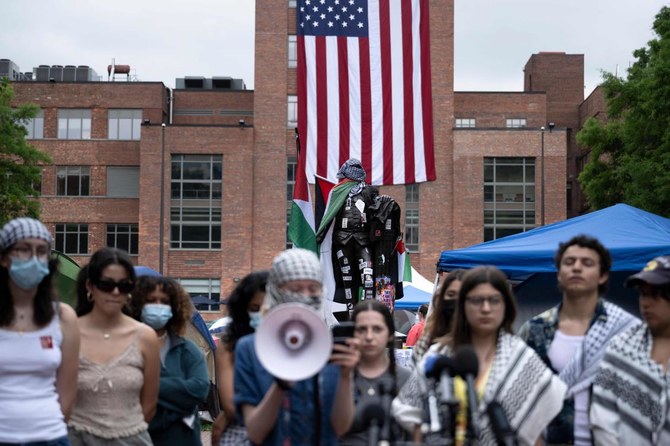
WASHINGTON: Police began to clear a Pro-Palestinian tent encampment at George Washington University early Wednesday and arrested dozens of protesters, hours after dozens left the site and marched to President Ellen Granberg’s home.
Officials at the university in Washington, D.C., had warned of possible suspensions for students engaging in protest activities on University Yard.
“While the university is committed to protecting students’ rights to free expression, the encampment had evolved into an unlawful activity, with participants in direct violation of multiple university policies and city regulations,” the university said in a statement.
Local media had reported that some protesters were pepper sprayed as police stopped them from entering the encampment and nearly 30 people had been arrested, according to community organizers.
In a statement, the District of Columbia’s Metropolitan Police Department said arrests were made for assault on a police officer and unlawful entry, but a number of arrests wasn’t immediately given. The department said it moved to disperse demonstrators because “there has been a gradual escalation in the volatility of the protest.”
Tuesday evening, protesters carrying signs that read, “Free Palestine” and “Hands off Rafah,” marched to Granberg’s home. Police were called to maintain the crowd. No arrests were made.
This comes as Mayor Muriel Bowser and MPD Chief Pamela Smith are set to testify about the District of Columbia’s handling of the protest at a House Committee on Oversight and Accountability hearing on Wednesday afternoon.
A pro-Palestinian tent encampment was cleared at the University of Chicago on Tuesday after administrators who had initially adopted a permissive approach said the protest had crossed a line and caused growing concerns about safety.
University President Paul Alivizatos acknowledged the school’s role as a protector of freedom of speech after officers in riot gear blocked access to the school’s Quad but also took an enough-is-enough stance.
“The university remains a place where dissenting voices have many avenues to express themselves, but we cannot enable an environment where the expression of some dominates and disrupts the healthy functioning of the community for the rest,” Alivizatos wrote in a message to the university community.
Tensions have continued to ratchet up in standoffs with protesters on campuses across the US — and increasingly, in Europe — nearly three weeks into a movement launched by a protest at Columbia University. Some colleges cracked down immediately on protests against the Israel-Hamas war. Among those that have tolerated the tent encampments, some have begun to lose patience and call in police over concerns about disruptions to campus life, safety and the involvement of nonstudents.
Since April 18, just over 2,600 people have been arrested on 50 campuses, figures based on AP reporting and statements from universities and law enforcement agencies.
But not all schools are taking that approach, with some letting protesters hold rallies and organize their encampments as they see fit.
The president of Wesleyan University, a liberal arts school in Connecticut, has commended the on-campus demonstration — which includes a pro-Palestinian tent encampment — as an act of political expression. The camp there has grown from about 20 tents a week ago to more than 100.
“The protesters’ cause is important — bringing attention to the killing of innocent people,” university President Michael Roth wrote to the campus community Thursday. “And we continue to make space for them to do so, as long as that space is not disruptive to campus operations.”
The Rhode Island School of Design, where students started occupying a building Monday, affirms students’ rights to freedom of speech and peaceful assembly and supports all members of the community, a spokesperson said. The school said President Crystal Williams spent more than five hours with the protesters that evening discussing their demands.
On Tuesday the school announced it was relocating classes that were scheduled to take place in the building. It was covered with posters reading “Free Palestine” and “Let Gaza Live,” and dove was drawn in colored chalk on the sidewalk.
Campuses have tried tactics from appeasement to threats of disciplinary action to resolve the protests and clear the way for commencements.
At the University of Chicago, hundreds of protesters gathered for at least eight days until administrators warned them Friday to leave or face removal. On Tuesday, law enforcement dismantled the encampment.
Officers later picked up a barricade erected to keep protesters out of the Quad and moved it toward the demonstrators, some of whom chanted, “Up, up with liberation. Down, down with occupation!” Police and protesters pushed back and forth along the barricade as the officers moved to reestablish control.


![]()

Police clearing Pro-Palestinian tent encampment at George Washington University, dozens arrested
Short Url
https://arab.news/mubrr
Police clearing Pro-Palestinian tent encampment at George Washington University, dozens arrested
- A pro-Palestinian tent encampment was cleared at the University of Chicago on Tuesdday
- Tensions have continued to ratchet up in standoffs with protesters on campuses across the US


Latest updates


© 2026 SAUDI RESEARCH & PUBLISHING COMPANY, All Rights Reserved And subject to Terms of Use Agreement.