

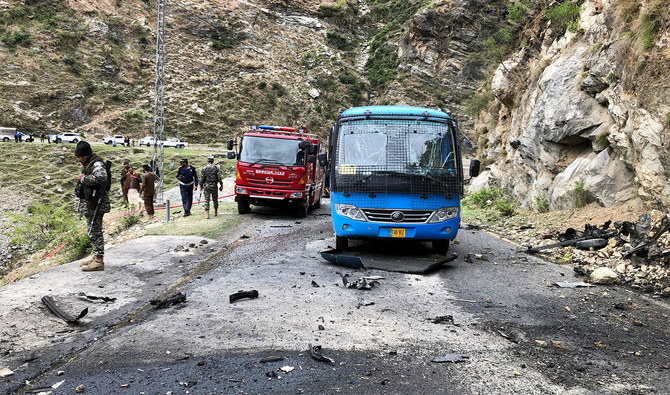

KABUL: The Taliban rejected on Wednesday allegations of Afghan involvement in a recent deadly attack on Chinese workers in neighboring Pakistan.
The five Chinese nationals, who were employed on the site of a hydropower project in Dasu in northwestern Khyber Pakhtunkhwa province bordering Afghanistan, were killed alongside their driver in a suicide blast on March 26.
Pakistan’s military said on Tuesday that the attack was planned in Afghanistan and that the attacker was an Afghan citizen.
Maj. Gen. Ahmad Sharif, a spokesperson for Pakistan’s army, also told reporters that Islamabad had “solid evidence” of militants using Afghan soil to launch attacks in Pakistan, that since the beginning of the year such assaults had killed more than 60 security personnel, and that authorities in Kabul were unhelpful in addressing the violence.
The Taliban’s Ministry of Defense responded on Wednesday that the claims were “irresponsible and far from the reality.”
“Blaming Afghanistan for such incidents is a failed attempt to divert attention from the truth, and we strongly reject it,” Enayatullah Khwarazmi, the ministry’s spokesperson, said in a statement.
“The killing of Chinese citizens in an area of Khyber Pakhtunkhwa which is under tight security cover of the Pakistani army shows the weakness of the Pakistani security agencies or cooperation with the attackers.”
The Dasu attack followed two other major assaults in regions where China has invested more than $65 billion in infrastructure projects as part of its wider Belt and Road Initiative.
On March 25, a naval air base was attacked in Turbat in Pakistan’s Balochistan province, and on March 20, militants stormed a government compound in nearby Gwadar district, which is home to a Chinese-operated port.
Pakistan is home to twin insurgencies, one by militants related to the Tehreek-e-Taliban Pakistan — the Pakistani Taliban — and the other by ethnic separatists who seek secession in southwestern Balochistan province, which remains Pakistan’s poorest despite being rich in natural resources.
While the attacks in Balochistan were claimed by the Baloch Liberation Army — the most prominent of several separatist groups in the province, no group claimed responsibility for the one in Dasu.
Blaming it on Afghanistan, however, was “baseless,” according to Naseer Ahmad Nawidy, international relations professor at Salam University in Kabul.
“The insurgency in the region has existed for very long now and cannot be attributed to a specific area or country. Pakistan looks at the Islamic Emirate in its current form as a threat to its interests. The Pakistan government needs to develop its relations with the Islamic Emirate based on equal rights and good will for stability in the whole region,” Nawidy told Arab News.
“Stability in the region requires mutual cooperation and trust. The governments in Afghanistan and Pakistan must end the relations crisis at the earliest. Repeating such claims will further increase the tensions and may cause enmity between the two countries.”
Abdul Saboor Mubariz, political scientist and lecturer at Alfalah University in Jalalabad, said Pakistan’s claims were meant to put pressure on the Taliban to help Islamabad in its campaign against the TTP.
“Pakistan’s government is using different forms of pressure such as forcible deportation of Afghan refugees, claims about security threats from Afghanistan, closing border points and creating challenges for Afghan traders,” he said, adding that accusations and claims of links to attacks were affecting the Taliban administration as it still sought recognition from foreign governments.
“The claims are critical for the Islamic Emirate as it is seeking engagement with the countries in the region and across the globe, while the government remains unrecognized by all world countries.”


