

Pakistan’s first lunar satellite ICUBE-Q successfully enters moon’s orbit 

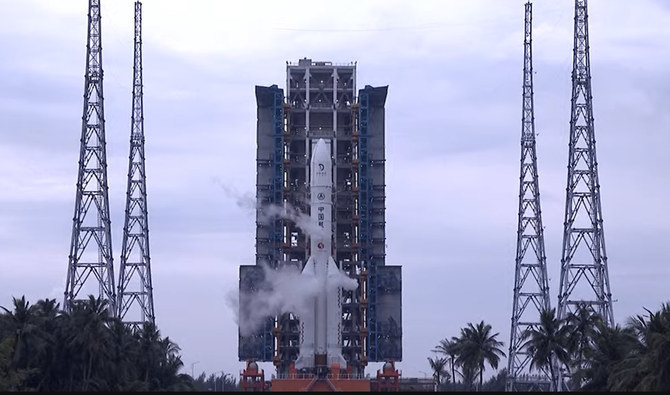
This screengrab taken on May 3, 2024 shows Pakistan Space & Upper Atmosphere Research Commission (SUPARCO) logo on China’s Chang’e-6 mission ahead of its launching on May 3, 2024. (Photo courtesy: YouTube/VideoFromSpace)
Short Url
Updated 08 May 2024
Follow

Pakistan’s first lunar satellite ICUBE-Q successfully enters moon’s orbit 

  • ICUBE-Q was deployed in moon’s orbit around 1:14 p.m. Pakistan Standard Time, says Institute of Space technology official 
  • IST official describes development as “important” one for Pakistan allowing it to conduct “bigger” space missions in future

Islamabad: Pakistan’s first lunar satellite ICUBE-Q entered the moon’s orbit successfully today, Wednesday, a senior official of the country’s Institute of Space Technology (IST) confirmed, saying the “important” development could pave the way for “bigger” space missions for the country in the future.

The ICUBE-Qamar satellite carries two optical cameras to image the lunar surface and weighs around 7kg. Cubesats are tiny box-shaped satellites that are mainly launched into low Earth orbit to observe the Earth, test new communications technology, or perform miniature experiments.

Pakistan’s first lunar satellite was launched aboard China’s Chang’e-6 probe on May 3. The Chinese probe is tasked with landing on the far side of the moon, which perpetually faces away from the Earth, after which it will retrieve and return samples. China is the first country to make such an ambitious attempt.

“Our ICUBE-Q was deployed successfully in its orbit at 1:14 p.m. Pakistan Standard Time,” Dr. Khurram Khurshid, the head of the electrical engineering and computer science department at IST and a co-lead on the satellite project, told Arab News.

Dr. Khurshid said Pakistani officials will continue to test the satellite’s system for the next three to four days. He said initial tests revealed there were no complications with the cubesat’s system. 

The IST official said the development means Pakistan is officially in an exclusive club of countries that have conducted deep space missions. 

“This is the first step, a step in the right direction,” Dr. Khurshid noted. “It can lead to bigger space missions, such as landing on the moon or various other experiments.”

Dr. Khurshid said Pakistan would be able to share images from the satellite by May 15. 

Around 100 students from IST contributed to developing the satellite. Pakistan’s proposal to build the satellite was accepted by the China National Space Agency (CNSA) from plans submitted by eight member states of the Asia-Pacific Space Cooperation Organization (APSCO). 

The design, development, and qualification of the ICUBE-Q satellite were spearheaded by faculty members and students of the IST in collaboration with China’s Shanghai Jiao Tong University (SJTU), with support from Pakistan’s National Space Agency, SUPARCO.

The ICUBE-Q has two cameras as payload for taking images of the lunar surface that will be transmitted back to Earth for analysis. 


Pakistan rejects India’s ‘irresponsible assertions’ after FM Jaishankar’s ‘bad neighbors’ remarks

Updated 03 January 2026
Follow

Pakistan rejects India’s ‘irresponsible assertions’ after FM Jaishankar’s ‘bad neighbors’ remarks

  • Indian FM Jaishankar accused Pakistan of fomenting militancy, backed New Delhi’s decision to put Indus Waters Treaty in abeyance
  • Islamabad calls the remarks an attempt to deflect attention from India’s ‘troubling record as a neighbor,’ vows to safeguard rights

ISLAMABAD: Pakistan on Saturday rejected “irresponsible assertions” made by Indian External Affairs Minister S. Jaishankar after his remarks about “bad neighbors” and the 1960 Indus Waters Treaty (IWT) between the two countries.

Jaishankar mentioned about “bad neighbors” at an event in Madras on Friday and said that New Delhi had a right to defend itself. “When you have bad neighbors... if you look to the one to the West, if a country decides that they will deliberately, persistently, unrepentantly continue with terrorism, we have a right to defend our people,” he was quoted as saying by The Hindu newspaper.

The remarks came months after New Delhi blamed Pakistan for a militant attack in Indian-administered Kashmir and conducted missile strikes inside Pakistan. Islamabad, which denied involvement in the Kashmir attack, responded to the strikes, leading to a four-day military conflict that saw the use of armed drones, fighter jets and artillery between the neighbors in May.

In a statement, Pakistani foreign office spokesman Tahir Andrabi said Islamabad firmly rejects the irresponsible assertions made by the Indian external affairs minister, describing the remarks as an attempt to deflect attention from India’s own “troubling record as a neighbor that promotes terrorism and contributes to regional instability.”

“India’s documented involvement in promoting terrorist activities in the region, particularly in Pakistan, is well known. The case of Commander Kulbhushan Jadhav remains a stark example of organized, state-sponsored terrorism directed against Pakistan,” he said.

“Equally concerning are recurring instances of extraterritorial killings, sabotage through proxies, and covert support to terrorist networks.”

Jadhav, an Indian navy officer who Islamabad said had been working with Indian spy agency, RAW, when Pakistani agencies arrested him in Balochistan in 2016. He was later sentenced to death by a Pakistani military court for alleged espionage. India disputes the conviction and has challenged it at the International Court of Justice.

Pakistan and India routinely accuse each other of supporting militant groups waging attacks against the other. The two countries have fought multiple wars, including two of them over the disputed region of Kashmir, since their independence from British rule in 1947. Both rule the region in part but claim it in full.

Jaishankar also spoke on Friday about the IWT that divides control of the Indus basin rivers between the neighbors and ensures water for 80 percent of Pakistani farms. India announced in April, following the Kashmir attack, that it was putting the 1960 World Bank-mediated treaty in abeyance.

“Many years ago, we agreed to a water-sharing arrangement — the belief was it was gesture of goodwill — because of good neighborliness we were doing it … but if you have decades of terrorism, there is no good neighborliness and you don’t get the benefit of good neighborliness,” Jaishankar was quoted as saying.

Pakistan foreign office spokesman Andrabi said the IWT is an international agreement concluded in good faith and at a considerable cost.

“Any unilateral violation of the Treaty by India would undermine regional stability and call into question its credibility as a state that claims to respect international legal obligations,” he said.

“Pakistan will take all necessary measures to safeguard its legitimate rights under the Treaty.”