



RAWALPINDI: As Nimra Shah stepped into the Rawalpindi Railway Station drenched in the golden hues of the early dawn hours, she was greeted by the vibrant thumping of a drum and a performance of traditional Punjabi dance.
This is how the “Safari Tourist Train” starts as it takes passengers on a journey every Sunday across the majestic Potohar, a plateau in Pakistan’s Punjab province, located between the Indus and Jehlum rivers. Pakistan Railways kicked off operations of the safari last month, offering a unique way to explore the region’s scenic landscapes and the 150-year-old history of the national, state-owned railway company of Pakistan.
Last Sunday, against the rhythmic chugging of the engines, the train sped out of the Rawalpindi Railway Station, promising an adventure-filled journey to the more than 350 passengers on board through the mountains, bridges and tunnels of the Potohar region but also through time.
“This is my first experience traveling by train and this is the reason I chose the Safari train as I was impressed by their things [activities planned during the journey],” Shah, who works as a beautician in Islamabad, told Arab News.
“So far so good and let’s see what happens next. I hope it will be good because the videos I have seen about this and the reviews were good.”
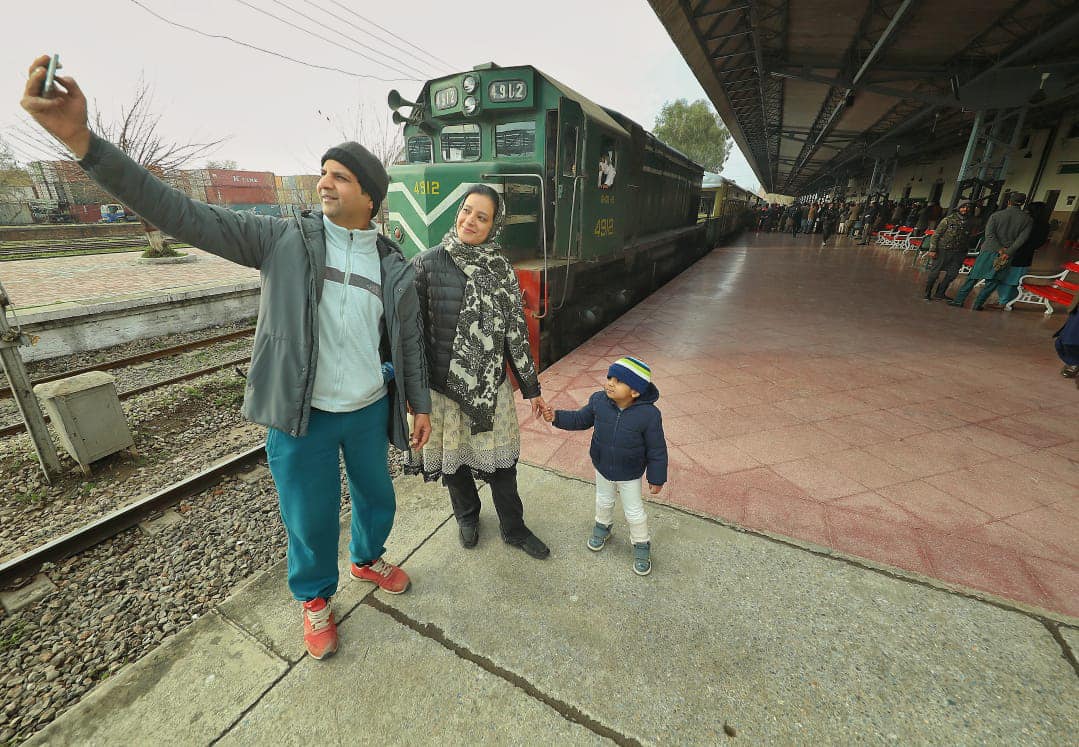
In this photograph, taken on March 3, 2024, a man takes the family photo ahead of their journey on “Safari Tourist Train” at the Saddar Railway Station in Rawalpindi. (Photo courtesy: KP Culture and Tourism Authority)
The Safari tourist train was first launched in February 2021 by then railways minister Azam Khan Swati, but its operations were halted in 2022 for undisclosed reasons. The train has now been relaunched by Pakistan Railways in collaboration with the PK-Unicorn private tourism company.
The train travels every Sunday from Rawalpindi to Attock Khurd, a small town located beside the Indus River in the Attock District of Punjab, offering luxurious seating arrangements and newly constructed washrooms to ensure maximum comfort and convenience. There is live music, magic shows and entertainers on board to engage children and adults alike and make the journey more interesting, according to Faiza Syed, a general manager at PK-Unicorn.
“Most of the families have never traveled on trains, so we have started this small journey so that the people can get the flavor of traveling in a train,” she told Arab News, adding that the main objective of the safari was to portray a “positive image” of Pakistan and boost tourism.
The train offers different categories of travel, including a basic economy class, followed by an air-conditioned parlor, and finally, a salon car, in which a group of up to 20 individuals can book a separate coach. The ticket price varies from Rs3,500 ($12.70) for economy class, Rs4,500 ($16.20) for the AC parlor, and Rs6,000 ($21.58) for the special saloon, with breakfast and lunch included in all categories.
Since its re-launch last month, Syed said, the public’s response to the service had been “overwhelmingly positive” and the train had been operating at full capacity.
“COMMENDABLE INITIATIVE”
This Sunday, the safari’s scenic route included iconic landmarks such as the Margalla Hills and the historic Sangjani Tunnel and Chablat and Ghazi Barotha bridges. A main attraction was a stopover at the historic Golra railway station, which was constructed in 1882 and boasts the esteemed Islamabad Railway Museum, a testament to Pakistan’s colonial past and the history of its famed British-built railway system.
Steam locomotives and royal saloons associated with India’s last viceroy, Lord Mountbatten, Pakistan’s founder and first governor general, Mohammad Ali Jinnah, and the Maharaja of Jodhpur are on display at the museum, whose two galleries are chock full of artifacts. These include a kerosene heater belonging to Mountbatten, vintage railway police guns, a punching machine for tickets, signal sticks and lamps, flags, drinking vessels, and a morse code machine.
Other items in the collection include surgical instruments used at the railways hospital, relief bogies as well as bells, kerosene lamps and a Neal’s ball token machine, captured from the Khemkaran station during the India-Pakistan war of 1965. A long pendulum by Gillet & Johnston Croydon, London, 1899, is another treasured item.
The train next passes through more historic tunnels of the Potohar region until the next stop: the scenic Attock Khurd Railway Station by the banks of the Indus River. Here, visitors get a chance to immerse themselves in the beauty of the water as well as go camel riding.
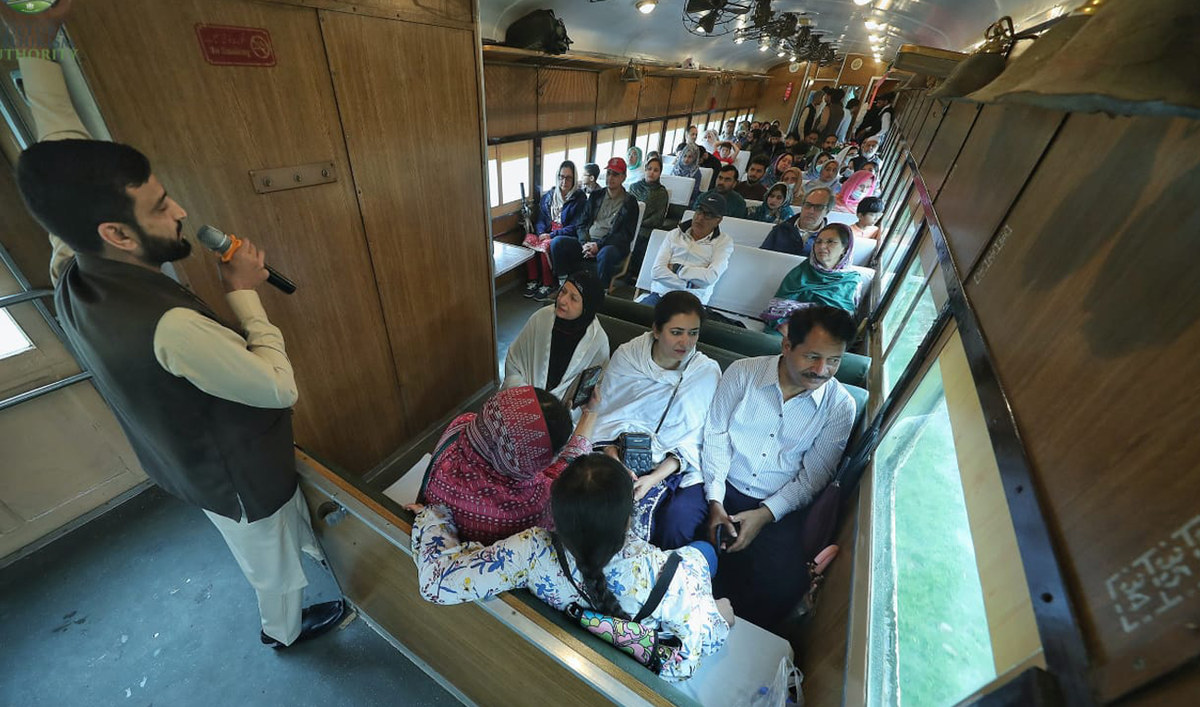
In this photo, taken on March 3, 2024, people take their seats after boarding the “Safari Tourist Train” in Rawalpindi. (Photo courtesy: KP Culture and Tourism Authority)
“We have enjoyed the trip as we came in a group and it was a good journey,” Khawaja Najam-ul-Hassan, a retired employee of the Pakistani state television, told Arab News. “I liked the architecture right from Golra to Attock as it was my first time here.”
Another passenger, Azhar Mubarak, a retired army doctor, described the safari as a “commendable initiative” and said more such trains should be introduced to explore other parts of the country.
“There are many such good places in Pakistan and initiatives like these are needed there as well to promote tourism potential and opportunities for the public,” he told Arab News.
Tahmina Azhar, a doctor, described the journey as “enjoyable” but said the service needed a few improvements, including upgrading the quality of the food served and employing trained guides.
“A bit more cleanliness in the train, [especially] toilets,” she said, “and somebody to guide us.”


