

Iran’s nuclear chief: EU has failed to fulfill 2015 deal commitments

1 / 2
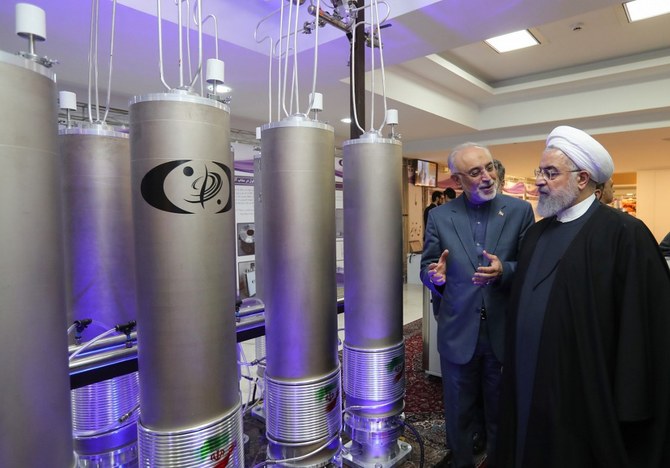
Iranian President Hassan Rouhani, right, listens to the head of Iran’s nuclear technology organization Ali Akbar Salehi during the ‘nuclear technology day’ in this April 9, 2019 photo. (Iranian Presidency / AFP)
2 / 2
A handout picture released by Iran's Atomic Energy Organization on September 7, 2019, shows spokesman for the organization Behrouz Kamalvandi speaking during a press conference in the capital Tehran. (File/AFP)
Updated 09 September 2019
Follow

Iran’s nuclear chief: EU has failed to fulfill 2015 deal commitments

  • Iranian state television aired Sunday video of Cornel Feruta in the capital, Tehran
  • Iran on Saturday announced it would begin using two types of advanced centrifuges

DUBAI: Iran’s nuclear chief said on Sunday the European parties to the 2015 nuclear deal have failed to fulfill their commitments under the pact, a day after Tehran announced further breaches of limits on its nuclear activity set by the pact.

The deal curbed Iran’s disputed nuclear program in exchange for relief from sanctions, but has unraveled since the United States withdrew last year and acted to strangle Iran’s oil trade to push it into wider security concessions.

France, Germany and Britain have tried to launch a barter trade mechanism with Iran protecting it from US sanctions but have struggled to get it off the ground, and Tehran on Wednesday set a 60-day deadline for effective European action.

“Unfortunately, the European parties have failed to fulfil their commitments ... The deal is not a one-way street and Iran will act accordingly as we have done so far by gradually downgrading our commitments,” said Ali Akbar Salehi, director of Iran’s nuclear energy agency.

“Iran will continue to reduce its nuclear commitments as long as the other parties fail to carry out their commitments,” Salehi said, speaking after meeting the acting head of the UN nuclear watchdog (IAEA), Cornel Feruta, in Tehran on Sunday.

Feruta, whose non-proliferation inspectors monitor Iran’s nuclear program, also planned to see Foreign Minister Mohammad Javad Zarif and other senior Iranian officials.

The IAEA’s 35-nation Board of Governors will discuss Iran at a quarterly meeting that begins on Monday.

Since May, Iran has begun to breach caps on its nuclear capacity set by the deal in retaliation for US pressure on Iran to negotiate restrictions on its ballistic missile program and support for proxy forces around the Middle East.

Iran says its retreat from terms of the deal is reversible if European signatories manage to restore its access to foreign trade promised under the nuclear deal but blocked by the re-imposition of US sanctions.

“The actions they have taken are negative but not definitive. They can come back (to full compliance) and the path of dialogue is still open,” French Foreign Minister Jean-Yves le Drian said on Sunday.

Upping the ante in its stand-off with Washington, Tehran said on Saturday it was now capable of raising uranium enrichment past the 20 percent level of fissile purity and had launched advanced centrifuge machines in further breaches of the deal.

IAEA inspectors reported in July that Iran had cranked up enrichment to 4.5 percent purity, above the 3.7 percent cap suitable for civilian energy generation set by the 2015 accord.

Under the deal, Iran is allowed limited research and development on advanced centrifuges, which accelerate the production of fissile material that could, if enriched to the 90 percent threshold, be used to develop a nuclear bomb.


Lebanese finance minister denies any plans for a Kushner-run economic zone in the south

Updated 5 sec ago
Follow

Lebanese finance minister denies any plans for a Kushner-run economic zone in the south

  • Proposal was made by US Envoy Morgan Ortagus but was ‘killed on the spot’
  • Priority is to regain control of state in all aspects, Yassine Jaber tells Arab News

DAVOS: Lebanon’s finance minister dismissed any plans of turning Lebanon’s battered southern region into an economic zone, telling Arab News on the sidelines of the World Economic Forum’s meeting in Davos that the proposal had died “on the spot.”

Yassine Jaber explained that US Envoy to Lebanon Morgan Ortagus had proposed the idea for the region, which has faced daily airstrikes by Israel, and it was immediately dismissed.

Jaber’s comments, made to Arab News on the sidelines of the World Economic Forum in Davos, were in response to reports which appeared in Lebanese media in December which suggested that parts of southern Lebanon would be turned into an economic zone, managed by a plan proposed by Jared Kushner, US President Donald Trump’s son in law.

Meanwhile, Jaber also dismissed information which had surfaced in Davos over the past two days of a bilateral meeting between Lebanese ministers, US Middle East Envoy Steve Witkoff and Kushner.

Jaber said that the meeting on Tuesday was a gathering of “all Arab ministers of finance and foreign affairs, where they (Witkoff and Kushner) came in for a small while, and explained to the audience the idea about deciding the board of peace for Gaza.”

He stressed that it did not develop beyond that.

When asked about attracting investment and boosting the economy, Jaber said: “The reality now is that we need to reach the situation where there is stability that will allow the Lebanese army, so the (Israeli) aggression has to stop.”

Over the past few years, Lebanon has witnessed one catastrophe after another: one of the world’s worst economic meltdowns, the largest non-nuclear explosion in its capital’s port, a paralyzed parliament and a war with Israel.

A formal mechanism was put in place between Lebanon and Israel to maintain a ceasefire and the plan to disarm Hezbollah in areas below the Litani river.

But, the minister said, Israel’s next step is not always so predictable.

“They’re actually putting pressure on the whole region. So, a lot of effort is being put on that issue,” he added.

“There are still attacks in the south of the country also, so stability is a top necessity that will really succeed in pushing the economy forward and making the reforms beneficial,” he said.

Lawmakers had also enacted reforms to overhaul the banking sector, curb the cash economy and abolish bank secrecy, alongside a bank resolution framework.

Jaber also stressed that the government had recently passed a “gap law” intended to help depositors recover funds and restore the banking system’s functionality.

“One of the priorities we have is really to deal with all the losses of the war, basically reconstruction … and we have started to get loans for reconstructing the destroyed infrastructure in the attacked areas.”

As Hezbollah was battered during the war, Lebanon had a political breakthrough as the army’s general, Joseph Aoun, was inaugurated as president. His chosen prime minister was the former president of the International Court of Justice, Nawaf Salam.

This year marks the first time a solid delegation from the country makes its way to Davos, with Salam being joined by Jaber, Economy and Trade Minister Amr Bisat, and Telecoms Minister Charles Al-Hage.

“Our priority is to really regain the role of the state in all aspects, and specifically in rebuilding the institutions,” Jaber said.