Iran seizes ship for alleged fuel smuggling in Gulf, holds 12 Filipino crew

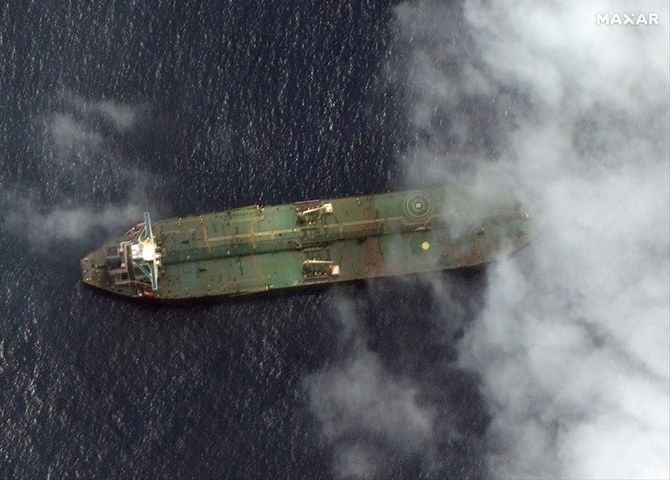
Handout image obtained September 7, 2019, courtesy of Satellite image ©2019 Maxar Technologies, reportedly shows the oil tanker Adrian Darya 1, near the port city of Tartus, Syria. Iran seized a boat and arrested 12 Filipinos on Saturday. (AFP)
Updated 08 September 2019
Follow

Iran seizes ship for alleged fuel smuggling in Gulf, holds 12 Filipino crew

  • The vessel was carrying nearly 284,000 liters of diesel
  • Iran frequently seizes boats it says are being used for smuggling oil in the Gulf

TEHRAN: Iran seized a boat and arrested 12 Filipinos as it busted a “fuel-smuggling ring” in the Strait of Hormuz on Saturday, the semi-official news agency ISNA reported.

“A foreign tugboat was confiscated as well as 283,900 liters (75,000 gallons) of petrol worth 233.71 billion rials ($20.2 million),” ISNA said, citing the coast guard chief in the southern province of Hormozgan.

“Twelve Philippine nationals were arrested and the relevant judiciary officials are currently taking the required legal measures,” Major Hossein Dehaki was quoted as saying.

Dehaki said the group was suspected of operating a fuel-smuggling ring and the confiscated shipment had been intercepted close to Sirik county in the Strait of Hormuz.

The seizure comes amid tensions in the Gulf after the United States unilaterally withdrew from a nuclear deal putting curbs on Iran’s nuclear program in return for relief from sanctions.

The escalation has seen ships mysteriously attacked, drones downed and oil tankers seized in the Strait of Hormuz — a chokepoint for a third of world’s seaborne oil.

Iran’s Islamic Revolutionary Guard Corps detained a “foreign tanker” in Gulf waters on July 14 for allegedly smuggling contraband fuel.

“With a capacity of two million liters and 12 foreign crew on board, the vessel was en route to deliver contraband fuel received from Iranian boats to foreign ships,” the Guards said at the time.

Maritime tracking service TankerTrackers reported the Panamanian-flagged MT Riah, used in the strait for fueling other vessels, had crossed into Iranian waters, and at that point its automatic identification system stopped sending signals.

In the most high-profile seizure, the Guards impounded the British-flagged Stena Impero tanker in the Strait of Hormuz on July 19 for breaking “international maritime rules.”

Iran also seized another ship on July 31 with seven foreign crew onboard over fuel smuggling, but it has not revealed the vessel’s identity or the nationality of its crew.


Syrian government says it controls prison in Raqqa with Daesh-linked detainees

Updated 23 January 2026
Follow

Syrian government says it controls prison in Raqqa with Daesh-linked detainees

  • Prison holds detainees linked to Daesh, and witnessed ⁠clashes in its vicinity between advancing Syrian government forces and Kurdish fighters

Syria’s Interior Ministry said on Friday it had taken over Al-Aktan prison in the city of Raqqa ​in northeastern Syria, a facility that was formerly under the control of Kurdish-led Syrian Democratic Forces (SDF).

The prison has been holding detainees linked to the militant group Daesh, and witnessed clashes in its vicinity this week between advancing Syrian government forces and the SDF.

It ‌was not ‌immediately clear how many ‌Daesh ⁠detainees ​remain in Al-Aktan ‌prison as the US military has started transferring up to 7,000 prisoners linked to the militant Islamist group from Syrian jails to neighboring Iraq. US officials say the detainees are citizens of many countries, including in Europe.

“Specialized teams were ⁠formed from the counter-terrorism department and other relevant authorities to ‌take over the tasks of guarding ‍and securing the prison ‍and controlling the security situation inside it,” ‍the Interior Ministry said in a statement.

Under a sweeping integration deal agreed on Sunday, responsibility for prisons housing Daesh detainees was meant to be transferred to ​the Syrian government.

The SDF said on Monday it was battling Syrian government forces near ⁠Al-Aktan and that the seizure of the prison by the government forces “could have serious security repercussions that threaten stability and pave the way for a return to chaos and terrorism.”

The US transfer of Daesh prisoners follows the rapid collapse of Kurdish-led forces in northeast Syria. Concerns over prison security intensified after the escape on Tuesday of roughly 200 low-level Daesh fighters from Syria’s ‌Shaddadi prison. Syrian government forces later recaptured many of them.